Since my first post about The Blogroll, I have added links to six very good personal finance blogs. Through these link exchanges, traffic to PFStock has increased somewhat. However, I have found that most of my blog traffic comes from repeat visitors, or from people who are searching for specific personal finance and investing topics.
In any case, I am still looking to exchange links with other PF bloggers that write useful, original content. If you have a legitimate personal finance or investing blog, please send me an Email, and I will consider including a link to it here on PFStock. (Note that my Email address is listed on the right side column of my blog.)
Please note that I reserve the right to remove links to any PF blog for any reason. Also, from time to time, I will receive comments to posts on PFStock that are off-topic or contain only advertising links. As a matter of policy, I regularly remove inappropriate comments.
PF Stock

Sunday, March 11, 2007

Saturday, March 10, 2007
Crude Oil vs. Cruise Line Stock Prices
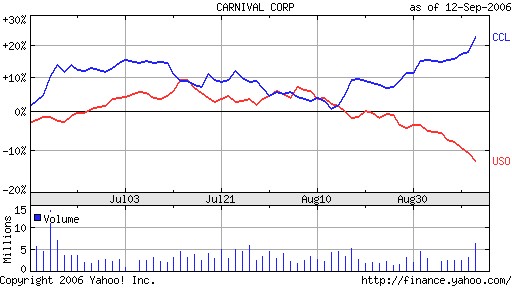
In September 2006, I wrote a post about investing in the cruise line industry. In that post, I asserted that the price of fuel, which is one of the biggest expenses of cruise lines, is a key factor in the price movements of cruise line stocks. I said that there is an inverse relationship between the cost of fuel and the price of cruise line stocks. To review, I have reproduced the graph that I posted of Carnival Corporation (NYSE: CCL), which is represented by the blue line below. The red line is the U.S. Oil Fund ETF (AMEX: USO). USO is an exchange-traded fund that tracks the price of crude oil. Back in September, the price of oil was dropping in price. If you pay attention to what you're paying at the gas pump, then you are attuned to these movements in crude oil prices. As you can see in the graph, the price of oil was dropping, while the price of CCL was soaring.

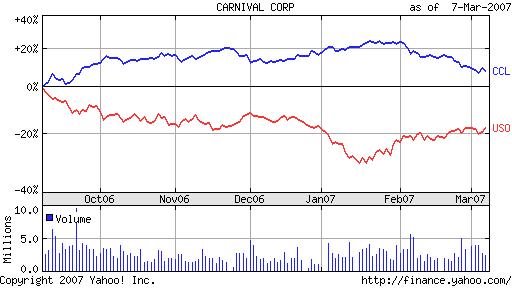
Fast forward six months to today, and you will notice things have changed. I was recently at the gas pump, and noticed that regular gas costs over $3 per gallon for the first time in a while. (Note that I live in Silicon Valley, California.) Below is what that same graph of CCL vs. USO looks like today.

Do you see the inverse relationship? It might be a little hard to see in the chart, but USO reached a low of 42.56 on 1/18/07. Only one day later, on 1/19/07, the price of Carnival Corporation (CCL ) reached a peak of 52.73. Since January, these two charts have reversed course. Oil and gas are increasing in price, while the cruise lines have dropped in price. The North American cruise line industry includes Carnival Corporation, Royal Caribbean (NYSE:RCL), and Norwegian Cruise Lines.
To a lesser extent, the increase in oil prices affects the stock market as a whole as well. So, knowing this relationship is something that you can use to help guide your investments. At this time, I would predict that the cruise lines will drop in value until oil reverses course, or at least until oil prices start to stabilize.
Note: My posts about the cruise line industry are among the most popular posts here at PFStock. Many visitors were searching for information about how to get the shareholder onboard credit benefit offered to cruise line (Carnival Corporation and Royal Caribbean) stock holders. If this is what you are searching for, please read the details in my post about cruise line shareholder benefits for RCCL and Carnival stock holders.
PF Stock
Fast forward six months to today, and you will notice things have changed. I was recently at the gas pump, and noticed that regular gas costs over $3 per gallon for the first time in a while. (Note that I live in Silicon Valley, California.) Below is what that same graph of CCL vs. USO looks like today.
Do you see the inverse relationship? It might be a little hard to see in the chart, but USO reached a low of 42.56 on 1/18/07. Only one day later, on 1/19/07, the price of Carnival Corporation (CCL ) reached a peak of 52.73. Since January, these two charts have reversed course. Oil and gas are increasing in price, while the cruise lines have dropped in price. The North American cruise line industry includes Carnival Corporation, Royal Caribbean (NYSE:RCL), and Norwegian Cruise Lines.
To a lesser extent, the increase in oil prices affects the stock market as a whole as well. So, knowing this relationship is something that you can use to help guide your investments. At this time, I would predict that the cruise lines will drop in value until oil reverses course, or at least until oil prices start to stabilize.
Note: My posts about the cruise line industry are among the most popular posts here at PFStock. Many visitors were searching for information about how to get the shareholder onboard credit benefit offered to cruise line (Carnival Corporation and Royal Caribbean) stock holders. If this is what you are searching for, please read the details in my post about cruise line shareholder benefits for RCCL and Carnival stock holders.
PF Stock
Thursday, March 8, 2007
Daylight Saving Time Reminder
As a reminder, Daylight Saving Time starts this coming Sunday, March 11. I would be interested to know if anyone's VCR automatically adjusts since DST starts early this year.
PF Stock
PF Stock
Wednesday, March 7, 2007
Still Waiting for Windows Vista
A while ago, I had mentioned that I bought a new computer in order to secure a copy of Microsoft Windows Vista. The computer, which I bought back in November 2006, is a Compaq Presario SR2050NX and included the Windows XP MCE 2005 operating system. As part of the deal, I am supposed to receive Microsoft Windows Vista Home Premium from Hewlett-Packard (the parent company of Compaq) after Vista's release. Well, Windows Vista was released back in January. So, where is my free upgrade?
The last time that I checked the status of my Windows Vista order, it said that Vista would be shipped in March 2007. It seems like a while to wait, since I can already go out and buy a new computer with Vista running on it now. On the other hand, compared to the old Dell computer running Windows 98, this new desktop computer is a big improvement. My old computer used to crash on a daily basis.
Is anybody else (who bought a new computer in the last 3-4 months) still waiting for their free Vista upgrade?
PF Stock
The last time that I checked the status of my Windows Vista order, it said that Vista would be shipped in March 2007. It seems like a while to wait, since I can already go out and buy a new computer with Vista running on it now. On the other hand, compared to the old Dell computer running Windows 98, this new desktop computer is a big improvement. My old computer used to crash on a daily basis.
Is anybody else (who bought a new computer in the last 3-4 months) still waiting for their free Vista upgrade?
PF Stock
Tuesday, March 6, 2007
Telephone Tax Refund
Something new that I noticed on 2006 tax forms is a credit for the federal telephone excise tax. You can get back $30 to $60 as a credit depending on your number of exemptions. This is only available in 2006 to taxpayers who paid for long-distance telephone service between March 2003 and July 2006.
Although it seems like you are getting free money, the refund is due to a court decision which found that the excise tax (which has been on the books since 1898 to fund the Spanish-American War) no longer applies to telephone service today.
If you choose to you can actually add up all the federal excise taxes that you paid based on your old phone records. But, most people will take a standard refund amount, based on the number of personal exemptions that you claim. On Form 1040, this credit is claimed on line 71.
PF Stock
Although it seems like you are getting free money, the refund is due to a court decision which found that the excise tax (which has been on the books since 1898 to fund the Spanish-American War) no longer applies to telephone service today.
If you choose to you can actually add up all the federal excise taxes that you paid based on your old phone records. But, most people will take a standard refund amount, based on the number of personal exemptions that you claim. On Form 1040, this credit is claimed on line 71.
PF Stock
Friday, March 2, 2007
Volatility
Volatility is a integral part of the stock market. It is on days like these that we are all reminded of this fact. In actuality, the stock market has done well in the past year. The Dow Jones Industrial Average reached an all-time high of 12,845 only last week. The other major indices (S&P 500 and Nasdaq) have also posted respectable gains over the past year. For the Dow, this new high was followed by a drop of 416 points in one day.
What is a warning sign that the stock market is overvalued? In a word: exuberance. In the past few months, we have seen a constant growth of optimism among financial professionals and analysts. This optimism extends into the realm of personal finance blogs as well. Recently, there seems to be a constant new crop of enthusiastic new PF bloggers out there. Over the past few months, some bloggers have been writing that their portfolios have increased by 4-7% per month. These are quite impressive numbers indeed!
I can't help but get the feeling of deja vu when I compare what is happening now to the hi-tech (dot com) boom of the late 1990s. One blogger, who admits to not having a stock picking philosophy, tell us that he will turn $100k into a cool million over the next ten years. Another blogger scaled back the initial estimate of his net worth growth rate to only 30% per year. Even so, he'll be a millionaire in a little over 4 short years.
Early on in this blog, I wrote a post about me. In that post, I said that I feel the economy is much better now than it was in 2002. But I've learned not to get too overconfident, and to plan for the worst while hoping for the best.
In fact, during the last few months of 2006, I had sold off much of my stock holdings. And I found it very difficult to find new investments to buy. These are the ones that I think have a much greater chance of going up rather than of going down. While there are some exceptions, I think that most stocks are overvalued at this time.
Note that these are my views on the stock market. But regardless if the market goes up or down, it does not make me feel nervous or worried. Indeed, it used to. I imagine that most people who are invested in the stock market would feel a little queasy these days. But I now feel that either direction presents a new, different set of opportunities.
PF Stock
What is a warning sign that the stock market is overvalued? In a word: exuberance. In the past few months, we have seen a constant growth of optimism among financial professionals and analysts. This optimism extends into the realm of personal finance blogs as well. Recently, there seems to be a constant new crop of enthusiastic new PF bloggers out there. Over the past few months, some bloggers have been writing that their portfolios have increased by 4-7% per month. These are quite impressive numbers indeed!
I can't help but get the feeling of deja vu when I compare what is happening now to the hi-tech (dot com) boom of the late 1990s. One blogger, who admits to not having a stock picking philosophy, tell us that he will turn $100k into a cool million over the next ten years. Another blogger scaled back the initial estimate of his net worth growth rate to only 30% per year. Even so, he'll be a millionaire in a little over 4 short years.
Early on in this blog, I wrote a post about me. In that post, I said that I feel the economy is much better now than it was in 2002. But I've learned not to get too overconfident, and to plan for the worst while hoping for the best.
In fact, during the last few months of 2006, I had sold off much of my stock holdings. And I found it very difficult to find new investments to buy. These are the ones that I think have a much greater chance of going up rather than of going down. While there are some exceptions, I think that most stocks are overvalued at this time.
Note that these are my views on the stock market. But regardless if the market goes up or down, it does not make me feel nervous or worried. Indeed, it used to. I imagine that most people who are invested in the stock market would feel a little queasy these days. But I now feel that either direction presents a new, different set of opportunities.
PF Stock
Saturday, February 24, 2007
Stock Pick: Whole Foods Market Inc (WFMI)
I have a new stock recommendation. I am now recommending Whole Foods Market Inc (Nasdaq: WFMI) for purchase. This company is a retailer that operates the largest U.S. based chain of natural and organic food supermarkets. WFMI recently announced its agreement to acquire a competitor, Wild Oats Markets Inc (Nasdaq: OATS). The truth be told, I've been following WFMI for a while. The recent price history of WFMI is a bit rocky. In November, there was a sharp price decline in WFMI after they reported below-expected earnings. It was after this price drop that I started looking into the company. The stock proceeded to drop as low as 42.13.
WFMI stock price had begun to turn around even before they announced the merger with OATS. Immediately after this merger announcement, Whole Foods stock rose $6.41 (14.03%) in one day to close Thursday at 52.11. On Friday, WFMI gave back some of its gain and closed at 50.47. However, the company is still well below its 52-week high of 74.00 for WFMI.
Whole Foods is a member of the Standard and Poors 500 index. Some of the reasons that I have picked WFMI are because of the following:
PF Stock
WFMI stock price had begun to turn around even before they announced the merger with OATS. Immediately after this merger announcement, Whole Foods stock rose $6.41 (14.03%) in one day to close Thursday at 52.11. On Friday, WFMI gave back some of its gain and closed at 50.47. However, the company is still well below its 52-week high of 74.00 for WFMI.
Whole Foods is a member of the Standard and Poors 500 index. Some of the reasons that I have picked WFMI are because of the following:
- WFMI has been consistently profitable for several years according to the S&P Stock Report. I do not generally recommend investing in unprofitable companies.
- WFMI has a current dividend yield of 1.6%. I like to know that if the stock price stagnates, that I will still receive some income for having my money tied up.
- Whole Foods acquisition of Wild Oats expands the chain's market share in several regions.
- I consider the Wild Oats acquisition to be a long-term positive as the stock price has moved up for both WFMI and OATS. Typically when a larger company acquires a smaller rival, the acquiring company goes down in price and the takeover target goes up.
PF Stock
Thursday, February 22, 2007
Discover Card Cash Back at Supermarkets
Get cash back when using your Discover Card. I am not talking about the Discover Card Cashback bonus that you earn for making purchases on a Discover Card. Rather, I'm talking about using the Discover Card in a supermarket, and then choosing cash back as a option during checkout. Here in Silicon Valley, California, I have gotten cash back from Safeway and Nob Hill Foods. You can get up to $50 from Safeway, and $30 from Nob Hill. This works out to be a nice interest free loan, as I pay off the card every month. It also saves me a trip to the ATM. And, I earn cashback on the cash back since it goes on my statement as being a purchase.
Of course, I do not recommend this strategy to people who run a balance on their credit card, and end up paying interest charges on the money.
Does anybody know of other supermarkets that allow you get get cash back on a credit card purchase?
PF Stock
Of course, I do not recommend this strategy to people who run a balance on their credit card, and end up paying interest charges on the money.
Does anybody know of other supermarkets that allow you get get cash back on a credit card purchase?
PF Stock
Thursday, February 15, 2007
TurboTax and TaxCut
I have been using tax software to prepare my taxes since 1996. For the first several years, I used TurboTax exclusively. There was one year (I think it was 1999) that Microsoft came out with a program called TaxSaver, but that product has disappeared. Even though I bought TaxSaver, I ended up using TurboTax for 1999. (Note that in this post, I will be referring to the tax year version of the software. The current tax products are for tax year 2006, even though it is already 2007.)
In 2002, I switched to using TaxCut from H&R Block. This was also the year that TurboTax introduced its short lived product activation scheme. To make a long story short, one was not allowed to install TurboTax on more than one computer, and this cause a lot of discontent among TurboTax users. Also, TaxCut is usually cheaper than TurboTax. I stayed with TaxCut until last year when I switched back to TurboTax. I feel this was a mistake, as TurboTax 2005 initially did not allow you to import tax files from TaxCut. Intuit cited "security reasons" as their excuse for not allowing data imported from TaxCut. Intuit later corrected this flaw, but not until after I had already manually re-entered all of my data into TurboTax. I guess that it wasn't really a security issue after all. I could still import my old TaxCut data to TurboTax, but that would wipe out all of the new data that I already entered.
I'm now back to TaxCut for 2006. I mentioned before that I bought this software over Thanksgiving weekend. The import of my TurboTax data from last year worked without a hitch. Going forward, I will probably stay with TaxCut, since I'm pretty much feed up with Intuit TurboTax's shenanigans over the past few years.
Another reason for my choice of tax software is the associated rebate for financial software. TaxCut offers a rebate on Microsoft Money, and TurboTax offers a rebate for Quicken. I suppose that I should cover what I like about Microsoft Money vs. Quicken in another post.
I have always used the Deluxe or Premier "desktop" version of the tax software, which includes a copy of the state version of the tax preparation software. However, an online version is available for both TurboTax and TaxCut, which I have not used. I also haven't tried using e-file yet, but I might consider it.
So, what tax software does everybody else use?
PF Stock
In 2002, I switched to using TaxCut from H&R Block. This was also the year that TurboTax introduced its short lived product activation scheme. To make a long story short, one was not allowed to install TurboTax on more than one computer, and this cause a lot of discontent among TurboTax users. Also, TaxCut is usually cheaper than TurboTax. I stayed with TaxCut until last year when I switched back to TurboTax. I feel this was a mistake, as TurboTax 2005 initially did not allow you to import tax files from TaxCut. Intuit cited "security reasons" as their excuse for not allowing data imported from TaxCut. Intuit later corrected this flaw, but not until after I had already manually re-entered all of my data into TurboTax. I guess that it wasn't really a security issue after all. I could still import my old TaxCut data to TurboTax, but that would wipe out all of the new data that I already entered.
I'm now back to TaxCut for 2006. I mentioned before that I bought this software over Thanksgiving weekend. The import of my TurboTax data from last year worked without a hitch. Going forward, I will probably stay with TaxCut, since I'm pretty much feed up with Intuit TurboTax's shenanigans over the past few years.
Another reason for my choice of tax software is the associated rebate for financial software. TaxCut offers a rebate on Microsoft Money, and TurboTax offers a rebate for Quicken. I suppose that I should cover what I like about Microsoft Money vs. Quicken in another post.
I have always used the Deluxe or Premier "desktop" version of the tax software, which includes a copy of the state version of the tax preparation software. However, an online version is available for both TurboTax and TaxCut, which I have not used. I also haven't tried using e-file yet, but I might consider it.
So, what tax software does everybody else use?
PF Stock
Saturday, February 10, 2007
The 1099 Form You Have is Wrong
By now, you should be receiving the last of your 1099 forms from banks and brokerages for tax year 2006. I have all the data that I need to prepare my tax returns. Unfortunately, if I were to do my taxes now I'd only have to do it over later when the CORRECTED 1099 forms arrive. It is a running theme lately, but I can't remember a year when I haven't had to re-figure my taxes due to updated numbers on my tax forms.
For me, the usual suspects are mutual funds (especially foreign funds), Exchange Traded Funds (ETFs), tax-free bonds, and dividend paying stocks. This year, the Internal Revenue Service (IRS) added two new boxes on the 1099-INT form that report tax exempt interest, and the amount of tax exempt interest that is subject to the Alternative Minimum Tax (AMT). For mutual funds, there are four categories of distributions: long-term capital gains, short-term capital gains, dividends and non-qualified dividends. Mutual funds sometimes classify their distributions incorrectly and need to re-classify them properly. ETFs will sometimes declare a distribution in December, but not pay you until January. Unfortunately, you need to pay taxes on these funds in your prior year's taxes. Sometimes, foreign mutual funds need to calculate the foreign taxes paid by the fund. This calculation usually takes a couple of months for them to figure out. Foreign taxes paid can be taken as a credit on your U.S. taxes. And, I've had instances where the broker listed tax-free interest as taxable interest. For dividend paying stocks, I've sometimes seen the dividends characterized incorrectly as non-qualified dividends when they were actually qualified dividends (which have preferential tax treatment).
The corrected 1099 forms are sometimes further corrected. In one case, I didn't get my last 1099 corrected until April! Some of my brokers have already informed their clients that corrected 1099 forms are not expected to be mailed until March. In another case, I can already predict that one of my 1099 forms is incorrect, and I'm already waiting for a correction. These issues are usually resolved by themselves by the brokers or banks, but it often takes them a while. I owe taxes this year, so I probably won't be finishing my taxes until April anyway. For people expecting a refund, it can be a hard call. You want to get your refund back quickly, but you wouldn't want to have to file an amended tax return later...
What do you think?
PF Stock
For me, the usual suspects are mutual funds (especially foreign funds), Exchange Traded Funds (ETFs), tax-free bonds, and dividend paying stocks. This year, the Internal Revenue Service (IRS) added two new boxes on the 1099-INT form that report tax exempt interest, and the amount of tax exempt interest that is subject to the Alternative Minimum Tax (AMT). For mutual funds, there are four categories of distributions: long-term capital gains, short-term capital gains, dividends and non-qualified dividends. Mutual funds sometimes classify their distributions incorrectly and need to re-classify them properly. ETFs will sometimes declare a distribution in December, but not pay you until January. Unfortunately, you need to pay taxes on these funds in your prior year's taxes. Sometimes, foreign mutual funds need to calculate the foreign taxes paid by the fund. This calculation usually takes a couple of months for them to figure out. Foreign taxes paid can be taken as a credit on your U.S. taxes. And, I've had instances where the broker listed tax-free interest as taxable interest. For dividend paying stocks, I've sometimes seen the dividends characterized incorrectly as non-qualified dividends when they were actually qualified dividends (which have preferential tax treatment).
The corrected 1099 forms are sometimes further corrected. In one case, I didn't get my last 1099 corrected until April! Some of my brokers have already informed their clients that corrected 1099 forms are not expected to be mailed until March. In another case, I can already predict that one of my 1099 forms is incorrect, and I'm already waiting for a correction. These issues are usually resolved by themselves by the brokers or banks, but it often takes them a while. I owe taxes this year, so I probably won't be finishing my taxes until April anyway. For people expecting a refund, it can be a hard call. You want to get your refund back quickly, but you wouldn't want to have to file an amended tax return later...
What do you think?
PF Stock
Monday, February 5, 2007
SogoInvest?
I have recently been seeing ads for SogoInvest, an online discount brokerage. They have advertised brokerage commissions as low as $1 per trade, for the first 90 days. Their regular commission pricing is a bit confusing to me, but I think that the bottom line is that their commissions vary from $1-3 depending on whether you pay a "subscription fee" and whether your trade is automatic or real-time.
I don't intend to go over the SogoInvest commission chart in detail here. But, from what I see, stock trading commissions are continuing to go down. In my previous post about comparing online brokers, I talked about the E*TRADE and TD Ameritrade brokerages that I use. I stated that when commissions dropped significantly below $20, I stopped paying attention to commissions. But, it is nice to know that there is still competition in this arena.
What does this all mean to individual investor? I'm not 100% sure. In addition to the brokerage commission, brokers make a profit on what is known as the spread. When you buy a stock, you pay the ask price, and the seller receives the bid price. This difference is usually only a few cents per share, and may be as low as a penny. My assumption is that this difference is divided up among the different brokers and the stock exchange.
In any case, I would like to know if anybody has opened an account with SogoInvest? How does it compare against the other brokerages that you've used? How is their customer service, and what sort of special services do they offer? I'm especially interested to know if anybody had a bad experience or other problem. I would like to hear your opinions and input.
PF Stock
I don't intend to go over the SogoInvest commission chart in detail here. But, from what I see, stock trading commissions are continuing to go down. In my previous post about comparing online brokers, I talked about the E*TRADE and TD Ameritrade brokerages that I use. I stated that when commissions dropped significantly below $20, I stopped paying attention to commissions. But, it is nice to know that there is still competition in this arena.
What does this all mean to individual investor? I'm not 100% sure. In addition to the brokerage commission, brokers make a profit on what is known as the spread. When you buy a stock, you pay the ask price, and the seller receives the bid price. This difference is usually only a few cents per share, and may be as low as a penny. My assumption is that this difference is divided up among the different brokers and the stock exchange.
In any case, I would like to know if anybody has opened an account with SogoInvest? How does it compare against the other brokerages that you've used? How is their customer service, and what sort of special services do they offer? I'm especially interested to know if anybody had a bad experience or other problem. I would like to hear your opinions and input.
PF Stock
Thursday, February 1, 2007
Early Retirement Housing
In October 2006, I wrote about Billy and Akaiska Kaderli, a couple who retired early, while they were still in their 30s. Over the years, the couple has been able to keep their expenses very low -- about $24,000 annually. So, in my post, I posed a question to my readers, "do you think that you could live off $24,000 a year?"
One of the ways that Billy and Akaisha are able to cut back their expenses is through their choice of housing. A couple of months ago, the Kaderlis sent me a link to an article on their Retire Early Lifestyle website where they wrote about active adult communities. I believe that the residences depicted in the article are similar to the type of accommodation that the Kaderlis have in Mesa, Arizona. Formally, their home would be referred to as a manufactured home, but it is also commonly called a mobile home. In this article, they show one mobile home that cost only $7,000.
Personally, I don't think that my wife and I would ever choose to live in a mobile home. On the other hand, Billy and Akaisha can say that their house is paid for. And, I don't think that the majority of us could say the same thing about our housing situation...
In the October 2006 Kiplinger's Personal Finance article "Extreme Early Retirement" which profiled Billy and Akaisha Kaderli, one statement stood out as being confusing to me:
I presumed that the minimum age for their active adult community is 55 years old. So, I asked Akaisha to clarify this point. She said that they bought their home when they were about 39. At that time, there were no age restrictions for their community. Later, their place became an "age restricted" community, as some active adult communities are. Since they already lived there before that age requirement became a rule, they were grandfathered in.
One question that I did not have the opportunity to ask the Kaderlis is "How do you think your lives would be different if you had children?" The rules concerning active adult communities generally require that one occupant be at least 55 years old, and generally prohibit children under 18 from residing permanently in the community. So, I suppose that their choice of housing would be one significant difference.
PF Stock
One of the ways that Billy and Akaisha are able to cut back their expenses is through their choice of housing. A couple of months ago, the Kaderlis sent me a link to an article on their Retire Early Lifestyle website where they wrote about active adult communities. I believe that the residences depicted in the article are similar to the type of accommodation that the Kaderlis have in Mesa, Arizona. Formally, their home would be referred to as a manufactured home, but it is also commonly called a mobile home. In this article, they show one mobile home that cost only $7,000.
Personally, I don't think that my wife and I would ever choose to live in a mobile home. On the other hand, Billy and Akaisha can say that their house is paid for. And, I don't think that the majority of us could say the same thing about our housing situation...
In the October 2006 Kiplinger's Personal Finance article "Extreme Early Retirement" which profiled Billy and Akaisha Kaderli, one statement stood out as being confusing to me:
Sixteen years after they retired, they are now both 54 -- almost old enough to satisfy the minimum age requirements of the active-adult community in Mesa, Ariz., they call home (when they're not traveling around the world).
I presumed that the minimum age for their active adult community is 55 years old. So, I asked Akaisha to clarify this point. She said that they bought their home when they were about 39. At that time, there were no age restrictions for their community. Later, their place became an "age restricted" community, as some active adult communities are. Since they already lived there before that age requirement became a rule, they were grandfathered in.
One question that I did not have the opportunity to ask the Kaderlis is "How do you think your lives would be different if you had children?" The rules concerning active adult communities generally require that one occupant be at least 55 years old, and generally prohibit children under 18 from residing permanently in the community. So, I suppose that their choice of housing would be one significant difference.
PF Stock
Saturday, January 27, 2007
Prosper.com?
A while ago, I heard about a website called Prosper.com. This is a marketplace for individual consumer loans. The concept is like eBay where you have borrowers asking for and lenders bidding on small personal loans. It works like this, a borrower requests a loan. Lenders then compete on some or all of the requested loan amount. The attractive part of this exchange is that potentially higher interest rates can be found than in a regular savings or CD account. For borrowers, it provides an opportunity to apply for loans that they would not usually qualify for using traditional avenues. In exchange for the higher interest rates, the lenders bear the risk that a borrower may default.
I have not signed up for a Prosper account, and probably won't do so in the near future. Since I'm not in the market to request a personal loan, I would be looking at this venture from the lender's prospective. I don't have a problem with the Prosper.com concept. However, it does take time to review and vet each of the loan requests. This is akin to the type of stock research that I do before I before I invest. With a typical loan bid running about $50-$250, this can quickly become a lot of research to do for even a small investment. Of course, one is welcome to offer larger loan amounts, but this also increases the risk in the event that one larger loan defaults.
I'm not saying that Prosper is a bad thing. Quite the contrary; I think that it may work out for a lot of lenders and borrowers. However, in order to invest the same amount that I would in a typical stock transaction, investing in Prosper loans would end up using a disproportionate amount of time for me. It is fair to say that Prosper is not necessarily right for everyone. My philosophy, when considering an investment, is to either invest a lot at once or not at all. Thus, small little loans are not consistent with my investment strategy.
All said, I invite others to share their experiences with Prosper.com. I guess that I'm interested in know if you've had any bad experiences, and whether or not you feel that the extra boost in interest rates is worth the extra effort (and risk).
PF Stock
I have not signed up for a Prosper account, and probably won't do so in the near future. Since I'm not in the market to request a personal loan, I would be looking at this venture from the lender's prospective. I don't have a problem with the Prosper.com concept. However, it does take time to review and vet each of the loan requests. This is akin to the type of stock research that I do before I before I invest. With a typical loan bid running about $50-$250, this can quickly become a lot of research to do for even a small investment. Of course, one is welcome to offer larger loan amounts, but this also increases the risk in the event that one larger loan defaults.
I'm not saying that Prosper is a bad thing. Quite the contrary; I think that it may work out for a lot of lenders and borrowers. However, in order to invest the same amount that I would in a typical stock transaction, investing in Prosper loans would end up using a disproportionate amount of time for me. It is fair to say that Prosper is not necessarily right for everyone. My philosophy, when considering an investment, is to either invest a lot at once or not at all. Thus, small little loans are not consistent with my investment strategy.
All said, I invite others to share their experiences with Prosper.com. I guess that I'm interested in know if you've had any bad experiences, and whether or not you feel that the extra boost in interest rates is worth the extra effort (and risk).
PF Stock
Friday, January 19, 2007
Questions
I remember reading somewhere that one way to increase blog traffic and comments is to ask a lot of questions. So, here goes nothing:
1) Does anybody know of any youth savings accounts that are similar to Glendale Federal Savings's Squirrels Club?
2) Did anybody use my method to calculate the APY on their bank accounts? Curiously, this is one of my most popular posts, and I haven't figured out why. So far, there are no comments on this post.
3) Did anybody else say "Sayonara" to NetBank (Nasdaq: NTBK), after they ousted their CEO, and in light of their continuing decline? To be fair, NetBank did increase their interest rates slightly.
4) Can somebody answer my question about why online banks feel it is necessary to outwardly lie in order to attract new customers?
5) Has anyone gone through the IPO qualification process?
6) Did anyone else invest in Bare Escentuals (Nasdaq: BARE) stock?
7) Did anyone else attend The Money Show or Hard Assets Conferences?
8) Has anyone called up Ameritrade demanding to be switched to a higher rate money market fund as their Money Market Sweep vehicle? This is another very popular post.
9) Has anybody else read The Automatic Millionaire?
10) Anybody else want to exchange links for the blogroll? I have links to four very good blogs already:
Retiring Early
Growing Money
The Money Tortoise
Blunt Money
and I'm still looking for more...
PF Stock
1) Does anybody know of any youth savings accounts that are similar to Glendale Federal Savings's Squirrels Club?
2) Did anybody use my method to calculate the APY on their bank accounts? Curiously, this is one of my most popular posts, and I haven't figured out why. So far, there are no comments on this post.
3) Did anybody else say "Sayonara" to NetBank (Nasdaq: NTBK), after they ousted their CEO, and in light of their continuing decline? To be fair, NetBank did increase their interest rates slightly.
4) Can somebody answer my question about why online banks feel it is necessary to outwardly lie in order to attract new customers?
5) Has anyone gone through the IPO qualification process?
6) Did anyone else invest in Bare Escentuals (Nasdaq: BARE) stock?
7) Did anyone else attend The Money Show or Hard Assets Conferences?
8) Has anyone called up Ameritrade demanding to be switched to a higher rate money market fund as their Money Market Sweep vehicle? This is another very popular post.
9) Has anybody else read The Automatic Millionaire?
10) Anybody else want to exchange links for the blogroll? I have links to four very good blogs already:
Retiring Early
Growing Money
The Money Tortoise
Blunt Money
and I'm still looking for more...
PF Stock
Wednesday, January 10, 2007
TD Ameritrade Sent Me a Flashlight Toolkit
What is a flashlight tool kit? Well, TD Ameritrade sent me one the other day. It was a gift for me, as one of TD Ameritrade's most valued clients. A note inside said, "Here, all in one place, are the tools you need to achieve success, and the guidance to help light your way."
The flashlight tool kit itself is somewhat hard to describe. It is silver in color emblazoned with their green on white "TD" trademark, and resembles a small clothes iron. A flashlight is mounted in the front, and the tool kit opens up to reveal a set of tools. Inside, the tool set includes small screwdrivers, and a set of interchangeable screwdriver bits with ratchet sockets.
As one of TD Ameritrade's most valued clients, I wished that they would offer me access to APEX which I've been asking for. That would be more helpful than a flashlight tool kit.
PF Stock
The flashlight tool kit itself is somewhat hard to describe. It is silver in color emblazoned with their green on white "TD" trademark, and resembles a small clothes iron. A flashlight is mounted in the front, and the tool kit opens up to reveal a set of tools. Inside, the tool set includes small screwdrivers, and a set of interchangeable screwdriver bits with ratchet sockets.
As one of TD Ameritrade's most valued clients, I wished that they would offer me access to APEX which I've been asking for. That would be more helpful than a flashlight tool kit.
PF Stock
Tuesday, January 9, 2007
Changes in Daylight Saving Time
Happy New Year! I was just recently looking at the list of optional updates at Microsoft Windows Update, and noticed a couple patches for Daylight Saving Time (DST). Curious, I clicked on one to find out more. It was then that I realized that the period when DST is in effect will be different starting in 2007. The new rules are:
That means that in 2007, these dates are March 11, 2007 and November 4, 2007. Note that DST (known as "summer time" in some places) actually begins in the last couple weeks of winter! So much for the expression "spring forward."
But, what is really starting to concern me now is the clocks in my VCRs? They are supposed to automatically adjust the time on the first Sunday of April and again on the last Sunday in October. By contrast computers, telephones, and radio-controlled clocks (also erroneously called atomic clocks) all have software that should automatically adjust to the new DST rules. However, as far as I can tell, VCRs (made prior to 2005) are hardwired to adjust their clocks according the old rules, and VCRs don't have upgradeable firmware to update this change.
I even have a bunch of physical (paper) calendars that say DST will begin on April 1, 2007, and end on October 28, 2007. (These are the incorrect dates, by the way.) I refer to these as defective calendars, as they will tell you the wrong dates for DST. Do I foresee hoards of lawyers salivating over the prospect of a massive class action lawsuit against electronics manufacturers and calendar makers over "defective DST" products? This is like the Y2K problem all over again...
PF Stock
DST will begin at 2 a.m. on the second Sunday in March and Standard Time will resume at 2 a.m. on the first Sunday in November.
That means that in 2007, these dates are March 11, 2007 and November 4, 2007. Note that DST (known as "summer time" in some places) actually begins in the last couple weeks of winter! So much for the expression "spring forward."
But, what is really starting to concern me now is the clocks in my VCRs? They are supposed to automatically adjust the time on the first Sunday of April and again on the last Sunday in October. By contrast computers, telephones, and radio-controlled clocks (also erroneously called atomic clocks) all have software that should automatically adjust to the new DST rules. However, as far as I can tell, VCRs (made prior to 2005) are hardwired to adjust their clocks according the old rules, and VCRs don't have upgradeable firmware to update this change.
I even have a bunch of physical (paper) calendars that say DST will begin on April 1, 2007, and end on October 28, 2007. (These are the incorrect dates, by the way.) I refer to these as defective calendars, as they will tell you the wrong dates for DST. Do I foresee hoards of lawyers salivating over the prospect of a massive class action lawsuit against electronics manufacturers and calendar makers over "defective DST" products? This is like the Y2K problem all over again...
PF Stock
Friday, January 5, 2007
Who is Running Windows Vista?
I was going to write a post about the lack of blog visitors running Microsoft Windows Vista. But, now I have had my first visitor who is running Windows Vista. One of the statistics that the Site Meter for this blog keeps track of is operating system. Until this week, I hadn't noticed any blog visitors running Microsoft Windows Vista. I know that Windows Vista hasn't been widely released, since most versions of Vista won't be available until the end of this month. But I do know that many beta versions of Vista exist, and the business version of Windows Vista has already been released.
On a related note, I recently purchased a new desktop computer. I held off on my buying decision until the computer manufacturer (Hewlett-Packard) agreed to provide an upgrade to Microsoft Windows Vista. Currently, the computer runs Windows XP Media Center Edition 2005, and I'm supposed to receive Windows Vista Home Premium after the general release later this year. I only have to pay for the shipping charges.
PF Stock
On a related note, I recently purchased a new desktop computer. I held off on my buying decision until the computer manufacturer (Hewlett-Packard) agreed to provide an upgrade to Microsoft Windows Vista. Currently, the computer runs Windows XP Media Center Edition 2005, and I'm supposed to receive Windows Vista Home Premium after the general release later this year. I only have to pay for the shipping charges.
PF Stock
Wednesday, January 3, 2007
The Millionaire's Rule of Thumb
In the landmark book, The Millionaire Next Door by Thomas J. Stanley and William D. Danko, the authors present a now well-known formula for one's expected net worth. Unfortunately, it seems that the result of the formula has been repeatedly misinterpreted as a hard limit, where if you are below this number, you are considered "poor", and if you are above it, you're "rich". But, there is not a single break point that divides Prodigious Accumulators of Wealth (PAWs, the "rich") and Under Accumulators of Wealth (UAWs, the "poor"). Instead there is a broad middle range that the authors call Average Accumulators of Wealth (AAW).
Admittedly, the way in which Stanley and Danko presented the formula for expected net worth in their book is perhaps the source of much of this confusion. (See Wealth According to The Millionaire Next Door.) To be a PAW one needs to have at least twice their expected net worth. Instead of repeating the often misinterpreted formula here, I will present a simplified version of what the authors tried to convey in their book.
Suppose that one is 40 years old and has an annual income of $75,000. In this case, 40/5=8. So, to be "rich" at 40, one needs to have 8X their annual income or $600,000 in this example.
But, you are not necessarily a UAW if you have less than $600,000. The converse formula is:
Using the same example, 40/20 = 2. So, one is poor at age 40, if their net worth is less than 2X their annual income, or $150,000 in this case.
I think that blog posts that discuss The Millionaire Next Door often illicit responses like: "The formula is flawed," or "This is nonsense." Indeed, broad rules of thumb like this one can have their limitations. I think that the authors only intended this formula to be a rough measure of one's wealth. On the other hand, if you find yourself making excuses as to why you can't achieve at least the lower limit of AAW status, then you are exactly what the authors have profiled as a UAW. My definition of a UAW is one that fits the formula and has a dozen "reasons" why he or she is stuck there.
Another typical reaction to the Millionaire's formula is people who say the formula is nonsensical, and that they will then develop a new and improved formula. Presumably, this new formula will show that they aren't doing so badly after all. In any case, I won't hold my breath for a new and improved breakthrough formula to come out.
Regardless of whether or not you agree with the Millionaire's Rule of Thumb, I think that everyone can strive to do better. Let me offer these words of encouragement: If you are a UAW, you can strive to become an AAW; if you are an AAW, you can strive to become a PAW. I wish you good luck in this endeavor.
Further Reading:
Wealth According to The Millionaire Next Door.
As a Rule of Thumb.
PF Stock
Admittedly, the way in which Stanley and Danko presented the formula for expected net worth in their book is perhaps the source of much of this confusion. (See Wealth According to The Millionaire Next Door.) To be a PAW one needs to have at least twice their expected net worth. Instead of repeating the often misinterpreted formula here, I will present a simplified version of what the authors tried to convey in their book.
Take your age, and divide by 5. Multiply the result by your annual income. If your net worth is at least that amount, then you are a PAW (i.e. wealthy).
Suppose that one is 40 years old and has an annual income of $75,000. In this case, 40/5=8. So, to be "rich" at 40, one needs to have 8X their annual income or $600,000 in this example.
But, you are not necessarily a UAW if you have less than $600,000. The converse formula is:
Take your age, and divide by 20. Multiply the result by your annual income. If your net worth is less than that amount, then you are a UAW (i.e. "poor").
Using the same example, 40/20 = 2. So, one is poor at age 40, if their net worth is less than 2X their annual income, or $150,000 in this case.
I think that blog posts that discuss The Millionaire Next Door often illicit responses like: "The formula is flawed," or "This is nonsense." Indeed, broad rules of thumb like this one can have their limitations. I think that the authors only intended this formula to be a rough measure of one's wealth. On the other hand, if you find yourself making excuses as to why you can't achieve at least the lower limit of AAW status, then you are exactly what the authors have profiled as a UAW. My definition of a UAW is one that fits the formula and has a dozen "reasons" why he or she is stuck there.
Another typical reaction to the Millionaire's formula is people who say the formula is nonsensical, and that they will then develop a new and improved formula. Presumably, this new formula will show that they aren't doing so badly after all. In any case, I won't hold my breath for a new and improved breakthrough formula to come out.
Regardless of whether or not you agree with the Millionaire's Rule of Thumb, I think that everyone can strive to do better. Let me offer these words of encouragement: If you are a UAW, you can strive to become an AAW; if you are an AAW, you can strive to become a PAW. I wish you good luck in this endeavor.
Further Reading:
Wealth According to The Millionaire Next Door.
As a Rule of Thumb.
PF Stock
Saturday, December 30, 2006
Are Macs Irrelevant?
In my post about recently installing Internet Explorer 7 on my computer, I had mentioned that I have added a Site Meter to my blog. This lets me keep track of some statistics, like browser share. Currently (as of 12/30/06), Internet Explorer represents 61% of the browsers used to view my blog. Firefox is represented by 38%, and the other 1% is an Opera browser.
One of the other statistics that is tracked is operating system (OS). Currently, 100% of the blog readers are using some version of Windows. This means that 0% of you are using an Apple Macintosh. While this is very surprising, Macs almost always represent less than 5% of my audience. I will occasionally see some Linux or UNIX systems show up in the stats. And so far, nobody running Windows Vista (beta) has visited my blog. I have recently purchased a new Compaq computer (made by Hewlett-Packard), and I'm entitled to a copy of Windows Vista when it is officially released.
I suppose that these statistics represent who is visiting this blog, and not the general population as a whole. Since I write this blog for the personal finance community, I would assume that the Windows-based PC is the machine of choice in the area of personal finance.
pfstock
One of the other statistics that is tracked is operating system (OS). Currently, 100% of the blog readers are using some version of Windows. This means that 0% of you are using an Apple Macintosh. While this is very surprising, Macs almost always represent less than 5% of my audience. I will occasionally see some Linux or UNIX systems show up in the stats. And so far, nobody running Windows Vista (beta) has visited my blog. I have recently purchased a new Compaq computer (made by Hewlett-Packard), and I'm entitled to a copy of Windows Vista when it is officially released.
I suppose that these statistics represent who is visiting this blog, and not the general population as a whole. Since I write this blog for the personal finance community, I would assume that the Windows-based PC is the machine of choice in the area of personal finance.
pfstock
Thursday, December 28, 2006
The Blogroll
I have been writing for PFStock for about five months now. I am surprised that (so far) nobody has asked me to put their blog onto my Blogroll. By contrast, I've recently been fighting blog spam. I found a bunch of irrelevant comments or links to advertising sites on my blog, which I have deleted.
Anyway, the invitation remains out to legitimate PF bloggers. If you have a personal finance or investing blog, please send me an Email, and I will consider including a link to it. (Note that my Email address is listed in the right side column of my blog.) However, I won't generally link to another blog that doesn't contain original material, or that has more ads than useful text. Even I have standards...
pfstock
Anyway, the invitation remains out to legitimate PF bloggers. If you have a personal finance or investing blog, please send me an Email, and I will consider including a link to it. (Note that my Email address is listed in the right side column of my blog.) However, I won't generally link to another blog that doesn't contain original material, or that has more ads than useful text. Even I have standards...
pfstock
Subscribe to:
Posts (Atom)






 Posts
Posts


