After I had written about giving up on Yodlee in my post, So Long Yodlee, I received a comment from an apparent Yodlee representative. I also received another message from Yodlee's senior VP Peter Hazlehurst. Together, their comments expounding the benefits of Yodlee made me think that we were talking about two different products. Their messages mentioned the features of their Yodlee 8.0 platform.
Taking a step backward, Yodlee is an account aggregation service that polls different websites where you have online accounts. These accounts can be aggregated so that you can get a "big picture" look at your financial data. As someone with more than 20 accounts at several different financial institutions, I understand how this type of service can be useful. I mentioned before that I was using two different sites that were "powered by Yodlee". Specifically, these sites were MSN Money and Smith Barney's "My Accounts" feature. Due to problems that I experienced with these websites, I decided to give up trying to make Yodlee's Account Aggregation service work with my finances.
As I mentioned, comments I received on my earlier post got me to reconsider using Yodlee. It turns out that these aggregation services (MSN and Smith Barney) are different from the services offered by Yodlee directly. Intrigued I decided to establish an account directly with the Yodlee MoneyCenter rather than using the other two sites. The differences are like night and day. Let me go over each point that I mentioned in my previous post:
1) Not all banks participate in Yodlee. Countrywide Bank is now available on Yodlee. About three or four of my accounts are still not supported, and I would need to add them manually if I wanted to use Yodlee. According to Peter Hazlehurst, some credit unions use a technology called "CAPTCHA" which shows "squiggly" letters, and Yodlee doesn't support them. The term CAPTCHA is an acronym that means "Completely Automated Public Turing test to tell Computers and Humans Apart". And, I have no idea what a Turing test is.
2) The security and "Secure Sign On" concerns are still there. This is a question of risk versus reward, and should be up to the individual user. How comfortable are you with storing your personal information online with Yodlee? While Yodlee's security is probably very good, if their security was ever compromised, fixing the problem would be a massive headache for its numerous users.
3) The duplicate account problems are taken care of with Yodlee Money Center. By contrast, if I use either MSN Money or Smith Barney, my duplicate accounts are double counted by Yodlee. As far as I know there is no way to eliminate this double counting in these third party applications. So, I have stopped using MSN Money and Smith Barney (Citigroup) for my account aggregation needs.
4) Similarly, extraneous accounts can be turned off in Yodlee MoneyCenter. But they cannot be turned off if I use MSN Money or Smith Barney. Before this change, I had a couple of accounts that I closed years ago, but are still associated with an existing bank login. These accounts would show up as extraneous zero balance accounts.
5) So things definitely work better with Yodlee 8.0 in MoneyCenter. However, I wouldn't consider all of my concerns to be fully resolved. To make a long story short, many of my issues were indeed corrected. But, there still are a few lingering problems. I think that one issue is how much effort one is willing to put in to make Yodlee work for a particular situation.
I will mention two features that I do find very useful in Yodlee are alerts and auto-login. The alerts feature allow you to set alerts if, for example, your account balance drops below a certain amount, or a very large transaction is processed. This feature can help in the early detection of fraud. The other feature I like is auto-login where Yodlee can automatically log you in to some (but not all) accounts with the click of a button. You don't need to remember or type your password. This, of course, makes it all the more important that you keep your Yodlee password secure.
Anyway, I now consider Yodlee to be satisfactory for my purposes. While I still use an Excel spreadsheet to periodically get a complete picture of my finances, Yodlee is a quick way to check on my account balances.
DC


Thursday, April 17, 2008

Thursday, April 3, 2008
Bank Error In Your Favor?
Has it happened to you, or anybody that you know? Do banks ever make a mistake in your favor? Many years ago, I opened a bank account and deposited $1000. A few days after I opened my new account, I noticed that I had significantly more than the $1000 that I put in. I didn't do anything, and a few days later, I noticed that the amount was corrected.
So, has something like this ever happened to you?
DC
So, has something like this ever happened to you?
DC
Wednesday, March 12, 2008
Are You Wealthy?
To answer the question of whether one is wealthy, I will take a quote from The Millionaire Next Door, by Thomas Stanley & William Danko, which I read several years ago. I consider this book to be a classic. Here, the authors discuss what one's expected net worth should be at any given point in life.
To give an example, suppose one is 40 years old and makes $100,000 per year. Then, by the above formula, one's expected net worth is $400,000. The authors then go on to describe the wealthy (prodigious accumulators of wealth, PAWs) as those who have at least double this expected net worth based on age and income. Conversely, one who has accumulated less than half of their expected net worth is known as an under accumulator of wealth, or UAW.
In any case, the suggestion by the two authors is a broad rule of thumb. I would caution one against putting too much weight into the usefulness of a rule of thumb. Nevertheless, armed with this knowledge, you can at least have a rough idea of where you stand with regard to what your savings should be at any point in time.
DC
Multiply your age times your realized pretax annual household income from all sources except inheritances. Divide by ten. This, less any inherited wealth, is what your net worth should be.
To give an example, suppose one is 40 years old and makes $100,000 per year. Then, by the above formula, one's expected net worth is $400,000. The authors then go on to describe the wealthy (prodigious accumulators of wealth, PAWs) as those who have at least double this expected net worth based on age and income. Conversely, one who has accumulated less than half of their expected net worth is known as an under accumulator of wealth, or UAW.
In any case, the suggestion by the two authors is a broad rule of thumb. I would caution one against putting too much weight into the usefulness of a rule of thumb. Nevertheless, armed with this knowledge, you can at least have a rough idea of where you stand with regard to what your savings should be at any point in time.
DC
Saturday, March 1, 2008
Update on Cruise Line Shareholder Benefits
Probably the single most popular post on PFStock is my article about Cruise Line Shareholder Benefits. Literally thousands of readers have seen this post. These readers were searching for information about how to get the Shareholder Benefit offered to stock holders of Carnival Corporation (NYSE: CCL), Carnival plc (NYSE: CUK), or Royal Caribbean (NYSE: RCL). With such an overwhelming response, I am surprised that I haven't been contacted by travel agents seeking to capture some of this attention.
In any case, there have been a few changes in the benefit programs, and I think that now is a good time to post an update. I mentioned that each cruise company offers a similar $100 onboard credit for shareholders that book a 7 day cruise and own a minimum of 100 shares. However, I didn't post all of the details at the time.
As a service to my blog readers, I am publishing the details of the Carnival and Royal Caribbean Cruise Lines (RCCL) shareholder benefit programs. If you are considering going on a cruise in the near future, both RCL and CCL require that shareholders own a minimum of 100 shares of their stock. The associated stock symbols are RCL, CCL, and CUK depending on which cruise you are going on.
For Carnival Corporation (including Carnival Cruise Lines, Princess Cruises, Holland America Line, Seabourn, and Cunard Line in North America) the following benefit is offered:
Onboard credit per stateroom on sailings of 14 days or longer: US $250
Onboard credit per stateroom on sailings of 7 to 13 days: US $100
Onboard credit per stateroom on sailings of 6 days or less: US $ 50
Outside of North America, Carnival Corporation also operates P&O Cruises, Ocean Village, Costa Cruises, Aida Cruises, and P&O Cruises Australia. Note that on these ships, the shareholder benefit will be offered in British pounds, Euros, or Australian dollars depending on the currency used onboard the particular cruise ship. The update here is that Carnival no longer operates Windstar, and Swan Hellenic. Cruisers on these cruise lines won't be able take advantage of the shareholder benefit.
Here is the direct link to the Carnival Corporation Shareholder Benefit. It gives the address and telephone numbers for each of the cruise lines that offer this benefit.
For Royal Caribbean (RCCL), Celebrity Cruises, and Azamara Cruises the following benefit is offered:
$250 Onboard Credit per Stateroom on Sailings of 14 or more nights.
$200 Onboard Credit per Stateroom on Sailings of 9 to 13 nights.
$100 Onboard Credit per Stateroom on Sailings of 6 to 8 nights.
$50 Onboard Credit per Stateroom on Sailings of 5 nights or less.
The Shareholder Benefit excludes sailings on Celebrity Xpeditions.
Here is the direct link to the RCCL Shareholder Benefit. This is an FAQ for their program. And this is a PDF file of the information for Royal Carribean International (RCI). Azamara Cruises is a new addition to the RCCL shareholder benefit plan.
In general, you will need to mail or fax either a shareholder proxy card or a copy or your brokerage statement to the company (either RCCL or CCL). This is to prove that you own at least 100 shares of stock.
Personally, I have taken advantage of the CCL shareholder benefit twice. However, I have not (yet) used the RCL benefit. One question that I have been asked is if cruiselines will offer two credits, if two separate shareholders book and share the same stateroom. Unfortunately, the terms of the shareholder benefit state that they allow only one shareholder credit per stateroom (not per passenger).
The other major player in the North American cruise market is Norwegian Cruise Lines (NCL). I previously mentioned that NCL and NCL America were owned by the Genting Group of Malaysia (which also owns the Asian cruise line Star Cruises). NCL is now jointed owned by Star Cruises (Genting) and Apollo Management which recently made a large investment in NCL. Investors cannot buy their stock directly in the United States. Unfortunately, a shareholder shipboard credit is not offered for NCL or NCL America cruises.
And, I wanted to share a picture from our most recent cruise. Here is a photo of the NCL America ship, Pride of Hawaii, docked in Maui.

NCL America had some substantial losses in the recent past caused by downward pricing pressure in the Hawaii market. Although these discounts are good for cruisers, they are bad for cruise lines. For this reason, NCL decided to move the Pride of Hawaii to Europe and rename it the Norwegian Jade.
If you have general questions about the shareholder benefit, or just want to talk about cruising, I invite you to send me an Email. (Note my Email address is listed in the right side column of my blog). Also, the above links may change or go out of date. If you find that the information or links are out of date, please Email me so that I will know to update it.
I have a one final thought. At one time, I did own shares in both CCL and RCL. However, I have since sold off my shares. If you don't already own Carnival or RCCL stock, they are both dividend paying stocks that might be an appropriate part of a diversified investment portfolio. However, I do not recommend buying the stock just to get the shareholder benefit. Make your investment decisions to buy CCL or RCL based on your investment needs, and not on your vacation needs.
A Note from the Author:
Thousands of people have read this post, but neither Carnival nor Royal Caribbean compensate me for directing readers to their websites. A few readers have sent me a message of thanks for pointing out a benefit that they didn't know about, but the vast majority of people pass through without saying a thing. If you have read my posts and have benefited from the information, I want to ask you to consider doing a couple of things to support PFStock.
First of all, please share this information. You can Email this post to friends, or spread the word by Twitter or Facebook. If you participate in a forum, such as those on Cruise Critic, please mention this post or link to the PFStock home page. If your are a blogger, please consider linking to PFStock.
Secondly, consider shopping or purchasing items from PFStock sponsors such as Amazon , or one of the other advertisers in the sidebar. If you are ready to book a cruise, please visit EasyClickTravel.com
 to shop for a deal on your next cruise.


Thank you for your support and happy travels.
DC
In any case, there have been a few changes in the benefit programs, and I think that now is a good time to post an update. I mentioned that each cruise company offers a similar $100 onboard credit for shareholders that book a 7 day cruise and own a minimum of 100 shares. However, I didn't post all of the details at the time.
As a service to my blog readers, I am publishing the details of the Carnival and Royal Caribbean Cruise Lines (RCCL) shareholder benefit programs. If you are considering going on a cruise in the near future, both RCL and CCL require that shareholders own a minimum of 100 shares of their stock. The associated stock symbols are RCL, CCL, and CUK depending on which cruise you are going on.
For Carnival Corporation (including Carnival Cruise Lines, Princess Cruises, Holland America Line, Seabourn, and Cunard Line in North America) the following benefit is offered:
Onboard credit per stateroom on sailings of 14 days or longer: US $250
Onboard credit per stateroom on sailings of 7 to 13 days: US $100
Onboard credit per stateroom on sailings of 6 days or less: US $ 50
Outside of North America, Carnival Corporation also operates P&O Cruises, Ocean Village, Costa Cruises, Aida Cruises, and P&O Cruises Australia. Note that on these ships, the shareholder benefit will be offered in British pounds, Euros, or Australian dollars depending on the currency used onboard the particular cruise ship. The update here is that Carnival no longer operates Windstar, and Swan Hellenic. Cruisers on these cruise lines won't be able take advantage of the shareholder benefit.
Here is the direct link to the Carnival Corporation Shareholder Benefit. It gives the address and telephone numbers for each of the cruise lines that offer this benefit.
For Royal Caribbean (RCCL), Celebrity Cruises, and Azamara Cruises the following benefit is offered:
$250 Onboard Credit per Stateroom on Sailings of 14 or more nights.
$200 Onboard Credit per Stateroom on Sailings of 9 to 13 nights.
$100 Onboard Credit per Stateroom on Sailings of 6 to 8 nights.
$50 Onboard Credit per Stateroom on Sailings of 5 nights or less.
The Shareholder Benefit excludes sailings on Celebrity Xpeditions.
Here is the direct link to the RCCL Shareholder Benefit. This is an FAQ for their program. And this is a PDF file of the information for Royal Carribean International (RCI). Azamara Cruises is a new addition to the RCCL shareholder benefit plan.
In general, you will need to mail or fax either a shareholder proxy card or a copy or your brokerage statement to the company (either RCCL or CCL). This is to prove that you own at least 100 shares of stock.
Personally, I have taken advantage of the CCL shareholder benefit twice. However, I have not (yet) used the RCL benefit. One question that I have been asked is if cruiselines will offer two credits, if two separate shareholders book and share the same stateroom. Unfortunately, the terms of the shareholder benefit state that they allow only one shareholder credit per stateroom (not per passenger).
The other major player in the North American cruise market is Norwegian Cruise Lines (NCL). I previously mentioned that NCL and NCL America were owned by the Genting Group of Malaysia (which also owns the Asian cruise line Star Cruises). NCL is now jointed owned by Star Cruises (Genting) and Apollo Management which recently made a large investment in NCL. Investors cannot buy their stock directly in the United States. Unfortunately, a shareholder shipboard credit is not offered for NCL or NCL America cruises.
And, I wanted to share a picture from our most recent cruise. Here is a photo of the NCL America ship, Pride of Hawaii, docked in Maui.

NCL America had some substantial losses in the recent past caused by downward pricing pressure in the Hawaii market. Although these discounts are good for cruisers, they are bad for cruise lines. For this reason, NCL decided to move the Pride of Hawaii to Europe and rename it the Norwegian Jade.
If you have general questions about the shareholder benefit, or just want to talk about cruising, I invite you to send me an Email. (Note my Email address is listed in the right side column of my blog). Also, the above links may change or go out of date. If you find that the information or links are out of date, please Email me so that I will know to update it.
I have a one final thought. At one time, I did own shares in both CCL and RCL. However, I have since sold off my shares. If you don't already own Carnival or RCCL stock, they are both dividend paying stocks that might be an appropriate part of a diversified investment portfolio. However, I do not recommend buying the stock just to get the shareholder benefit. Make your investment decisions to buy CCL or RCL based on your investment needs, and not on your vacation needs.
A Note from the Author:
Thousands of people have read this post, but neither Carnival nor Royal Caribbean compensate me for directing readers to their websites. A few readers have sent me a message of thanks for pointing out a benefit that they didn't know about, but the vast majority of people pass through without saying a thing. If you have read my posts and have benefited from the information, I want to ask you to consider doing a couple of things to support PFStock.
First of all, please share this information. You can Email this post to friends, or spread the word by Twitter or Facebook. If you participate in a forum, such as those on Cruise Critic, please mention this post or link to the PFStock home page. If your are a blogger, please consider linking to PFStock.
Secondly, consider shopping or purchasing items from PFStock sponsors such as Amazon
, or one of the other advertisers in the sidebar. If you are ready to book a cruise, please visit EasyClickTravel.com to shop for a deal on your next cruise.Thank you for your support and happy travels.
DC
Tuesday, February 19, 2008
I Got a 1099 for a Signup Bonus
Last year, I opened an interest-free checking account at Bank of America. To be honest, I only opened this "MyAccess Checking" account because they offered me a $75 bonus for signing up. The most ironic thing about this "checking" account was that although they include an ATM card and free online bill payments, they didn't actually include a checkbook with the account.
Getting to the point, I was recently surprised to receive a 1099-INT form from Bank of America. When I opened it up, I saw that the bank had listed my $75 "reward/gift" on line 1 as interest earned. That means that I need to pay tax on my signup bonus. Is this common? I've participated in similar offers in the past, but this is the first time that I've seen a 1099 list a bonus as being taxable. So, I dug up a copy of the original offer, and this is what the fine print said:
So, I guess that I was forewarned. A side note is that Bank of America allowed me to fund the account using a credit card. There was no cash advance fee. If you use a miles or points card to open a new account, you would earn points as if your initial deposit was a purchase.
What are other people's experiences with bank bonuses?
DC
Getting to the point, I was recently surprised to receive a 1099-INT form from Bank of America. When I opened it up, I saw that the bank had listed my $75 "reward/gift" on line 1 as interest earned. That means that I need to pay tax on my signup bonus. Is this common? I've participated in similar offers in the past, but this is the first time that I've seen a 1099 list a bonus as being taxable. So, I dug up a copy of the original offer, and this is what the fine print said:
We (Bank of America) may report the value of any premium to the IRS.
So, I guess that I was forewarned. A side note is that Bank of America allowed me to fund the account using a credit card. There was no cash advance fee. If you use a miles or points card to open a new account, you would earn points as if your initial deposit was a purchase.
What are other people's experiences with bank bonuses?
DC
Friday, February 8, 2008
The 1099 Waiting Game
By now, you should be receiving the last of your 1099 forms from banks and brokerages for tax year 2007. Together with these 1099s and my W-2 form, I have all the data that I need to prepare my tax returns. But, I am now waiting for my CORRECTED 1099 forms arrive. For several years, I have had to re-figure my taxes due to updated numbers on my tax forms.
For investors, the usual suspects are mutual funds (especially foreign funds), Exchange Traded Funds (ETFs), tax-free bonds, and dividend paying stocks. Starting last year, the Internal Revenue Service (IRS) added two new boxes on the 1099-INT form that report tax exempt interest, and the amount of tax exempt interest that is subject to the Alternative Minimum Tax (AMT). For mutual funds, there are four categories of distributions: long-term capital gains, short-term capital gains, dividends and non-qualified dividends. Mutual funds sometimes classify their distributions incorrectly and need to re-classify them properly. ETFs will sometimes declare a distribution in December, but not pay you until January. Unfortunately, you need to pay taxes on these funds in your prior year's taxes. Sometimes, foreign mutual funds need to calculate the foreign taxes paid by the fund. This calculation often takes a couple of months for the fund to figure out. Foreign taxes paid can be taken as a credit on your U.S. taxes. And, I've had instances where my brokerage put my tax-free interest in the wrong box, listing it as taxable interest. For dividend paying stocks, I've sometimes seen the dividends characterized incorrectly as non-qualified dividends when they were actually qualified dividends (which have preferential tax treatment).
The corrected 1099 forms are sometimes further corrected. In one case, I didn't get my last 1099 corrected until April! Some brokers have already informed their clients that corrected 1099 forms will be mailed until March. I can sometimes predict when one of my 1099 forms is incorrect, and expect to receive a correction. Issues with 1099 forms usually resolve themselves, but it often takes the brokerages and banks a while. For people who are expecting a tax refund, deciding when to file can be a hard call. You want to get your refund back quickly, but you wouldn't want to have to file an amended tax return later...
DC
For investors, the usual suspects are mutual funds (especially foreign funds), Exchange Traded Funds (ETFs), tax-free bonds, and dividend paying stocks. Starting last year, the Internal Revenue Service (IRS) added two new boxes on the 1099-INT form that report tax exempt interest, and the amount of tax exempt interest that is subject to the Alternative Minimum Tax (AMT). For mutual funds, there are four categories of distributions: long-term capital gains, short-term capital gains, dividends and non-qualified dividends. Mutual funds sometimes classify their distributions incorrectly and need to re-classify them properly. ETFs will sometimes declare a distribution in December, but not pay you until January. Unfortunately, you need to pay taxes on these funds in your prior year's taxes. Sometimes, foreign mutual funds need to calculate the foreign taxes paid by the fund. This calculation often takes a couple of months for the fund to figure out. Foreign taxes paid can be taken as a credit on your U.S. taxes. And, I've had instances where my brokerage put my tax-free interest in the wrong box, listing it as taxable interest. For dividend paying stocks, I've sometimes seen the dividends characterized incorrectly as non-qualified dividends when they were actually qualified dividends (which have preferential tax treatment).
The corrected 1099 forms are sometimes further corrected. In one case, I didn't get my last 1099 corrected until April! Some brokers have already informed their clients that corrected 1099 forms will be mailed until March. I can sometimes predict when one of my 1099 forms is incorrect, and expect to receive a correction. Issues with 1099 forms usually resolve themselves, but it often takes the brokerages and banks a while. For people who are expecting a tax refund, deciding when to file can be a hard call. You want to get your refund back quickly, but you wouldn't want to have to file an amended tax return later...
DC
Saturday, February 2, 2008
Updates to the Blogroll
I wanted to take the opportunity to draw attention to a few blogs that I have added to my blogroll. The first blog is Finance Puzzle written by Elias Tsepouridis. This blog chronicles the author's financial thoughts, and he hopes to help his readers along the way. This blog's postings include many areas of personal finance including money saving tips, stock trading, and investing. A spreadsheet tallies a running total of the author's savings.
The second blog is Personal Financier which is written by Dorian Wales. Most articles focus on personal finance, economics, and business. But, the author also offers very insightful posts about making money blogging. Personally, I feel that the articles on this blog are very high quality, and wish that I could be as prolific as this writer is.
Lastly, I want to mention Realm of Prosperity written by Simon, a 20-year old college student. Many of his posts focus on a college student's struggles to make and save money. He has also written about stock investing, eBay, and making small amounts of money by taking internet surveys. His situation reminds me of myself 15 (maybe 20) years ago when I was in college. Currently, he seems to have a declining net worth, but hopefully this is only a temporary setback.
I am looking to add more blogs to my blogroll, so my invitation is still out to PF bloggers. If you have a bona fide personal finance blog, you can have your blog listed for FREE at PFStock (a $120/year value). Please Email me (my contact information is listed in the sidebar) and I will see if you qualify for a free link exchange.
Note that I do not currently link to commercial, real estate, or multi-level marketing blogs. Only personal finance blogs that are written by individual bloggers on a not-for-profit basis qualify for a free listing. Blogs and websites that do not qualify for a free listing may inquire about the low advertising rates offered for PFStock sponsors.
DC
The second blog is Personal Financier which is written by Dorian Wales. Most articles focus on personal finance, economics, and business. But, the author also offers very insightful posts about making money blogging. Personally, I feel that the articles on this blog are very high quality, and wish that I could be as prolific as this writer is.
Lastly, I want to mention Realm of Prosperity written by Simon, a 20-year old college student. Many of his posts focus on a college student's struggles to make and save money. He has also written about stock investing, eBay, and making small amounts of money by taking internet surveys. His situation reminds me of myself 15 (maybe 20) years ago when I was in college. Currently, he seems to have a declining net worth, but hopefully this is only a temporary setback.
I am looking to add more blogs to my blogroll, so my invitation is still out to PF bloggers. If you have a bona fide personal finance blog, you can have your blog listed for FREE at PFStock (a $120/year value). Please Email me (my contact information is listed in the sidebar) and I will see if you qualify for a free link exchange.
Note that I do not currently link to commercial, real estate, or multi-level marketing blogs. Only personal finance blogs that are written by individual bloggers on a not-for-profit basis qualify for a free listing. Blogs and websites that do not qualify for a free listing may inquire about the low advertising rates offered for PFStock sponsors.
DC
Friday, January 25, 2008
What Happened to the Exuberant PF Bloggers?
It has been almost a year since I wrote my post about Stock Market Volatility. In that post, I poked a little fun at my fellow PF bloggers that have some very ambitious investing goals. Two such bloggers stood out in my mind. Here is what I said:
The term "irrational exuberance" comes to mind when I read blogs such as these. So, whatever became of these bloggers? Well, the first blogger stopped publishing his blog early last year. He has not been heard from since.
The second blogger has a more interesting story... His blog is still alive and well. After setting forth his goals for the year, he terminated his employment (i.e. quit his job) and ran off with a younger woman. They've shacked up together, and are engaged. He now considers her assets to be a part of his net worth... Hey, I guess that is one way to grow your net worth, huh?
Interestingly, this blogger did actually meet his net worth goal for the year. And if he had cashed out at the time, he would have been ahead. But, after a few bad equity and currency trades, he is again below the goal. He did, however, remove the goal of accumulating a million dollars in four years from his blog, finally conceding that it was overly optimistic. According to the blogger, that goal will take a couple more years.
When I wrote my post, the Dow Jones Industrial Average (DJIA) had just reached its then all-time high of 12,845. To review, the DJIA continued its upward climb, and peaked well above 14,000 this past October. However, it should now be clear to most investors that we are in the midst of a bear market, and the economy is likely heading into a recession. As we all know, this decline was accelerated by the subprime mortgage fiasco.
Now is probably a good time to reiterate and underscore what I have already said to my readers: I have learned not to get too overconfident about the stock market, or my investment abilities. And I have learned to plan for the worst while hoping for the best. While market volatility used to make me nervous and worried, a diversified portfolio definitely helps in times like these. But now regardless if the market goes up or down, I feel that either direction can present a new, different set of opportunities. Look for them!
DC
One blogger, who admits to not having a stock picking philosophy, tell us that he will turn $100k into a cool million over the next ten years. Another blogger scaled back the initial estimate of his net worth growth rate to only 30% per year. Even so, he'll be a millionaire in a little over 4 short years.
The term "irrational exuberance" comes to mind when I read blogs such as these. So, whatever became of these bloggers? Well, the first blogger stopped publishing his blog early last year. He has not been heard from since.
The second blogger has a more interesting story... His blog is still alive and well. After setting forth his goals for the year, he terminated his employment (i.e. quit his job) and ran off with a younger woman. They've shacked up together, and are engaged. He now considers her assets to be a part of his net worth... Hey, I guess that is one way to grow your net worth, huh?
Interestingly, this blogger did actually meet his net worth goal for the year. And if he had cashed out at the time, he would have been ahead. But, after a few bad equity and currency trades, he is again below the goal. He did, however, remove the goal of accumulating a million dollars in four years from his blog, finally conceding that it was overly optimistic. According to the blogger, that goal will take a couple more years.
When I wrote my post, the Dow Jones Industrial Average (DJIA) had just reached its then all-time high of 12,845. To review, the DJIA continued its upward climb, and peaked well above 14,000 this past October. However, it should now be clear to most investors that we are in the midst of a bear market, and the economy is likely heading into a recession. As we all know, this decline was accelerated by the subprime mortgage fiasco.
Now is probably a good time to reiterate and underscore what I have already said to my readers: I have learned not to get too overconfident about the stock market, or my investment abilities. And I have learned to plan for the worst while hoping for the best. While market volatility used to make me nervous and worried, a diversified portfolio definitely helps in times like these. But now regardless if the market goes up or down, I feel that either direction can present a new, different set of opportunities. Look for them!
DC
Wednesday, January 16, 2008
Tax Preparation Software
It is that time of year again. I have been using tax software to prepare my taxes since 1996. For the first several years, I used TurboTax exclusively. There was one year (I think it was 1999) that Microsoft came out with a program called TaxSaver, but that product has since disappeared. Even though I bought TaxSaver, I ended up using TurboTax for 1999. (Note that in this post, I will be referring to the tax year "TY" version of the software. The current tax products are for tax year 2007, even though it is already 2008.)
In TY 2002, I switched to using TaxCut from H&R Block. This was also the year that TurboTax from Intuit introduced its short-lived product activation scheme. To make a long story short, one was not allowed to install TurboTax on more than one computer, and this caused a lot of discontent among TurboTax users. Also, TaxCut is usually cheaper than TurboTax. I stayed with TaxCut until TY 2005 when I switched back to TurboTax. I feel this was a mistake, as TurboTax 2005 initially did not allow me to import my tax file from TaxCut 2004. Intuit cited "security reasons" as their excuse for not allowing data imported from TaxCut. Intuit later corrected their flaw, but not until after I had already re-entered all of my data into TurboTax manually. I guess that it wasn't really a security issue after all. I could still import my old TaxCut data to TurboTax, but that would wipe out all of the new data that I had already entered.
I have noticed that if you register your copy of either TaxCut or TurboTax with the manufacturer, they will automatically send you a CD-ROM with their software for the following year. Don't be fooled into thinking that you are getting something for nothing. When you read through the fine print, you will find that the software requires you to enter a credit card number to purchase the software. I have found that the software on the CD-ROM that they send you usually costs more than if you bought it from a store.
Once again, I am back to using TaxCut for TY 2007. The TaxCut CD-ROM that I received in the mail did have a $10 rebate coupon for purchases from certain stores. So, I recently I bought TaxCut Premium Federal + State software at Staples. The import of my TaxCut data from last year worked without a hitch. Going forward, I will probably stay with TaxCut, since I'm pretty much fed up with Intuit's TurboTax shenanigans over the past few years.
Another reason for buying the tax software in a store is that they usually offer a rebate for certain financial software. TaxCut offers a rebate on Microsoft Money Plus (Money 2008), and TurboTax offers a rebate for Quicken. I bought MS Money Plus with TaxCut 2007, but I haven't installed Money yet. Ironically, this new version is the first version of Money that requires you to “activate” the product. There is an activation key included with the CD-ROM.
From what I have read on the Internet, one can install MS Money Plus software on two machines using the same key. Also, I read that Microsoft will discontinue support of Money 2007 in September 2009. Until last year, I was still using Money 2004 on one of my computers, so it is very possible I’ll still be using Money 2007 in 2009. For Money Plus, they discontinue online services 2 years after your activation date. That is another reason I will probably postpone activating the new product.
I have always used the Deluxe or Premium "desktop" version of the tax software, which includes the state version of the tax preparation software. However, an online version is available for both TurboTax and TaxCut, which I have not used. I also haven't tried using e-file yet, but I might consider it this year.
One last thing that I wanted to bring up is that that H&R Block is offering a free "Ask a Tax Advisor" session in honor of National Tax Advice Day. Through January 31, 2008 you can have a free email or phone exchange with an H&R Block tax professional. Here is a link to the H&R Block offer. Note that it seems that you have to sign up with a username and password to take advantage of this offer. Another criticism that I have about this offer is that it is only good for this month. I would guess that the average person doesn't even get started with their taxes until February or March. By that time, they will be too late to take advantage of this free advice.
Update: I have been informed in the comments below that TurboTax has a similar offer for free tax advice. In order to be fair, here is a link to the Intuit offer from TurboTax. PFStock does not receive any compensation for this post or for the posting of these links.
So, what tax software does everybody else use?
DC
In TY 2002, I switched to using TaxCut from H&R Block. This was also the year that TurboTax from Intuit introduced its short-lived product activation scheme. To make a long story short, one was not allowed to install TurboTax on more than one computer, and this caused a lot of discontent among TurboTax users. Also, TaxCut is usually cheaper than TurboTax. I stayed with TaxCut until TY 2005 when I switched back to TurboTax. I feel this was a mistake, as TurboTax 2005 initially did not allow me to import my tax file from TaxCut 2004. Intuit cited "security reasons" as their excuse for not allowing data imported from TaxCut. Intuit later corrected their flaw, but not until after I had already re-entered all of my data into TurboTax manually. I guess that it wasn't really a security issue after all. I could still import my old TaxCut data to TurboTax, but that would wipe out all of the new data that I had already entered.
I have noticed that if you register your copy of either TaxCut or TurboTax with the manufacturer, they will automatically send you a CD-ROM with their software for the following year. Don't be fooled into thinking that you are getting something for nothing. When you read through the fine print, you will find that the software requires you to enter a credit card number to purchase the software. I have found that the software on the CD-ROM that they send you usually costs more than if you bought it from a store.
Once again, I am back to using TaxCut for TY 2007. The TaxCut CD-ROM that I received in the mail did have a $10 rebate coupon for purchases from certain stores. So, I recently I bought TaxCut Premium Federal + State software at Staples. The import of my TaxCut data from last year worked without a hitch. Going forward, I will probably stay with TaxCut, since I'm pretty much fed up with Intuit's TurboTax shenanigans over the past few years.
Another reason for buying the tax software in a store is that they usually offer a rebate for certain financial software. TaxCut offers a rebate on Microsoft Money Plus (Money 2008), and TurboTax offers a rebate for Quicken. I bought MS Money Plus with TaxCut 2007, but I haven't installed Money yet. Ironically, this new version is the first version of Money that requires you to “activate” the product. There is an activation key included with the CD-ROM.
From what I have read on the Internet, one can install MS Money Plus software on two machines using the same key. Also, I read that Microsoft will discontinue support of Money 2007 in September 2009. Until last year, I was still using Money 2004 on one of my computers, so it is very possible I’ll still be using Money 2007 in 2009. For Money Plus, they discontinue online services 2 years after your activation date. That is another reason I will probably postpone activating the new product.
I have always used the Deluxe or Premium "desktop" version of the tax software, which includes the state version of the tax preparation software. However, an online version is available for both TurboTax and TaxCut, which I have not used. I also haven't tried using e-file yet, but I might consider it this year.
One last thing that I wanted to bring up is that that H&R Block is offering a free "Ask a Tax Advisor" session in honor of National Tax Advice Day. Through January 31, 2008 you can have a free email or phone exchange with an H&R Block tax professional. Here is a link to the H&R Block offer. Note that it seems that you have to sign up with a username and password to take advantage of this offer. Another criticism that I have about this offer is that it is only good for this month. I would guess that the average person doesn't even get started with their taxes until February or March. By that time, they will be too late to take advantage of this free advice.
Update: I have been informed in the comments below that TurboTax has a similar offer for free tax advice. In order to be fair, here is a link to the Intuit offer from TurboTax. PFStock does not receive any compensation for this post or for the posting of these links.
So, what tax software does everybody else use?
DC
Wednesday, January 2, 2008
Calculating APY
Have you ever wondered how banks calculate the annual percentage yield (APY) of a bank account? Suppose that an account pays 4.88% (nominal rate) compounded daily and yields 5.00% APY. The APY is the annual percentage yield, and is the best number to use when comparing rates from different banks. To calculate the APY from the nominal rate, you will need a scientific or financial calculator. A computer spreadsheet could be used instead of a calculator.
Warning: math is involved in the next section. In this example,
1) Enter the interest rate in decimal form: 0.0488
2) Divide the rate by 365 (number of days in a year)
3) Add 1 to the result
4) Then use the y^x key, and type 365 for the number of days.
You should end up with something that says 1.0500069.... The digits after the decimal point represent the APY. In this case, it is 5.00% APY.
Shortcut: In most cases, you can take the nominal interest rate: 0.0488, and hit the e^x key on your calculator to get 1.0500103.... This quickly approximates the APY, assuming that interest is compounded daily.
If you have an account that is compounded monthly, then replace the 365's above with 12 (number of months in a year). In this case, if interest were compounded monthly, then the APY would round off to 4.99% APY.
DC
Warning: math is involved in the next section. In this example,
1) Enter the interest rate in decimal form: 0.0488
2) Divide the rate by 365 (number of days in a year)
3) Add 1 to the result
4) Then use the y^x key, and type 365 for the number of days.
You should end up with something that says 1.0500069.... The digits after the decimal point represent the APY. In this case, it is 5.00% APY.
Shortcut: In most cases, you can take the nominal interest rate: 0.0488, and hit the e^x key on your calculator to get 1.0500103.... This quickly approximates the APY, assuming that interest is compounded daily.
If you have an account that is compounded monthly, then replace the 365's above with 12 (number of months in a year). In this case, if interest were compounded monthly, then the APY would round off to 4.99% APY.
DC
Friday, December 21, 2007
So Long Yodlee
After being a long-time user of Yodlee's Account Aggregation service, I have decided to give up trying to make it work with my finances. In the past, I have used MSN Money (which uses Yodlee) to track my finances online. But, I have several reasons why I'm about to abandon Yodlee:
1) Not all banks participate in Yodlee. This is annoying because it constantly leaves a hole in my financial picture. Most notably, I have significant holdings at Countrywide Bank, and at a credit union that are not participants in Yodlee's services.
2) Ongoing concerns about security and "Secure Sign On" problems make Yodlee potentially less secure than before. For reference, secure sign on is a multi-screen login feature that an increasing number of banks are now using. Typically you are shown a previously chosen picture and personal phrase during login. In addition to typing your password, the bank will then ask you to answer one or more confirmation questions for added security. These are personal questions that the user previously provided answers for.
In order to get Yodlee to work with these new security measures, you would have to store the answers to each one of these questions with Yodlee. Some examples of these questions are "What is your father's middle name?" and "What is the name of your first school?" If Yodlee's security was ever compromised, fixing the problem might not be as straightforward as changing your login name or password. An attacker could potentially build a database of information based on how you answered these questions for different banks, and more easily assume your identity.
3) Duplicate accounts are not handled well. At TD Ameritrade, my wife and I each have a login which allows us to access our individual accounts and the one joint account that we share. This account is double counted by Yodlee. To add to this confusion, the two "different" accounts may each show a different account value, depending on when the data for each login was updated. Yodlee has not provided a way to eliminate this double counting.
4) Extraneous accounts are an annoyance. I have a couple of accounts that I closed years ago, but are still associated with an existing bank login. These accounts shows up as extraneous zero balance accounts. I cannot delete a single account from Yodlee without deleting all of my accounts at the same bank. This extraneous information is definitely annoying.
5) In a previous post about account aggregation, I mentioned issues with Yodlee double counting the cash balances in my TD Ameritrade accounts. That post attracted the attention of Yodlee's senior VP Peter Hazlehurst who personally contacted me about these issues. Interestingly, immediately after I posted that article, I received a large number of visitors from a Yodlee domain located in India. I presume that Yodlee's customer service folks are based there. To make a long story short, some of my issues were indeed corrected. But as you can see by this post, several other problems are still not fully resolved. If Yodlee approached me again about helping them to resolve their issues, I think that I would decline the invitation. I don't intend to become a beta test site for Yodlee's software.
In one of the comments on my last post about Yodlee, Moneymonk said that "there is no perfect software [when] it comes to personal finance." She is correct there. I'm going back to the only way I know how to get a complete picture of our finances. I am again using an Excel spreadsheet to manually enter and track my financial balances.
DC
1) Not all banks participate in Yodlee. This is annoying because it constantly leaves a hole in my financial picture. Most notably, I have significant holdings at Countrywide Bank, and at a credit union that are not participants in Yodlee's services.
2) Ongoing concerns about security and "Secure Sign On" problems make Yodlee potentially less secure than before. For reference, secure sign on is a multi-screen login feature that an increasing number of banks are now using. Typically you are shown a previously chosen picture and personal phrase during login. In addition to typing your password, the bank will then ask you to answer one or more confirmation questions for added security. These are personal questions that the user previously provided answers for.
In order to get Yodlee to work with these new security measures, you would have to store the answers to each one of these questions with Yodlee. Some examples of these questions are "What is your father's middle name?" and "What is the name of your first school?" If Yodlee's security was ever compromised, fixing the problem might not be as straightforward as changing your login name or password. An attacker could potentially build a database of information based on how you answered these questions for different banks, and more easily assume your identity.
3) Duplicate accounts are not handled well. At TD Ameritrade, my wife and I each have a login which allows us to access our individual accounts and the one joint account that we share. This account is double counted by Yodlee. To add to this confusion, the two "different" accounts may each show a different account value, depending on when the data for each login was updated. Yodlee has not provided a way to eliminate this double counting.
4) Extraneous accounts are an annoyance. I have a couple of accounts that I closed years ago, but are still associated with an existing bank login. These accounts shows up as extraneous zero balance accounts. I cannot delete a single account from Yodlee without deleting all of my accounts at the same bank. This extraneous information is definitely annoying.
5) In a previous post about account aggregation, I mentioned issues with Yodlee double counting the cash balances in my TD Ameritrade accounts. That post attracted the attention of Yodlee's senior VP Peter Hazlehurst who personally contacted me about these issues. Interestingly, immediately after I posted that article, I received a large number of visitors from a Yodlee domain located in India. I presume that Yodlee's customer service folks are based there. To make a long story short, some of my issues were indeed corrected. But as you can see by this post, several other problems are still not fully resolved. If Yodlee approached me again about helping them to resolve their issues, I think that I would decline the invitation. I don't intend to become a beta test site for Yodlee's software.
In one of the comments on my last post about Yodlee, Moneymonk said that "there is no perfect software [when] it comes to personal finance." She is correct there. I'm going back to the only way I know how to get a complete picture of our finances. I am again using an Excel spreadsheet to manually enter and track my financial balances.
DC
Monday, December 3, 2007
Predicting Stock Market Direction
Wouldn't we all like to have some insight into where the stock market is going? I am often asked if I know what the stock market will do. I would be the first to admit that I am not a psychic in that regard. But, I have known for some time that there are ways to predict the direction of the stock market. And no, I am not selling you some get rich scheme. These predictive insights come from the stock futures markets.
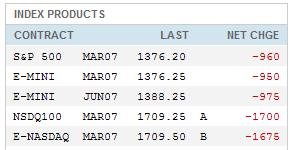 The Chicago Mercantile Exchange (CME) trades stock market futures contracts. Specifically these futures contracts are for the S&P 500 and Nasdaq 100. You can often get an idea of how the stock market will do in early trading. The prediction that the CME tells you gets more accurate as you get closer to the opening of the stock markets.
The CME website has a page that shows Globex Flash Quotes. These are quotes for indices. Because of the global nature of the Globex, quotes are often available after hours, and before the market opening. In the example above, large-valued red numbers for the S&P and Nasdaq futures portend a down day in the stock market. Green numbers would predict an up day. However, I will warn you that these "predictions" are only really accurate for about the first half-hour or so of trading. I am sure that you've seen it happen many times where the stock market opens up in the beginning and ends significantly lower. Or the stock market drops in the early minutes of trading, only to recover significantly before the end of the day.
Other places to look for a predictions of the stock market are in the International Market indices. These indices tell you how the overseas markets are doing. If the markets in Asia and in Europe have had a down day, it is likely that the US markets will follow suit.
As a side note here, my DW and I had the opportunity to visit the CME several years ago (before we were married) when we were visiting Chicago. Sadly, however, the CME visitor gallery where you can view traders on the floor of the exchange has closed to visitors since September 2001.
DC
 The Chicago Mercantile Exchange (CME) trades stock market futures contracts. Specifically these futures contracts are for the S&P 500 and Nasdaq 100. You can often get an idea of how the stock market will do in early trading. The prediction that the CME tells you gets more accurate as you get closer to the opening of the stock markets.
The CME website has a page that shows Globex Flash Quotes. These are quotes for indices. Because of the global nature of the Globex, quotes are often available after hours, and before the market opening. In the example above, large-valued red numbers for the S&P and Nasdaq futures portend a down day in the stock market. Green numbers would predict an up day. However, I will warn you that these "predictions" are only really accurate for about the first half-hour or so of trading. I am sure that you've seen it happen many times where the stock market opens up in the beginning and ends significantly lower. Or the stock market drops in the early minutes of trading, only to recover significantly before the end of the day.
Other places to look for a predictions of the stock market are in the International Market indices. These indices tell you how the overseas markets are doing. If the markets in Asia and in Europe have had a down day, it is likely that the US markets will follow suit.
As a side note here, my DW and I had the opportunity to visit the CME several years ago (before we were married) when we were visiting Chicago. Sadly, however, the CME visitor gallery where you can view traders on the floor of the exchange has closed to visitors since September 2001.
DC
Tuesday, November 27, 2007
The Backward Investor
Would you rather make 21% in a year on your investment or lose 18% in a year on your investments? Believe it or not there is a subset of investors who would rather lose 18% than gain 21% on their investments. Let me clarify. The Standard and Poors (S&P) 500 index went down 23.37% (excluding dividends) in 2002. In 2003, the S&P 500 gained 26.38%. There is a subset of investors who strive to "beat the S&P 500." This perverse group of people would be thrilled to have lost 18% of their money in 2002 because they would have beaten the S&P 500 by over 5%. (If you didn't invest in the stock market at all and ended up with a 0% return, you would have beaten the S&P 500 by 23% in 2002.) In either case, I didn't exactly see many people celebrating their investment portfolios at the time.
By contrast, These same folks would be bummed out to make only 21% on their investments in 2003 because they would have underperformed the S&P 500 by more than 5%. I don't know about you, but I would happy to make 21% in a year on my investments, and would feel ashamed to have lost 18% in my investments. The truth be told, I used to compare my stock performance against the S&P. I don't do that anymore, after I saw how ridiculous that comparison can be. This reminds me of the "keeping up with the Joneses" comparison in personal finance. My advice is not to constantly compare your portfolio performance with the S&P, Nasdaq, or your neighbors. Instead, strive to improve your own position year over year.
DC
This article was originally published on September 23, 2006. It is being republished today.
By contrast, These same folks would be bummed out to make only 21% on their investments in 2003 because they would have underperformed the S&P 500 by more than 5%. I don't know about you, but I would happy to make 21% in a year on my investments, and would feel ashamed to have lost 18% in my investments. The truth be told, I used to compare my stock performance against the S&P. I don't do that anymore, after I saw how ridiculous that comparison can be. This reminds me of the "keeping up with the Joneses" comparison in personal finance. My advice is not to constantly compare your portfolio performance with the S&P, Nasdaq, or your neighbors. Instead, strive to improve your own position year over year.
DC
This article was originally published on September 23, 2006. It is being republished today.
Friday, November 2, 2007
Misc. 401(k) Plan Facts
I've come up with a short list of miscellaneous facts about 401(k) plans that are not so commonly known. As always, I'm not an expert, so you might want to contact a tax professional for clarification.
1) Company stock: when you take a distribution, you can take a distribution of stock shares, and pay ordinary income tax on your cost basis. You can hold these shares outside of the 401(k) until you sell your company stock shares. You will then pay taxes only at the lower capital gains rate on the amount gained.
2) 401(k) plans are qualified plans that afford you greater legal protections than a rollover IRA. Of course, this only comes into play only if you are sued later in life.
3) 401(k) plans have a fiduciary duty to invest your money. What this means is that the 401(k) administrators need to select appropriate investment choices for you. This is not the case with an IRA.
4) Contributions to 401(k) plans are indexed to inflation beginning in 2007. In 2001, Congress passed the Economic Growth and Tax Relief Reconciliation Act that set forth a schedule for the increases in 401(k) contribution limits. Through 2006, this was $1000 per year. From 2007 onward, the contributions are indexed to inflation (known as a cost-of-living adjustment) rounded to $500 increments. The small increase for this year is because the inflation rate is low. For 2007, the current contribution limit is $15,500.
5) In-service distributions: You don't need to quit your job in order roll money from your 401(k) into an IRA. Companies don't advertise this fact, but in most cases you can request an "in-service distribution" and roll that into an IRA while you are still working there. You will need to read through the company 401(k) plan documents to find the details for your plan.
DC
1) Company stock: when you take a distribution, you can take a distribution of stock shares, and pay ordinary income tax on your cost basis. You can hold these shares outside of the 401(k) until you sell your company stock shares. You will then pay taxes only at the lower capital gains rate on the amount gained.
2) 401(k) plans are qualified plans that afford you greater legal protections than a rollover IRA. Of course, this only comes into play only if you are sued later in life.
3) 401(k) plans have a fiduciary duty to invest your money. What this means is that the 401(k) administrators need to select appropriate investment choices for you. This is not the case with an IRA.
4) Contributions to 401(k) plans are indexed to inflation beginning in 2007. In 2001, Congress passed the Economic Growth and Tax Relief Reconciliation Act that set forth a schedule for the increases in 401(k) contribution limits. Through 2006, this was $1000 per year. From 2007 onward, the contributions are indexed to inflation (known as a cost-of-living adjustment) rounded to $500 increments. The small increase for this year is because the inflation rate is low. For 2007, the current contribution limit is $15,500.
5) In-service distributions: You don't need to quit your job in order roll money from your 401(k) into an IRA. Companies don't advertise this fact, but in most cases you can request an "in-service distribution" and roll that into an IRA while you are still working there. You will need to read through the company 401(k) plan documents to find the details for your plan.
DC
Friday, October 12, 2007
TD Ameritrade Courtesy Fill Notifications
On my original Ameritrade account, there is an option to receive fill notifications. For those not familiar with the term, a "courtesy fill notification" is notice from the broker that one of your stock orders has gone through. This can be either by Email, phone, or fax, and there is no extra charge for this service. The choice to select a fill notification is found under "Communications" on the "General" tab of the "My Profile" page. And you can get to "My Profile" by selecting "Portfolio & Accounts". In my case, I have the broker call me (through their automated phone system) whenever a trade has been executed. There was a time when a real person would call to notify you of your trade, but that seem like a thing of the past now.
I think that this is a useful feature on my Ameritrade account, but I don't see this same option in the TD Ameritrade accounts that were converted over from TD Waterhouse. I am assuming that you cannot get automatic fill notifications if you had a Waterhouse account. Has anybody else been able to setup courtesy fill notifications from their former Waterhouse account?
DC
I think that this is a useful feature on my Ameritrade account, but I don't see this same option in the TD Ameritrade accounts that were converted over from TD Waterhouse. I am assuming that you cannot get automatic fill notifications if you had a Waterhouse account. Has anybody else been able to setup courtesy fill notifications from their former Waterhouse account?
DC
Monday, October 8, 2007
Countrywide Bank Update
I have two updates to my post about Countrywide Bank. First of all Countrywide has increased it SavingsLink interest rate to 5.5%, with a $10,000 minimum account balance. Considering that many Certificates of Deposits (CDs) don't even pay that much, this interest rate is quite impressive.
I mentioned that SavingsLink accounts have to be linked to a savings or checking account at another financial institution for you to access your money. At the time of my post, Countrywide only allowed one linked account at a time. Furthermore, the process of linking and unlinking accounts is cumbersome. So, the other update is that recently received an Email from Countrywide saying that they've increased the number of external linked accounts to 5. Though I haven't yet tried adding more accounts, this improvement should take away some of the pain of transferring funds between Countrywide and other banks.
Lastly, a reader of PFStock expressed some concern about Countrywide Financial (NYSE: CFC), the parent company of Countrywide Bank. CFC stock has been buffeted over the past year by sub-prime concerns. Indeed, CFC is down over 50% from its 52-week high. And, I do understand the reader's concern. But actually, because Countrywide Bank is FDIC insured, this is not something that depositors need to worry about as long as they stay within the FDIC insurance limits.
DC
I mentioned that SavingsLink accounts have to be linked to a savings or checking account at another financial institution for you to access your money. At the time of my post, Countrywide only allowed one linked account at a time. Furthermore, the process of linking and unlinking accounts is cumbersome. So, the other update is that recently received an Email from Countrywide saying that they've increased the number of external linked accounts to 5. Though I haven't yet tried adding more accounts, this improvement should take away some of the pain of transferring funds between Countrywide and other banks.
Lastly, a reader of PFStock expressed some concern about Countrywide Financial (NYSE: CFC), the parent company of Countrywide Bank. CFC stock has been buffeted over the past year by sub-prime concerns. Indeed, CFC is down over 50% from its 52-week high. And, I do understand the reader's concern. But actually, because Countrywide Bank is FDIC insured, this is not something that depositors need to worry about as long as they stay within the FDIC insurance limits.
DC
Friday, October 5, 2007
Link Exchange
You can have your blog listed for FREE at PFStock. I am looking to add more blogs to my blogroll. If you have a bona fide personal finance blog, please Email me (my contact information is listed in the sidebar) about exchanging links. Note that I do not currently link to commercial, real estate, or multi-level marketing blogs.
Only personal finance blogs that are written by individual bloggers on a not-for-profit basis qualify for a free listing in the blogroll. Blogs and websites that do not qualify for a free listing may inquire about the low advertising rates offered for PFStock sponsors.
DC
Only personal finance blogs that are written by individual bloggers on a not-for-profit basis qualify for a free listing in the blogroll. Blogs and websites that do not qualify for a free listing may inquire about the low advertising rates offered for PFStock sponsors.
DC
Tuesday, October 2, 2007
Business 2.0 = Fortune 1.0
I just received my last issue of Business 2.0 magazine. This post is a follow-up to my article about Business 2.0 going out of business. A note on the cover of the magazine answers my question about what will happen to the issues remaining in my subscription that have already been paid for. They will substitute one copy of Fortune magazine for every 2 paid copies of Business 2.0 remaining. There is also an option to request a refund if you are not happy with receiving Fortune as a substitute.
DC
DC
Monday, October 1, 2007
NetBank Closes Down
As of Friday (September 28) NetBank has been closed down, and the FDIC has now taken over the bank. According to the FDIC, "No advance notice is given to the public when a financial institution is closed." However, I have written extensively about NetBank, and readers of PFStock would have been given full advanced warning that NetBank was on the brink of closure.
To summarize the current situation, depositors with less than $100,000 at NetBank have their deposits fully insured by the FDIC, and their accounts will be transfered to to ING DIRECT. Depositors with over $100,000 may have a portion of their funds that are uninsured, and will lose half of the uninsured amount. Investors in NetBank stock should fully expect to lose ALL of their money. NetBank is essentially bankrupt at this point and stock investors do not usually recover any funds.
PFStock's coverage of NetBank began over a year ago on September 20, 2006, when I posted here that I was about to begin the process of withdrawing my money from NetBank and close my account with them. In that post, Sayonara NetBank, I referred to this process as "evacuating my money." There and in subsequent posts on PFStock, I cited deteriorating financial conditions at NetBank as one of my prime reasons for closing out my account. At that time, I conceded that NetBank was not likely to be forced into bankruptcy, but was wrong.
Over the course of the last year, financial results at NetBank continued to deteriorate. The company eliminated its dividend, and later ousted its CEO in October 2006. Even before this event, I had speculated that something fishy was going on at NetBank. And, I asserted that NetBank could no longer remain competitive with other banks in its online market space.
After a set of staggering losses, NetBank's independent auditor resigned. The stock was eventually delisted from Nasdaq, after it fell well below $1. In May 2007, NetBank made an agreement to sell a substantial portion of its remaining assets to privately held EverBank. This deal was supposed to have been completed by July, but it recently fell through. As recently as my September 10 posting, I speculated that the EverBank deal was in serious jeopardy. With the collapse of this deal, it became obvious that NetBank had exhausted all of its options, and was only be a matter of time before NetBank would be forced by government regulators to liquidate.
The NetBank bankruptcy saga has been an interesting ride. But as the story is nearing an end, this may likely be my last post about NetBank.
Further reading:
NetBank Continued 9/10/2007
NetBank Again 8/5/2007
NetBank's Demise 5/22/2007
The Decline and Fall of Internet-only Banks 12/1/2006
Unprofitable and Unstable, NetBank Ousts its CEO 10/3/2006
More on NetBank 10/2/2006
Sayonara NetBank 9/20/2006
DC
To summarize the current situation, depositors with less than $100,000 at NetBank have their deposits fully insured by the FDIC, and their accounts will be transfered to to ING DIRECT. Depositors with over $100,000 may have a portion of their funds that are uninsured, and will lose half of the uninsured amount. Investors in NetBank stock should fully expect to lose ALL of their money. NetBank is essentially bankrupt at this point and stock investors do not usually recover any funds.
PFStock's coverage of NetBank began over a year ago on September 20, 2006, when I posted here that I was about to begin the process of withdrawing my money from NetBank and close my account with them. In that post, Sayonara NetBank, I referred to this process as "evacuating my money." There and in subsequent posts on PFStock, I cited deteriorating financial conditions at NetBank as one of my prime reasons for closing out my account. At that time, I conceded that NetBank was not likely to be forced into bankruptcy, but was wrong.
Over the course of the last year, financial results at NetBank continued to deteriorate. The company eliminated its dividend, and later ousted its CEO in October 2006. Even before this event, I had speculated that something fishy was going on at NetBank. And, I asserted that NetBank could no longer remain competitive with other banks in its online market space.
After a set of staggering losses, NetBank's independent auditor resigned. The stock was eventually delisted from Nasdaq, after it fell well below $1. In May 2007, NetBank made an agreement to sell a substantial portion of its remaining assets to privately held EverBank. This deal was supposed to have been completed by July, but it recently fell through. As recently as my September 10 posting, I speculated that the EverBank deal was in serious jeopardy. With the collapse of this deal, it became obvious that NetBank had exhausted all of its options, and was only be a matter of time before NetBank would be forced by government regulators to liquidate.
The NetBank bankruptcy saga has been an interesting ride. But as the story is nearing an end, this may likely be my last post about NetBank.
Further reading:
NetBank Continued 9/10/2007
NetBank Again 8/5/2007
NetBank's Demise 5/22/2007
The Decline and Fall of Internet-only Banks 12/1/2006
Unprofitable and Unstable, NetBank Ousts its CEO 10/3/2006
More on NetBank 10/2/2006
Sayonara NetBank 9/20/2006
DC
Thursday, September 27, 2007
MS Money Plus (2008) System Requirements
A while back, I posted an article about issues that I was having with Microsoft Money 2004. I have the 2007 version of MS Money, and found it to be generally good, but there are a few features that are missing. For example, you can more easily switch between investments in the 2004 version. There is a drop-down box that allows you to quickly view any securities that you've entered into MS Money, but this feature doesn’t exist in the 2007 version. Also, the 2007 version of Money only runs under Windows XP Service Pack 2 (SP2) or Windows Vista.
For 2008, Microsoft has renamed their financial software as "Microsoft Money Plus". Have you seen the system requirements? Again, you need to be running either Windows XP Service Pack 2 (SP2) or Windows Vista.
Looking at the box for MS Money Plus (Deluxe version), I was actually shocked by the system requirement to run the software under Windows Vista. For PCs running Windows XP, the minimum requirements are quite reasonable: a Pentium II 300-MHz or faster processor (or compatible), and 128 MB of RAM.
However, for those with PCs running Windows Vista, the requirements are much more demanding: a Pentium (or compatible) 1 gigahertz (GHz) or faster 32-bit (x86) or 64-bit (x64) processor, and a whopping 1 GB of RAM.
I’m starting to question why the requirements are so drastically different for Windows Vista versus the same software running under Windows XP. Is Vista version of MS Money Plus so phenomenally superior to Windows XP? Is there anybody who has the software that can give some insight as to what the main differences are between the two software versions?
DC
For 2008, Microsoft has renamed their financial software as "Microsoft Money Plus". Have you seen the system requirements? Again, you need to be running either Windows XP Service Pack 2 (SP2) or Windows Vista.
Looking at the box for MS Money Plus (Deluxe version), I was actually shocked by the system requirement to run the software under Windows Vista. For PCs running Windows XP, the minimum requirements are quite reasonable: a Pentium II 300-MHz or faster processor (or compatible), and 128 MB of RAM.
However, for those with PCs running Windows Vista, the requirements are much more demanding: a Pentium (or compatible) 1 gigahertz (GHz) or faster 32-bit (x86) or 64-bit (x64) processor, and a whopping 1 GB of RAM.
I’m starting to question why the requirements are so drastically different for Windows Vista versus the same software running under Windows XP. Is Vista version of MS Money Plus so phenomenally superior to Windows XP? Is there anybody who has the software that can give some insight as to what the main differences are between the two software versions?
DC
Subscribe to:
Posts (Atom)





 Posts
Posts


