Recently, I opened an eBay account and started bidding on items. Let me take a step backward for those who are not familiar with how eBay works. Before I opened an eBay account, I setup an account on PayPal which is like a bank account that you use to pay for eBay items. While it is not entirely necessary, most sellers on eBay prefer PayPal. One can also pay with a credit card, but PayPal is the entity that handles the transaction. So, I figured that I would have to end up opening a PayPal account anyway.
I was in the market to buy a Hewlett Packard 92274A (74A) toner cartridge for my 13 year old HP LaserJet 4MP printer. For the record, a new one of these replacement cartridges cost about $90 retail. On eBay I saw that they could be had for a lot cheaper, especially those that are designated as remanufactured cartridges. My first 4 or 5 attempts to buy a cartridge didn't meet with much success as I was outbid (sometimes at the very last minute) by somebody else. Up until this point, I had been bidding on cartridges one at a time. Frustrated by my lack of success, I started putting in bids on multiple items at once, hoping that I might be able to get one of them. To make a long story short, my bidding now became too successful, and I ended up winning two toner cartridges from the same seller. This is where the fun began.
I immediately tried to contact the seller to see if he would be willing to combine the shipping charges since most sellers do that when you win multiple auctions. There was no reply to my Emails after a couple of days. I then contacted eBay to see if I could get the seller's phone number. This is when I found out that his telephone was disconnected! Not a great first experience. So, I informed eBay, and they also could not confirm his contact information. For reference, when this happens eBay restricts the member's activities until the outdated contact information is corrected. I eventually got this updated info. So finally after several days, I did make contact with the seller, and he was willing to knock a few dollars off of the shipping. I then made my payment through PayPal.
What happened next was that I think the seller went on vacation or something. Again, there was no response to my Emails. *sigh* After another week or so, I made contact again, and he informed me that my goods had already been shipped. So, then it was up to UPS to deliver the goods. This also seemed to take forever, but in reality it took about 8 days.
In the end, about 3 weeks after the saga began (with setting up a PayPal account), I completed my first eBay purchase. This experience is certainly the opposite of when you just go into a store and walk out with the product you want. I did end up saving quite a bit over the $90+ I would have paid at say Office Depot. But, I wonder if it was worth the hassle. Since I consider this purchase from eBay a learning experience, I would say that it is interesting to learn how the mechanics of the system work. My new toner cartridge is now in my old printer, and I have one more cartridge to spare. These cartridges last me about 2 years each, so I'm set for a while.
I think I'll go looking for something else to buy now.
DC

Wednesday, September 5, 2007

Monday, August 27, 2007
Update on Office Depot Rebates
On April 27, I wrote about my experiences with Office Depot rebates. I did finally get all of my rebates, but not before a very long waiting period. I usually have good success with rebate offers for products that I buy. I estimate that I participate in maybe two dozen rebates a year, and have not had any problem 80-90% of the time. However, over the past year, I have sent in three rebates for products that I bought at Office Depot and had a problem receiving each one. If a problem happens with receiving a rebate, I usually consider it a fluke or coincidence. But since I had a problem three times in a row with the same retailer, I think that this is more than just a coincidence.
In each case, my rebate got "stuck" in their system. I waited almost half a year for a rebate on blank DVD media that I bought the day after Thanksgiving. I have talked to their customer service (at Web-Rebates.com), and they said that they would try to "expedite" the rebate. Most of the time, the rebate showed up as in the "Required Validation Period" in their online tracking system. In any case, Office Depot is now officially off my list of places of where I will shop for rebate items. Curiously, I have not had problems with other retailers who also use "Web-Rebates.com" for rebate submissions.
I have also heard from other readers who had the same problem with Office Depot rebates. In one case, a reader spent a great deal of effort, but it still took over 6 months to get the rebate check. That person no longer trusts Office Depot and immediately went to a bank to cash the $20 check, for fear that it would bounce. Does anybody else have a similar experience with Office Depot?
DC
In each case, my rebate got "stuck" in their system. I waited almost half a year for a rebate on blank DVD media that I bought the day after Thanksgiving. I have talked to their customer service (at Web-Rebates.com), and they said that they would try to "expedite" the rebate. Most of the time, the rebate showed up as in the "Required Validation Period" in their online tracking system. In any case, Office Depot is now officially off my list of places of where I will shop for rebate items. Curiously, I have not had problems with other retailers who also use "Web-Rebates.com" for rebate submissions.
I have also heard from other readers who had the same problem with Office Depot rebates. In one case, a reader spent a great deal of effort, but it still took over 6 months to get the rebate check. That person no longer trusts Office Depot and immediately went to a bank to cash the $20 check, for fear that it would bounce. Does anybody else have a similar experience with Office Depot?
DC
Friday, August 17, 2007
Countrywide Bank SavingsLink
On PFStock, I have posted extensively about my experiences with NetBank. I have found a replacement for the funds that I withdrew from NetBank when I closed my account with them. The winner is ... Countrywide Bank.
Recently, I opened a SavingsLink account at Countrywide Bank. The highlights are that they pay 5.25% APY interest if you have more that $10k, and 5.4% APY if you have over $50k. The interest rate drops to 4.0% APY if your balance is below $10k. The account itself works like an ING or iGo savings account. If you are not familiar with these, the SavingsLink account is an online only account that must be linked to a regular savings or checking account that you have at another institution. This is pretty much the only practical way to transfer funds in or out.
Countrywide Bank actually has a branch within walking distance of my home. But unlike most regular banks, the branch doesn't have an ATM and a prominently displayed sign says that they don't have any cash in the branch. When I asked the asked the sole employee of this office how to make a deposit, he showed me a deposit envelope, which was actually a Federal Express envelope. Apparently if you give them a check, they will send by overnight mail to Texas where the deposit is processed. Countrywide did send me a few postage paid deposit envelopes, but I assume that the FedEx method would be faster.
The SavingsLink account doesn't come with either checks or an ATM card. So, most transactions have to go through your linked account. SavingsLink only allows one linked account at a time, and the process of linking an account is cumbersome. Countrywide Bank uses what is known as "trial deposits". When you request that they link an external account to your Countrywide Bank account, they will make two random deposits (of less than $1.00 each) to your external account and ask you to verify the amounts that were deposited. This is to assure that you are actually the owner of the external account, and this process usually takes 2-3 days to complete. One other little hassle is that deposits are subject to a 10 business day hold. This basically means that you won't be able to withdrawal any deposit for a period of two weeks.
In spite of a few hassles to setup a Countrywide SavingsLink account, their interest rates are much better than at NetBank. Indeed, the 5.4% APY rate is better than the vast majority of bank savings accounts available.
DC
This article was originally published on May 1, 2007. It is being republished today due to previous posting problems.
Recently, I opened a SavingsLink account at Countrywide Bank. The highlights are that they pay 5.25% APY interest if you have more that $10k, and 5.4% APY if you have over $50k. The interest rate drops to 4.0% APY if your balance is below $10k. The account itself works like an ING or iGo savings account. If you are not familiar with these, the SavingsLink account is an online only account that must be linked to a regular savings or checking account that you have at another institution. This is pretty much the only practical way to transfer funds in or out.
Countrywide Bank actually has a branch within walking distance of my home. But unlike most regular banks, the branch doesn't have an ATM and a prominently displayed sign says that they don't have any cash in the branch. When I asked the asked the sole employee of this office how to make a deposit, he showed me a deposit envelope, which was actually a Federal Express envelope. Apparently if you give them a check, they will send by overnight mail to Texas where the deposit is processed. Countrywide did send me a few postage paid deposit envelopes, but I assume that the FedEx method would be faster.
The SavingsLink account doesn't come with either checks or an ATM card. So, most transactions have to go through your linked account. SavingsLink only allows one linked account at a time, and the process of linking an account is cumbersome. Countrywide Bank uses what is known as "trial deposits". When you request that they link an external account to your Countrywide Bank account, they will make two random deposits (of less than $1.00 each) to your external account and ask you to verify the amounts that were deposited. This is to assure that you are actually the owner of the external account, and this process usually takes 2-3 days to complete. One other little hassle is that deposits are subject to a 10 business day hold. This basically means that you won't be able to withdrawal any deposit for a period of two weeks.
In spite of a few hassles to setup a Countrywide SavingsLink account, their interest rates are much better than at NetBank. Indeed, the 5.4% APY rate is better than the vast majority of bank savings accounts available.
DC
This article was originally published on May 1, 2007. It is being republished today due to previous posting problems.
Thursday, August 16, 2007
Bankruptcy and IVAs
In a discussion with one of the sponsors of PFStock, the topic of an Individual Voluntary Arrangement (IVA) was brought up. I was not familiar with IVAs, so I decided to do a little research into the topic. In the United Kingdom, when a person declares bankruptcy, the details of the bankruptcy are advertised in the local press.
Due to the Insolvency Act of 1986, individuals in the United Kingdom have an alternative if they wish to avoid bankruptcy. This option, called an Individual Voluntary Arrangement (IVA) , is an agreement between a debtor and creditors. The debtor agrees to pay a monthly sum, usually for 5 years, to their creditors through this arrangement. This sum is divided up between the creditors, who accept the sum in settlement of the amount owed.
The monthly payment is based on one's income and expenditure. In general, more than 75% (in value) of the creditors must agree in order for the IVA to be approved. A standing order authority (usually a company) will be set up to handle the payments.
An IVA might be suitable for people who cannot pay their debts. To read more about IVAs, I suggest the following website: Debt Advice Trust. The Debt Advice Trust is a not-for-profit charity in the UK with the aim of helping people get out of debt by giving free, impartial advice. The site has a forum and lots of in-depth FAQs on debt and staying debt-free.
Due to the Insolvency Act of 1986, individuals in the United Kingdom have an alternative if they wish to avoid bankruptcy. This option, called an Individual Voluntary Arrangement (IVA) , is an agreement between a debtor and creditors. The debtor agrees to pay a monthly sum, usually for 5 years, to their creditors through this arrangement. This sum is divided up between the creditors, who accept the sum in settlement of the amount owed.
The monthly payment is based on one's income and expenditure. In general, more than 75% (in value) of the creditors must agree in order for the IVA to be approved. A standing order authority (usually a company) will be set up to handle the payments.
An IVA might be suitable for people who cannot pay their debts. To read more about IVAs, I suggest the following website: Debt Advice Trust. The Debt Advice Trust is a not-for-profit charity in the UK with the aim of helping people get out of debt by giving free, impartial advice. The site has a forum and lots of in-depth FAQs on debt and staying debt-free.
Sunday, August 12, 2007
Brokerage Survey Results
The results of PFStock's first brokerage survey are in. TD Ameritrade is the most popular brokerage among PFStock readers with 80% of the votes. The next most popular brokerage is SogoInvest with 20% of the votes. Thank you to all that voted.
In the latest poll, PFStock asks how much of your banking do you do online? Personally I do most, but not all, of my banking online. This leads to a lot of frustration when the bank website goes down. For example, yesterday when I got ready to pay a bunch bills on the Washington Mutual (WaMu) website, I got the following error message "Our site is temporarily unavailable due to a scheduled technology upgrade." So in the meanwhile, my bills are lined up next to the computer, waiting for WaMu's website to come back to life...
Please vote using the poll in the right sidebar.
DC
In the latest poll, PFStock asks how much of your banking do you do online? Personally I do most, but not all, of my banking online. This leads to a lot of frustration when the bank website goes down. For example, yesterday when I got ready to pay a bunch bills on the Washington Mutual (WaMu) website, I got the following error message "Our site is temporarily unavailable due to a scheduled technology upgrade." So in the meanwhile, my bills are lined up next to the computer, waiting for WaMu's website to come back to life...
Please vote using the poll in the right sidebar.
DC
Friday, August 10, 2007
TD Ameritrade Online Documents
It seems that TD Ameritrade is having some issues with its online documents. For a while, my July online statements were not available online. The TD Ameritrade website had this notice regarding "July Statement Availability":
But a larger issue for me is that I am missing several of my trade confirmations from the May-June 2007 time frame. These are trade confirmations that were previously listed under the "History & Statements" tab, but mysteriously disappeared sometime last week. A couple of Emails and a call to TD Ameritrade APEX customer service assured me that they are "aware of the problem and expect to have this issue resolved quickly." Well, it has been more that a week and my trade confirmations have not yet reappeared.
Banks and brokerages encourage their clients to agree to online delivery of account documents in part because it saves them money in the form of printing and mailing costs. I don't know about you, but when I agree to the arrangement of having my documents kept online, I also expect to be able to access them whenever I want. TD Ameritrade is only one example, as I think that most people who bank online can describe a situation where they were unable to access the online system because it was "down for maintenance" or "undergoing system enhancements". Is it any wonder that many people are still hesitant to do all of their banking online?
Also, I thought that I would update readers on my TD Ameritrade Warning that the brokerage would start to charge for monthly paper statements. They recently posted the following information about "Former TD Waterhouse clients receiving paper statements":
Since I'm an Apex client, I get my monthly paper statements delivered for free. I did notice that the new TD Ameritrade statements take about two weeks longer to arrive versus the old TD Waterhouse statements, which came quickly. However, if they I did charge me for statements, I would probably opt for only quarterly statements.
DC
Electronic Statements for July are currently unavailable for some clients. We are working to make them available as soon as possible. We apologize for any inconvenience. If you have further questions please contact Client Services.
But a larger issue for me is that I am missing several of my trade confirmations from the May-June 2007 time frame. These are trade confirmations that were previously listed under the "History & Statements" tab, but mysteriously disappeared sometime last week. A couple of Emails and a call to TD Ameritrade APEX customer service assured me that they are "aware of the problem and expect to have this issue resolved quickly." Well, it has been more that a week and my trade confirmations have not yet reappeared.
Banks and brokerages encourage their clients to agree to online delivery of account documents in part because it saves them money in the form of printing and mailing costs. I don't know about you, but when I agree to the arrangement of having my documents kept online, I also expect to be able to access them whenever I want. TD Ameritrade is only one example, as I think that most people who bank online can describe a situation where they were unable to access the online system because it was "down for maintenance" or "undergoing system enhancements". Is it any wonder that many people are still hesitant to do all of their banking online?
Also, I thought that I would update readers on my TD Ameritrade Warning that the brokerage would start to charge for monthly paper statements. They recently posted the following information about "Former TD Waterhouse clients receiving paper statements":
Most former TD Waterhouse clients who received paper statements in their old accounts will now receive paper statements on a quarterly basis in their TD AMERITRADE account. There is no fee for quarterly paper statements. Statements are also available in electronic or monthly paper formats. Electronic statements are free, monthly paper statements are available for a $2 monthly fee (free for Apex clients). To change how often you receive statements or the format you receive them in, login to your account and go to My Profile (under Portfolio & Accounts), then select Statements (located in the Communication section) and click the "edit" link.
Since I'm an Apex client, I get my monthly paper statements delivered for free. I did notice that the new TD Ameritrade statements take about two weeks longer to arrive versus the old TD Waterhouse statements, which came quickly. However, if they I did charge me for statements, I would probably opt for only quarterly statements.
DC
Tuesday, August 7, 2007
AOL Time Warner Settlement
A couple weeks ago, I received a class action settlement check for some AOL Time Warner stock that I purchased a long time ago. In fact, the purchases of stock go back as far as 1999. To make a long story short, this settlement stems from the botched merger of America Online and Time Warner in which investors lost a lot of money. Time Warner currently trades on the NYSE as symbol TWX. Of course, the check that I received is much less than the amount that I lost trading the stock.
I filled in and mailed the proof of claim form for the AOL Time Warner class action settlement over a year and a half ago. Usually, these types of settlements are handled by a firm called Gilardi and Co. This is the first time I ever received a settlement check, and I've already figured out that these matters can take a long time. Has anybody else received a settlement for securities litigation? Do you know how one is supposed to report this on their taxes?
DC
I filled in and mailed the proof of claim form for the AOL Time Warner class action settlement over a year and a half ago. Usually, these types of settlements are handled by a firm called Gilardi and Co. This is the first time I ever received a settlement check, and I've already figured out that these matters can take a long time. Has anybody else received a settlement for securities litigation? Do you know how one is supposed to report this on their taxes?
DC
Sunday, August 5, 2007
NetBank Again
On the morning of September 20, 2006, I posted here that I was about to begin the process of withdrawing my money from NetBank and close my account with them. In that post, Sayonara NetBank, I referred to this process as "evacuating my money." There and in subsequent posts on PFStock, I cited deteriorating financial conditions at NetBank as one of my prime reasons for closing out my account. Even then, I conceded that NetBank was not likely to be forced into bankruptcy, but in the event that they did declare bankruptcy, it would be a hassle for depositors to get their funds back from the FDIC.
Let's take a look back over the last ten months at NetBank (Nasdaq: NTBK). On September 20th, the stock closed at $6.10. Today, NTBK trades at a mere $0.22 (and is on the verge of being delisted). And, NTBK recently reached an all-time low of $0.18 (a 97% decline). This decline is not surprising considering NetBank's deteriorating financials. From NetBank's previous press releases and other information available at their website, we can clearly see a series of quarterly losses over the past year. And early last year, NetBank stopped paying its shareholder dividend saying that they needed "to protect the company's capital base and tangible book value from further erosion."
Then on October 3rd, NetBank announced that it would be replacing its CEO. Even before this event, I had speculated that something fishy was going on at NetBank. A worst-case scenario could be that NetBank customers would need to recover their funds from the FDIC if NetBank becomes insolvent. However, I noted that while this is certainly possible, it is not the most likely case. Nevertheless, I asserted that NetBank could no longer remain competitive with other banks in its market space.
According to a more recent NTBK press release dated February 21, 2007, NetBank recorded a net loss of $202 million or $4.36 per share for 2006. This loss of $4.36 per share over the 12-month period is absolutely staggering when you consider that the entire company is only valued at $0.22 a share. Unfortunately, what is really lacking from NetBank's report is any type of good news. To further exacerbate the already existing problems, NTBK has received a notice from the Nasdaq Stock Market that the company's common stock is subject to delisting. NetBank has been delinquent in its regulatory filings because its former independent auditor resigned as of November 9, 2006. Since then, NTBK has been having difficulty bringing a new auditor on board. Again, this cannot be construed as good news.
And, the other shoe dropped on May 21st. NetBank announced that it is selling a substantial portion of what remaining assets it has to privately held EverBank. Here are a couple of statements from the NTBK press release:
Doesn't this seem to imply that the aforementioned "regulators" forced NetBank to essentially liquidate its remaining assets in order to protect depositors' money? And the NTBK stock price has reacted very negatively to these developments.
So, what is left of NetBank? According to NetBank CEO, Steven F. Herbert, "Our remaining businesses will include our mortgage servicing operation, along with our retail prime mortgage franchise, Market Street Mortgage." My interpretation is that there won't be anything left of the online banking operation, after EverBank takes its share. So substantially I can say that as you and I know it, the online bank, NetBank is no more!
Let's take a look back over the last ten months at NetBank (Nasdaq: NTBK). On September 20th, the stock closed at $6.10. Today, NTBK trades at a mere $0.22 (and is on the verge of being delisted). And, NTBK recently reached an all-time low of $0.18 (a 97% decline). This decline is not surprising considering NetBank's deteriorating financials. From NetBank's previous press releases and other information available at their website, we can clearly see a series of quarterly losses over the past year. And early last year, NetBank stopped paying its shareholder dividend saying that they needed "to protect the company's capital base and tangible book value from further erosion."
Then on October 3rd, NetBank announced that it would be replacing its CEO. Even before this event, I had speculated that something fishy was going on at NetBank. A worst-case scenario could be that NetBank customers would need to recover their funds from the FDIC if NetBank becomes insolvent. However, I noted that while this is certainly possible, it is not the most likely case. Nevertheless, I asserted that NetBank could no longer remain competitive with other banks in its market space.
According to a more recent NTBK press release dated February 21, 2007, NetBank recorded a net loss of $202 million or $4.36 per share for 2006. This loss of $4.36 per share over the 12-month period is absolutely staggering when you consider that the entire company is only valued at $0.22 a share. Unfortunately, what is really lacking from NetBank's report is any type of good news. To further exacerbate the already existing problems, NTBK has received a notice from the Nasdaq Stock Market that the company's common stock is subject to delisting. NetBank has been delinquent in its regulatory filings because its former independent auditor resigned as of November 9, 2006. Since then, NTBK has been having difficulty bringing a new auditor on board. Again, this cannot be construed as good news.
And, the other shoe dropped on May 21st. NetBank announced that it is selling a substantial portion of what remaining assets it has to privately held EverBank. Here are a couple of statements from the NTBK press release:
The company has been under extreme financial pressure for more than a year due to a difficult mortgage origination market, a flat yield curve environment and other factors. These pressures have resulted in large operating losses that have significantly reduced the company's capital position and prompted heightened regulatory oversight.And:
Regulators have been increasingly concerned about the bank's capital and earnings trends and advised management to find an alternative immediately that covered all of the bank's deposit obligations.
Doesn't this seem to imply that the aforementioned "regulators" forced NetBank to essentially liquidate its remaining assets in order to protect depositors' money? And the NTBK stock price has reacted very negatively to these developments.
So, what is left of NetBank? According to NetBank CEO, Steven F. Herbert, "Our remaining businesses will include our mortgage servicing operation, along with our retail prime mortgage franchise, Market Street Mortgage." My interpretation is that there won't be anything left of the online banking operation, after EverBank takes its share. So substantially I can say that as you and I know it, the online bank, NetBank is no more!
Further reading:
The Decline and Fall of Internet-only Banks
Unprofitable and Unstable, NetBank Ousts its CEO
More on NetBank
NetBank's Demise
DC
This article was originally published on April 15, 2007. It is being republished today due to previous posting problems. It has been updated.
Thursday, August 2, 2007
Money Market Choices for TD Ameritrade
The series of posts that I made about my experiences with TD Ameritrade have been very popular at PFStock. Perhaps the most popular of my posts was the one where I exposed Ameritrade's "Hidden" cash sweep account. I have recently come across another cash (money market) option for TD Ameritrade account holders. This is another fund offered through "The Reserve" (website: ther.com).
The fund is called the Reserve Yield Plus Fund Class R (symbol: RYPQX), and is classified by The Reserve as an "enhanced cash fund". Currently, this fund pays in the neighborhood of 5.4% APY. This rate is much better than the default TD Ameritrade cash option which puts you in a sweep account that pays less than 1% interest.
However, unlike the other Reserve funds (offered through Ameritrade's Total Asset Plan) that I've talked about before, this fund is not available as a sweep option which automatically places your uninvested cash into a money market account. Instead it is traded like a No-Transaction Fee (NTF) mutual fund. You would need to put in a mutual fund order each time that you want to buy or sell the fund.
Now I have a few questions for my readers. Has anybody invested in this type of enhanced cash fund before? Do you need to report each mutual fund sale (each time you take money out of the fund) as a broker transaction on Schedule D of your tax return? Presumably, the fund tries to maintain a $1/share valuation, and each transaction would represent $0 in capital gains. And, does anybody know if TD Ameritrade would count each NTF transaction toward qualification for their premier (or APEX) trading status?
I suppose that I would be remiss if I didn't add that The Reserve Yield Plus Fund contains the following disclaimer:
This Fund is not a money market fund. Achievement of the Fund’s objectives cannot be assured. An investment in the Fund is not insured or guaranteed by the Federal Deposit Insurance Corporation or any other government agency. Although the Fund seeks to preserve the value of your investment at $1.00 per share, it is possible to lose money by investing in the fund. Yields may vary.
Since the first time that I mentioned the Reserve Yield Plus Fund, I discovered that cash you have in RYPQX is not counted as funds available for trading by TD Ameritrade. Arguably funds held in RYPQX can be considered as cash, but not as "available cash" for the purpose of trading. TD Ameritrade only counts the cash sweep balance here. What this means is that if you want to buy a new stock and don't have enough money in your cash sweep, you will have to sell RYPQX before placing an order.
I think that TD Ameritrade made this process unnecessarily cumbersome. Because RYPQX trades like a mutual fund, there is a 1 day settlement period on funds. For stocks, the settlement date is 3 days later. So in theory, one should be able to execute a stock trade and then later liquidate enough fund holdings to cover the trade in time for settlement. However, the new TD Ameritrade website will not allow you to even enter an order if it thinks you don't have enough in your cash sweep. By my memory, the former Waterhouse website did not have this particular restriction on placing stock trades.
DC
This article was originally published April 11, 2007 . It is being republished because of previous posting problems. It has been updated.
The fund is called the Reserve Yield Plus Fund Class R (symbol: RYPQX), and is classified by The Reserve as an "enhanced cash fund". Currently, this fund pays in the neighborhood of 5.4% APY. This rate is much better than the default TD Ameritrade cash option which puts you in a sweep account that pays less than 1% interest.
However, unlike the other Reserve funds (offered through Ameritrade's Total Asset Plan) that I've talked about before, this fund is not available as a sweep option which automatically places your uninvested cash into a money market account. Instead it is traded like a No-Transaction Fee (NTF) mutual fund. You would need to put in a mutual fund order each time that you want to buy or sell the fund.
Now I have a few questions for my readers. Has anybody invested in this type of enhanced cash fund before? Do you need to report each mutual fund sale (each time you take money out of the fund) as a broker transaction on Schedule D of your tax return? Presumably, the fund tries to maintain a $1/share valuation, and each transaction would represent $0 in capital gains. And, does anybody know if TD Ameritrade would count each NTF transaction toward qualification for their premier (or APEX) trading status?
I suppose that I would be remiss if I didn't add that The Reserve Yield Plus Fund contains the following disclaimer:
This Fund is not a money market fund. Achievement of the Fund’s objectives cannot be assured. An investment in the Fund is not insured or guaranteed by the Federal Deposit Insurance Corporation or any other government agency. Although the Fund seeks to preserve the value of your investment at $1.00 per share, it is possible to lose money by investing in the fund. Yields may vary.
Since the first time that I mentioned the Reserve Yield Plus Fund, I discovered that cash you have in RYPQX is not counted as funds available for trading by TD Ameritrade. Arguably funds held in RYPQX can be considered as cash, but not as "available cash" for the purpose of trading. TD Ameritrade only counts the cash sweep balance here. What this means is that if you want to buy a new stock and don't have enough money in your cash sweep, you will have to sell RYPQX before placing an order.
I think that TD Ameritrade made this process unnecessarily cumbersome. Because RYPQX trades like a mutual fund, there is a 1 day settlement period on funds. For stocks, the settlement date is 3 days later. So in theory, one should be able to execute a stock trade and then later liquidate enough fund holdings to cover the trade in time for settlement. However, the new TD Ameritrade website will not allow you to even enter an order if it thinks you don't have enough in your cash sweep. By my memory, the former Waterhouse website did not have this particular restriction on placing stock trades.
DC
This article was originally published April 11, 2007 . It is being republished because of previous posting problems. It has been updated.
Friday, July 27, 2007
Welcome to the New PFStock
I have finally gotten around to updating my blog template, and resolving the issues that I had with Internet Explorer 7 and the new Blogger Beta. I have tried to keep the same color scheme as the original PFStock. However, I have changed the underlying template. One interesting feature of my new template is that the blog post pane will resize itself depending on the size of the browser window. Also, it is much easier for me to add (or remove) list items on the side bar using the new Blogger template. For example, updating the blogroll or sponsors section is much easier than before.
This reminds me that I am still looking to add more blogs to my blogroll. If you have a bona fide personal finance blog, please Email me (my contact information is listed in the sidebar) about exchanging links. Note that I do not currently link to commercial, real estate, or multi-level marketing blogs. However, you are welcome to contact me about advertising rates for the sponsors section.
After Google converted PFStock to Blogger Beta, I had experienced some problems with the RSS feed. As a result, my readership at PFStock dropped. For the record, the correct RSS feed for PFStock posts is now http://pfstock.blogspot.com/feeds/posts/default or http://pfstock.blogspot.com/feeds/posts/default?alt=rss and http://pfstock.blogspot.com/feeds/comments/default for comments. Because of this and a few other posting problems, I plan to republish some of my blog posts that readers may have missed.
Lastly, I wanted to mention the addition of polls to PFStock. Currently, I am asking readers to vote on which brokerage they use. So far, TD Ameritrade is the most popular brokerage among PFStock readers. This is not surprising since I do tend to write a lot about that broker. Anyway, if you haven't voted yet, please try to get your vote in before the poll closes.
DC
This reminds me that I am still looking to add more blogs to my blogroll. If you have a bona fide personal finance blog, please Email me (my contact information is listed in the sidebar) about exchanging links. Note that I do not currently link to commercial, real estate, or multi-level marketing blogs. However, you are welcome to contact me about advertising rates for the sponsors section.
After Google converted PFStock to Blogger Beta, I had experienced some problems with the RSS feed. As a result, my readership at PFStock dropped. For the record, the correct RSS feed for PFStock posts is now http://pfstock.blogspot.com/feeds/posts/default or http://pfstock.blogspot.com/feeds/posts/default?alt=rss and http://pfstock.blogspot.com/feeds/comments/default for comments. Because of this and a few other posting problems, I plan to republish some of my blog posts that readers may have missed.
Lastly, I wanted to mention the addition of polls to PFStock. Currently, I am asking readers to vote on which brokerage they use. So far, TD Ameritrade is the most popular brokerage among PFStock readers. This is not surprising since I do tend to write a lot about that broker. Anyway, if you haven't voted yet, please try to get your vote in before the poll closes.
DC
Saturday, July 21, 2007
MSN Money Fiasco
MSN Money has recently "upgraded" its online account services. According to their website, MSN Money’s banking services have been updated to improve the online banking experience. This can be described in one word: fiasco! I logged into MSN to find that nearly all of my bank and brokerage accounts had little red exclamation points next to them. These exclamation points mean that the login information for each of these accounts needs to be updated.
It might be acceptable if I only had to re-enter the new updated information. But in most cases, I had to go through the whole process as if I were adding a new account. Then I have to delete the old account. I have to repeat this process as many times as I have accounts. So far, this task has already taken me hours, and I'm not even half way done.
Great job, Microsoft!
DC
It might be acceptable if I only had to re-enter the new updated information. But in most cases, I had to go through the whole process as if I were adding a new account. Then I have to delete the old account. I have to repeat this process as many times as I have accounts. So far, this task has already taken me hours, and I'm not even half way done.
Great job, Microsoft!
DC
Thursday, July 19, 2007
Update on Discover Card
I mentioned getting cash back at supermarkets when using a Discover Card. By choosing cash back (also known as cash over) as a option during checkout, this works out as a nice interest-free loan. I pay off the card every month, and it saves me a trip to the ATM. I even said that I earn cashback on the cash back since it goes on my statement as being a purchase. Well, I guess that it couldn't last forever.
My last Discover Card statement had two supermarket transactions, that say "cashover $50". They now separate out the "cash over" part from the "purchases" part of the transaction. I am no longer earning a cashback bonus on the cash over amount. Oh well. At least it still saves me a trip to the ATM.
Again, I do not recommend this strategy to people who run a balance on their credit card, and end up paying interest charges on the cash over amount.
DC
My last Discover Card statement had two supermarket transactions, that say "cashover $50". They now separate out the "cash over" part from the "purchases" part of the transaction. I am no longer earning a cashback bonus on the cash over amount. Oh well. At least it still saves me a trip to the ATM.
Again, I do not recommend this strategy to people who run a balance on their credit card, and end up paying interest charges on the cash over amount.
DC
Sunday, July 15, 2007
Whole Foods Recommendation Withdrawn
In the past, I made a stock recommendation to buy Whole Foods Market Inc (Nasdaq: WFMI). However, due to recent events involving the CEO of Whole Foods, PFStock is withdrawing its recommendation of Whole Foods (WFMI). To make a long story short, Whole Foods CEO John Mackey has admitted to making anonymous comments about Whole Foods and its competitors on Yahoo Finance. Using the Yahoo user ID "rahodeb," Mackey had posted negative comments about a competitor, Wild Oats Markets Inc (Nasdaq: OATS). These comments were made prior to Whole Foods' offer to acquire Wild Oats.
This type of behavior is simply not appropriate for a CEO-level employee. As a direct result of Mackey's reckless judgment, Whole Foods is now the subject of a Securities and Exchange Commission (SEC) inquiry. Needless to say, this is not good news. Due to these recent developments, I cannot recommend WFMI to anybody.
DC
This type of behavior is simply not appropriate for a CEO-level employee. As a direct result of Mackey's reckless judgment, Whole Foods is now the subject of a Securities and Exchange Commission (SEC) inquiry. Needless to say, this is not good news. Due to these recent developments, I cannot recommend WFMI to anybody.
DC
Wednesday, July 11, 2007
TD Ameritrade's Cost Basis Tool
I had previously mentioned that TD Ameritrade has added a gain/loss tracking tool called GainsKeeper to their website. I have used GainsKeeper before, and I believe that it can be very helpful to keep track of investment cost basis. However, there are a few obstacles to their new tool.
For me, GainsKeeper didn't have any cost basis information for investments that I bought before 2003. I had to go through a process known as "baselining" to tell the online tool what I originally paid for my stocks and mutual funds. For the most part, this process is straightforward if you have your cost basis handy. However, if a stock or fund has undergone a stock split, spinoff, or merger, it can get very confusing. For example, I had a mutual fund that was merged into another one, and I had to manually figure out the cost basis, and update it in GainsKeeper.
TD Ameritrade uses this GainsKeeper cost basis information to figure the Unrealized Gain (Loss) on your monthly statement. If it doesn't know what you paid, it shows "NP" for the Average Cost, and leaves the gain amount blank. On the other hand, I noticed that the GainsKeeper cost basis doesn't seem to be reflected on the "Balances & Positions" page. New trades are almost immediately reflected here. This leads me to conclude that TD Ameritrade uses two different sources for the cost basis data. The fact that they do this can lead to confusion.
Going forward, I think that GainsKeeper has the potential to provide accurate cost basis information at a glance. But, I do have a wishlist of improvements to GainsKeeper that I think would be easy to make. First of all, I would like to see a bigger font size; my eyes are not what they used to be. I'd like to see green and red colors used to indicate a gain or a loss. Another improvement would be for GainsKeeper to flag securities that could potentially trigger a wash sale if you buy or sell. Currently, GainsKeeper divides all gains into long and short term, giving you a subtotal for each. How about adding a line that gives you the total gain too? Lastly, I found that if you make a trade during the day, GainsKeeper doesn't reflect that trade until the next day. This could be updated in real-time.
DC
For me, GainsKeeper didn't have any cost basis information for investments that I bought before 2003. I had to go through a process known as "baselining" to tell the online tool what I originally paid for my stocks and mutual funds. For the most part, this process is straightforward if you have your cost basis handy. However, if a stock or fund has undergone a stock split, spinoff, or merger, it can get very confusing. For example, I had a mutual fund that was merged into another one, and I had to manually figure out the cost basis, and update it in GainsKeeper.
TD Ameritrade uses this GainsKeeper cost basis information to figure the Unrealized Gain (Loss) on your monthly statement. If it doesn't know what you paid, it shows "NP" for the Average Cost, and leaves the gain amount blank. On the other hand, I noticed that the GainsKeeper cost basis doesn't seem to be reflected on the "Balances & Positions" page. New trades are almost immediately reflected here. This leads me to conclude that TD Ameritrade uses two different sources for the cost basis data. The fact that they do this can lead to confusion.
Going forward, I think that GainsKeeper has the potential to provide accurate cost basis information at a glance. But, I do have a wishlist of improvements to GainsKeeper that I think would be easy to make. First of all, I would like to see a bigger font size; my eyes are not what they used to be. I'd like to see green and red colors used to indicate a gain or a loss. Another improvement would be for GainsKeeper to flag securities that could potentially trigger a wash sale if you buy or sell. Currently, GainsKeeper divides all gains into long and short term, giving you a subtotal for each. How about adding a line that gives you the total gain too? Lastly, I found that if you make a trade during the day, GainsKeeper doesn't reflect that trade until the next day. This could be updated in real-time.
DC
Tuesday, July 3, 2007
Interest Compounded Continuously
Have you heard of the concept of continuous compounding? This is a question that I posed a while back while commenting on a post at My Money Blog. In that post, the author, Jonathan asked the question if it matters whether interest is compounded monthly or daily. The answer was that it doesn't make much difference.
In Jonathan's post, he included the following example of a $10,000, 1-Year CD paying 5% APR (Annual Percentage Rate). He then went on to calculate the amount of money you would end up with after one year of compounding.
At this point, some readers might like to review my post about how to calculate APY on a bank account, as the following math is similar. For an account that is compounded monthly, you will have the following after one year:
$10,000 x (1 + .05/12)12 = $10511.62
And if this amount is compounded daily, you would end of with this amount:
$10,000 x (1 + .05/365)365 = $10,512.67
In other words, you'd end up with $1.05 more by compounding daily versus compounding monthly.
I have always held that it is best to compare the Annual Percentage Yield (APY) for deposit accounts, rather than Annual Percentage Rate (APR). And, the author agrees with this sentiment.
But getting back to the original question, what about continuous interest compounding? This is not compounded daily, hourly, every minute, or every second, but continuously. Many people (erroneously) believe that if they could have their savings compound continuously, then they would have an infinite amount of money. However, taking the formula above, in the limit that the 365 goes to infinity (continuous compounding), the formula results in this one:
$10,000 x exp(.05) = $10,512.71
…or about 4 cents more than compounded daily. Note: This formula uses the e^x key on a scientific or financial calculator.In reality, no bank offers continuous compounding. But if it did, you would probably realize that it was certainly an advertising gimmick because even continuous compounding doesn't make much of a difference.
DC
In Jonathan's post, he included the following example of a $10,000, 1-Year CD paying 5% APR (Annual Percentage Rate). He then went on to calculate the amount of money you would end up with after one year of compounding.
At this point, some readers might like to review my post about how to calculate APY on a bank account, as the following math is similar. For an account that is compounded monthly, you will have the following after one year:
$10,000 x (1 + .05/12)12 = $10511.62
And if this amount is compounded daily, you would end of with this amount:
$10,000 x (1 + .05/365)365 = $10,512.67
In other words, you'd end up with $1.05 more by compounding daily versus compounding monthly.
I have always held that it is best to compare the Annual Percentage Yield (APY) for deposit accounts, rather than Annual Percentage Rate (APR). And, the author agrees with this sentiment.
But getting back to the original question, what about continuous interest compounding? This is not compounded daily, hourly, every minute, or every second, but continuously. Many people (erroneously) believe that if they could have their savings compound continuously, then they would have an infinite amount of money. However, taking the formula above, in the limit that the 365 goes to infinity (continuous compounding), the formula results in this one:
$10,000 x exp(.05) = $10,512.71
…or about 4 cents more than compounded daily. Note: This formula uses the e^x key on a scientific or financial calculator.In reality, no bank offers continuous compounding. But if it did, you would probably realize that it was certainly an advertising gimmick because even continuous compounding doesn't make much of a difference.
DC
Friday, June 22, 2007
New E*TRADE Offerings
A few months ago, E*TRADE announced that they will soon be offering global trading. According to their website, you will be able to trade stocks in six global markets: Canada, France, Germany, Hong Kong, Japan, and the United Kingdom. And, you'll be able to hedge U.S. dollar exposure with five global currencies. While I think that this is interesting, I personally believe that investing in individual foreign stocks is too risky for most U.S. based investors. I will and have invested in foreign mutual funds and ETFs, though. Actually, this notice has been on the E*TRADE website for a while, and I'm still waiting for them to implement the feature.
I had mentioned before that E*TRADE is one brokerage that I use which offers IPOs. The other broker that offers IPOs is TD Ameritrade (i.e. the broker formerly known as Waterhouse, not to be confused with the broker formerly known as Ameritrade which does not offer IPOs). Of course, to add to this confusion, all former Waterhouse accounts have now been merged into TD Ameritrade, which doesn't offer online access to IPOs. One of the E*TRADE IPOs that I was recently allocated shares in is Interactive Brokers (Nasdaq: IBKR).
One new thing that I recently noticed on E*TRADE's IPO Center page is "structured products." The one I was looking into was BNP Paribas 3.75 Year 100% Principal Protected Notes. These are bonds that mature on December 30, 2010. Unlike a regular bond the return on these bonds are linked to the quarterly averaged performance of the S&P 500 Index and have a minimum return of 5%.
That caught my eye! You get the performance of the stock market with no downside risk. I did a little more investigating, and it seems that the word average above is key. Assuming that the S&P goes up like a straight line (don't we wish), you won't be receiving the return of the stock market, but the Average Index Performance of the S&P 500 value during the term. The bond prospectus goes on to define the Average Index Performance by a somewhat intricate formula where they value the S&P every three months, and take the average value of the index during the term of the bond. Suffice it to say that the return in this case might be significantly less than the actual S&P performance. On the other hand, if the stock market goes down, you are assured that you will at least receive the 5%. And that is the other catch... The 5% is over the term of the bond, and not an annualized return. For the mathematically challenged here, this works out to the equivalent of about a 1.3% nominal annual rate.
It is clever wording on the part of the offering party here. In essence you can't really lose money on the investment, but you might not make as much as you would in either an index fund (if the stock market goes up) or a regular bond fund (if the market goes down). I can see that the worst case is that you get stuck with the 5% return (1.3% annually). The best case would be if the stock market goes up over the next 4 years, but tanks during the last year.
DC
I had mentioned before that E*TRADE is one brokerage that I use which offers IPOs. The other broker that offers IPOs is TD Ameritrade (i.e. the broker formerly known as Waterhouse, not to be confused with the broker formerly known as Ameritrade which does not offer IPOs). Of course, to add to this confusion, all former Waterhouse accounts have now been merged into TD Ameritrade, which doesn't offer online access to IPOs. One of the E*TRADE IPOs that I was recently allocated shares in is Interactive Brokers (Nasdaq: IBKR).
One new thing that I recently noticed on E*TRADE's IPO Center page is "structured products." The one I was looking into was BNP Paribas 3.75 Year 100% Principal Protected Notes. These are bonds that mature on December 30, 2010. Unlike a regular bond the return on these bonds are linked to the quarterly averaged performance of the S&P 500 Index and have a minimum return of 5%.
That caught my eye! You get the performance of the stock market with no downside risk. I did a little more investigating, and it seems that the word average above is key. Assuming that the S&P goes up like a straight line (don't we wish), you won't be receiving the return of the stock market, but the Average Index Performance of the S&P 500 value during the term. The bond prospectus goes on to define the Average Index Performance by a somewhat intricate formula where they value the S&P every three months, and take the average value of the index during the term of the bond. Suffice it to say that the return in this case might be significantly less than the actual S&P performance. On the other hand, if the stock market goes down, you are assured that you will at least receive the 5%. And that is the other catch... The 5% is over the term of the bond, and not an annualized return. For the mathematically challenged here, this works out to the equivalent of about a 1.3% nominal annual rate.
It is clever wording on the part of the offering party here. In essence you can't really lose money on the investment, but you might not make as much as you would in either an index fund (if the stock market goes up) or a regular bond fund (if the market goes down). I can see that the worst case is that you get stuck with the 5% return (1.3% annually). The best case would be if the stock market goes up over the next 4 years, but tanks during the last year.
DC
Monday, June 18, 2007
Account Aggregation
I had written that I was having some trouble with two sites (MSN Money, and Smith Barney) that aggregate my account balances. For my TD Ameritrade accounts, MSN Money double counts my cash holdings, and Smith Barney doesn't count them at all. The account aggregation service is powered by a company called Yodlee. Unfortunately, there are other problems with Yodlee.
 Some banks are now using a system called "Secure Sign On" to log you in. The secure sign on feature uses a multi-screen login that will typically show you a picture and personal phrase that you previously chose. In addition to typing your password, the bank will then ask you to answer one or more confirmation questions for added security. These are personal questions that you previously provided answers for. This is what one bank says about using this sign on procedure in conjunction with account aggregation services like Yodlee.
For a long time, I was largely satisfied with the account aggregation service that sites powered by Yodlee provided. However, my satisfaction has now been replaced with skepticism about Yodlee.
A person claiming to be Peter Hazlehurst (senior vice president of product development at Yodlee) posted a comment in response to one of my posts. In this post, I mentioned the account aggregation problems that I was having with TD Ameritrade. I sent a message to what I believe was his Email address. Although he offered to help debug the problems, I never received any response to my message. While I cannot verify that this person actually wrote the response, I can confirm that Yodlee employees do visit and read my blog.
Of all my accounts, the majority of them have some sort of issue with the Yodlee's account aggregation scheme. Another issue that I've seen is that with some 401(k) plans, the individual funds are listed as "unknown" securities because Yodlee doesn't know the symbols to these funds. And I also remember one instance, where the money fund symbol was replaced with an "X". Money funds are supposed to have retain a value of $1 per share. But, Yodlee was substituting the value for stock symbol "X" (United States Steel Corp.). Suddenly, I appeared to have millions of dollars in my 401(k) plan.
What is the value of a service that claims to give you a complete picture of your finances when much of your account information is missing or inaccurate? At best, this is a big hassle. Lastly, others have expressed security concerns that Yodlee needs to have your user IDs and passwords on record as part of their service. I hadn't really considered this a problem before, but it is certainly something for me to think about.
PF Stock
 Some banks are now using a system called "Secure Sign On" to log you in. The secure sign on feature uses a multi-screen login that will typically show you a picture and personal phrase that you previously chose. In addition to typing your password, the bank will then ask you to answer one or more confirmation questions for added security. These are personal questions that you previously provided answers for. This is what one bank says about using this sign on procedure in conjunction with account aggregation services like Yodlee.
Account aggregation lets you see the information from all your online accounts on one website. The firm operating the account aggregation service logs in as you and uses your security information to get your information for you. [With] Secure Sign On, these services may not work with the user ID and password you provided them because Secure Sign On uses a multi-page signon process. Confirmation questions and cookies are also used as additional security information.
For a long time, I was largely satisfied with the account aggregation service that sites powered by Yodlee provided. However, my satisfaction has now been replaced with skepticism about Yodlee.
A person claiming to be Peter Hazlehurst (senior vice president of product development at Yodlee) posted a comment in response to one of my posts. In this post, I mentioned the account aggregation problems that I was having with TD Ameritrade. I sent a message to what I believe was his Email address. Although he offered to help debug the problems, I never received any response to my message. While I cannot verify that this person actually wrote the response, I can confirm that Yodlee employees do visit and read my blog.
Of all my accounts, the majority of them have some sort of issue with the Yodlee's account aggregation scheme. Another issue that I've seen is that with some 401(k) plans, the individual funds are listed as "unknown" securities because Yodlee doesn't know the symbols to these funds. And I also remember one instance, where the money fund symbol was replaced with an "X". Money funds are supposed to have retain a value of $1 per share. But, Yodlee was substituting the value for stock symbol "X" (United States Steel Corp.). Suddenly, I appeared to have millions of dollars in my 401(k) plan.
What is the value of a service that claims to give you a complete picture of your finances when much of your account information is missing or inaccurate? At best, this is a big hassle. Lastly, others have expressed security concerns that Yodlee needs to have your user IDs and passwords on record as part of their service. I hadn't really considered this a problem before, but it is certainly something for me to think about.
PF Stock
Friday, June 15, 2007
Glendale Federal's Squirrels Club
I remember opening my first bank account when I was about 7 years old. It was at a bank called Glendale Federal Savings, at the corner of 25th Avenue and Geary Boulevard in San Francisco. They offered a special account for children called the Squirrels Club account. The club would send a newsletter every few months and gave me a bank for saving coins in. The newsletters featured squirrels as cartoon characters with the head squirrel named Filbert. The materials included games, puzzles, and tips on such things as saving money. The educational part of the newsletter would explain things like interest compounding. I believe that the Squirrels Club was run by an association of different savings and loans.
I was a Squirrels Club member until I was 12 years old. After that, my account was changed to a regular savings account. Looking back, I think that it is a pity that more banks don't offer this type of club for young savers. The educational material that they offered really formed the foundation of how I think about money today as an adult. Actually, the Squirrels Club still exists in a different incarnation. This was the only information that I could find on the Internet.
As far as Glendale Federal is concerned, it went through different incarnations in its history. I think that they changed the name once to West Coast Federal Savings, and then back to Glendale Federal. In the late 1990s, they advertised that as a small bank, they were able to give superior customer service. This was largely a true statement. That was before things started to change.
Glendale Federal was acquired by California Federal Savings which was for the most part acceptable. Then CalFed was finally bought by Citibank. So, what was to me a small bank with good customer service was replaced with one of the biggest, most impersonal banks in the country.
Does anybody know of any youth savings accounts that are similar to Glendale Federal Savings's Squirrels Club? This post was originally published on September 16, 2006. It is being republished today because I am still in search of a youth saving account.
PF Stock
I was a Squirrels Club member until I was 12 years old. After that, my account was changed to a regular savings account. Looking back, I think that it is a pity that more banks don't offer this type of club for young savers. The educational material that they offered really formed the foundation of how I think about money today as an adult. Actually, the Squirrels Club still exists in a different incarnation. This was the only information that I could find on the Internet.
As far as Glendale Federal is concerned, it went through different incarnations in its history. I think that they changed the name once to West Coast Federal Savings, and then back to Glendale Federal. In the late 1990s, they advertised that as a small bank, they were able to give superior customer service. This was largely a true statement. That was before things started to change.
Glendale Federal was acquired by California Federal Savings which was for the most part acceptable. Then CalFed was finally bought by Citibank. So, what was to me a small bank with good customer service was replaced with one of the biggest, most impersonal banks in the country.
Does anybody know of any youth savings accounts that are similar to Glendale Federal Savings's Squirrels Club? This post was originally published on September 16, 2006. It is being republished today because I am still in search of a youth saving account.
PF Stock
Thursday, June 14, 2007
I'm Famous
Yesterday, I found that my blog has been mentioned on a website called Credit Card Lowdown. They posted a list of "The 100 Most Inspirational Personal Finance Turnaround Stories Online". I am number 89 on the list. Please have a look.
PF Stock
PF Stock
Wednesday, June 13, 2007
Template Fixed -- Kinda
A comment left for my last post suggested that I add space to the top margin of the blog template. This is to fix the issue of the title being cutoff and unreadable under Internet Explorer 7 (IE7). The blog now looks fine under IE7, and the title is not cutoff. My blog also looks fine in Firefox. But, when viewed in IE6, there is an additional blank space at the top. Nevertheless, I consider this to be a good workaround since there isn't any unreadable text, but I am still considering switching to a new template altogether.
PF Stock
PF Stock
Sunday, June 10, 2007
It's Not That Easy Being Green
Is it written somewhere that a financial blog has to be green in color? I read a post by Smarty of Growing Money where he notes that Citibank uses green in its website. Referring to his own blog, he said that bright green is his color of choice and is used widely in his website theme. The color green could be used to represent the color of money (in the United States), which is appropriate for a personal finance blog. When looking at stock screen, green is often used to represent a gain or profit. However, the color green also represents one of the deadly sins; hence the phrase "green with envy."
I have mentioned that I am considering changing my blog's template from this current green one "Son of Moto". See Blogger Beta Strikes PFStock. The main reason for my change is because the title is cut off in Internet Explorer 7. A few other PF blogs that I've noticed with the same title issue under IE7 are Moomin Valley, Penny Foolish, and My Wealth Builder.
I haven't decided if I will keep the green color in my updated template. But, I am considering other color schemes. Does anybody have any input on this topic?
PF Stock
I have mentioned that I am considering changing my blog's template from this current green one "Son of Moto". See Blogger Beta Strikes PFStock. The main reason for my change is because the title is cut off in Internet Explorer 7. A few other PF blogs that I've noticed with the same title issue under IE7 are Moomin Valley, Penny Foolish, and My Wealth Builder.
I haven't decided if I will keep the green color in my updated template. But, I am considering other color schemes. Does anybody have any input on this topic?
PF Stock
Thursday, June 7, 2007
Microsoft Money Issues
I have recently been having problems downloading transactions from TD Ameritrade to Microsoft Money 2004. One of my computers has this older version of MS Money installed on it. I use the Deluxe version of MS Money. After attempting to update my brokerage account, I get an error message saying that "There is a problem with the data received from this online provider."
For years, I have been using Microsoft Money with TD Ameritrade and its predecessor, Waterhouse Securities. This new error only occurs in the "Waterhouse" accounts that were recently transfered to TD Ameritrade. This problem doesn't seem to happen with my original Ameritrade accounts, or with E*TRADE.
On the other hand, I have purchased a new copy of MS Money Deluxe almost every year since 2002, and I haven't seen the same downloading problem with the current 2007 version of MS Money. I will also note that I received a notification from Microsoft saying that they will soon discontinue supporting updates to Money 2004. Their policy is to discontinue updates three years after the introduction of a product. This is obviously a way for Microsoft to force its customers to upgrade, and pay for new software.
There are a few things that I think are better in Money 2004 than in the new Money 2007. For example, you can more easily switch from viewing one investment to another in the 2004 version. There is a drop-down box with the names of all of the securities that you entered into money. This feature doesn't exist in the 2007 version. Also, the latest version of Money only runs under Windows XP Service Pack 2 (SP2) or Windows Vista.
PFStock
For years, I have been using Microsoft Money with TD Ameritrade and its predecessor, Waterhouse Securities. This new error only occurs in the "Waterhouse" accounts that were recently transfered to TD Ameritrade. This problem doesn't seem to happen with my original Ameritrade accounts, or with E*TRADE.
On the other hand, I have purchased a new copy of MS Money Deluxe almost every year since 2002, and I haven't seen the same downloading problem with the current 2007 version of MS Money. I will also note that I received a notification from Microsoft saying that they will soon discontinue supporting updates to Money 2004. Their policy is to discontinue updates three years after the introduction of a product. This is obviously a way for Microsoft to force its customers to upgrade, and pay for new software.
There are a few things that I think are better in Money 2004 than in the new Money 2007. For example, you can more easily switch from viewing one investment to another in the 2004 version. There is a drop-down box with the names of all of the securities that you entered into money. This feature doesn't exist in the 2007 version. Also, the latest version of Money only runs under Windows XP Service Pack 2 (SP2) or Windows Vista.
PFStock
Friday, June 1, 2007
Annoying Magazine Ads
You know the ads that I'm talking about. When you read a magazine, it will open up to the page with the advertisement. The ads make it hard for you to stay on the page that you're actually reading. And they're so big that they get in the way of everything else. They're the ones that are printed on heavy paper or cardboard, and sometimes have elements that stick out from the page. They are held in place with a rubbery glue. And when you finally remove the ad, it leaves a sticky residue that resembles a booger.
Whenever I encounter one of these ads, I tear it out and throw it away, almost as soon as I see it. I suppose this is not the advertisers original intent. But, I guess that it serves them right for being so obnoxious with their advertising. Recently, Philips ran an ad like this, and I found myself repeated tearing out the same ad from my Money, SmartMoney, and Business 2.0 Magazines.
PF Stock
Whenever I encounter one of these ads, I tear it out and throw it away, almost as soon as I see it. I suppose this is not the advertisers original intent. But, I guess that it serves them right for being so obnoxious with their advertising. Recently, Philips ran an ad like this, and I found myself repeated tearing out the same ad from my Money, SmartMoney, and Business 2.0 Magazines.
PF Stock
Monday, May 28, 2007
More on the TD Ameritrade Switchover
I had a couple of other notes about the switchover of TD Waterhouse clients to the new TD Ameritrade website. I needed to change login information for Microsoft Money, Quicken, and my online account aggregation sites (which are powered by Yodlee).
MS Money and Quicken never did display the correct account balance information for TD Waterhouse, so this is nothing new. On the other hand, I also use MSN Money and a Smith Barney account (powered by Yodlee). In the case of MSN Money, its seems to double count my cash balance, listing cash as both an "unknown" security and then again in the cash section. Smith Barney drops the cash amount altogether, thus under reporting my account balances. Does anybody else experience these issues with account aggregation?
As far as MS Money and Quicken (I use both) are concerned, there were a bunch of extraneous transactions caused by the changeover. On the TD Ameritrade website, these are listed as "TRANSFER OF SECURITY OR OPTION IN" and are dated 05/14/2007. In MS Money, these are listed as a series of "Remove Shares" and "Add Shares" transactions. Because the number of shares added and removed are equal, these transactions cancel out. But I had to mark both transactions as void to retain my original purchase dates and cost basis information.
Another big change at TD Ameritrade is the addition of a gain/loss tracking tool provided by GainsKeeper. I have used GainsKeeper before, and I believe that it can be very helpful to keep track of the cost basis of investments. However, the first obstacle for me is that GainsKeeper doesn't have any cost basis information for investments I bought before 2003 or so. I had to go through a process known as "baselining" to tell the online tool what I originally paid for my stocks and mutual funds. For the most part, this process is straightforward if you have your cost basis handy. However, if a stock or fund has undergone a stock split, spinoff, or merger, it can get very confusing. For example, I have 0.001 shares of T ROWE PRICE EQUITY INDEX (symbol: PREIX) that I don't know the cost basis for! This was originally the TD Waterhouse 500 Index that got merged into T. Rowe Price. When I was finally done updating and correcting the cost basis, I noticed that these updates don't seem to be reflected on the "Balances & Positions" page. There must be two different sources for cost basis data, which can be confusing.
In addition to the Streamer Suite of online tools, the new TD Ameritrade website also includes a couple of tools that you can download (and install on your computer). These are StrategyDesk and Advanced Analyzer. I have experimented a little with StrategyDesk which is designed to help you find a successful trading strategy. I have not installed Advanced Analyzer yet.
Lastly, for my money market fund which is officially called the "TDAM Money Market Portfolio – Investor Class," the symbol that TD Ameritrade uses changed from CMFMZ to 9ZZZTD109. I'm not sure about the reason for this change.
PF Stock
MS Money and Quicken never did display the correct account balance information for TD Waterhouse, so this is nothing new. On the other hand, I also use MSN Money and a Smith Barney account (powered by Yodlee). In the case of MSN Money, its seems to double count my cash balance, listing cash as both an "unknown" security and then again in the cash section. Smith Barney drops the cash amount altogether, thus under reporting my account balances. Does anybody else experience these issues with account aggregation?
As far as MS Money and Quicken (I use both) are concerned, there were a bunch of extraneous transactions caused by the changeover. On the TD Ameritrade website, these are listed as "TRANSFER OF SECURITY OR OPTION IN" and are dated 05/14/2007. In MS Money, these are listed as a series of "Remove Shares" and "Add Shares" transactions. Because the number of shares added and removed are equal, these transactions cancel out. But I had to mark both transactions as void to retain my original purchase dates and cost basis information.
Another big change at TD Ameritrade is the addition of a gain/loss tracking tool provided by GainsKeeper. I have used GainsKeeper before, and I believe that it can be very helpful to keep track of the cost basis of investments. However, the first obstacle for me is that GainsKeeper doesn't have any cost basis information for investments I bought before 2003 or so. I had to go through a process known as "baselining" to tell the online tool what I originally paid for my stocks and mutual funds. For the most part, this process is straightforward if you have your cost basis handy. However, if a stock or fund has undergone a stock split, spinoff, or merger, it can get very confusing. For example, I have 0.001 shares of T ROWE PRICE EQUITY INDEX (symbol: PREIX) that I don't know the cost basis for! This was originally the TD Waterhouse 500 Index that got merged into T. Rowe Price. When I was finally done updating and correcting the cost basis, I noticed that these updates don't seem to be reflected on the "Balances & Positions" page. There must be two different sources for cost basis data, which can be confusing.
In addition to the Streamer Suite of online tools, the new TD Ameritrade website also includes a couple of tools that you can download (and install on your computer). These are StrategyDesk and Advanced Analyzer. I have experimented a little with StrategyDesk which is designed to help you find a successful trading strategy. I have not installed Advanced Analyzer yet.
Lastly, for my money market fund which is officially called the "TDAM Money Market Portfolio – Investor Class," the symbol that TD Ameritrade uses changed from CMFMZ to 9ZZZTD109. I'm not sure about the reason for this change.
PF Stock
Tuesday, May 22, 2007
NetBank's Demise
PFStock has helped to chronicle the ongoing demise of the online bank NetBank. In my first posting (Sayonara NetBank) dated September 20, 2006, I stated that I was beginning the process of "evacuating my money" from NetBank. In subsequent posts on PFStock, I cited deteriorating financial conditions at NetBank as my prime reasons for closing out my account. Although I conceded that NetBank was not likely to be forced into bankruptcy, I felt that it would be a hassle for depositors to get their funds back from the FDIC.
In my more recent post, on April 15th (NetBank Revisited), I advised any of my readers that still owned shares of NetBank (Nasdaq: NTBK) to get out, even though the NTBK shares then trading at $1.74 per share seemed cheap at the time. Quoting myself:
Yesterday (May 21st), the other shoe dropped. NetBank announced that it is selling a substantial portion of what remaining assets it has to privately held EverBank. Here are a couple of statements from the NTBK press release:
Doesn't this seem to imply that the aforementioned "regulators" forced NetBank to essentially liquidate its remaining assets in order to protect depositors' money? And the NTBK stock price has reacted very negatively to these developments. On Friday, May 18th, NTBK closed at 1.75, and it closed Monday at 0.59 (a stunning 66% one-day decline).
So, what is left of NetBank? According to NetBank CEO, Steven F. Herbert, "Our remaining businesses will include our mortgage servicing operation, along with our retail prime mortgage franchise, Market Street Mortgage." My interpretation is that there won't be anything left of the online banking operation, after EverBank takes its share. So substantially I can say that as you and I know it, the online bank, NetBank is no more!
NOTE: On May 12th PFStock received an comment that said, "Stay tuned for more on NetBank. There might even be some big news this coming week." (See Obsession Tagged.) I know for a fact that NetBank employees regularly read this blog, but I was not able to ascertain the identity of the commenter. Nevertheless, it is clear now that this event is what the anonymous reader was referring to.
I don't know if there is really much more to say about the NetBank situation, other than, "I told you so".
For further reading:
NetBank Revisited
The Decline and Fall of Internet-only Banks
Unprofitable and Unstable, NetBank Ousts its CEO
More on NetBank
Sayonara NetBank
PF Stock
In my more recent post, on April 15th (NetBank Revisited), I advised any of my readers that still owned shares of NetBank (Nasdaq: NTBK) to get out, even though the NTBK shares then trading at $1.74 per share seemed cheap at the time. Quoting myself:
For NTBK shareholders, I think that there are better investments out there. Taking a loss may be a difficult thing, but so is watching your remaining investment dwindle to practically nothing.
Yesterday (May 21st), the other shoe dropped. NetBank announced that it is selling a substantial portion of what remaining assets it has to privately held EverBank. Here are a couple of statements from the NTBK press release:
The company has been under extreme financial pressure for more than a year due to a difficult mortgage origination market, a flat yield curve environment and other factors. These pressures have resulted in large operating losses that have significantly reduced the company's capital position and prompted heightened regulatory oversight.And:
Regulators have been increasingly concerned about the bank's capital and earnings trends and advised management to find an alternative immediately that covered all of the bank's deposit obligations.
Doesn't this seem to imply that the aforementioned "regulators" forced NetBank to essentially liquidate its remaining assets in order to protect depositors' money? And the NTBK stock price has reacted very negatively to these developments. On Friday, May 18th, NTBK closed at 1.75, and it closed Monday at 0.59 (a stunning 66% one-day decline).
So, what is left of NetBank? According to NetBank CEO, Steven F. Herbert, "Our remaining businesses will include our mortgage servicing operation, along with our retail prime mortgage franchise, Market Street Mortgage." My interpretation is that there won't be anything left of the online banking operation, after EverBank takes its share. So substantially I can say that as you and I know it, the online bank, NetBank is no more!
NOTE: On May 12th PFStock received an comment that said, "Stay tuned for more on NetBank. There might even be some big news this coming week." (See Obsession Tagged.) I know for a fact that NetBank employees regularly read this blog, but I was not able to ascertain the identity of the commenter. Nevertheless, it is clear now that this event is what the anonymous reader was referring to.
I don't know if there is really much more to say about the NetBank situation, other than, "I told you so".
For further reading:
NetBank Revisited
The Decline and Fall of Internet-only Banks
Unprofitable and Unstable, NetBank Ousts its CEO
More on NetBank
Sayonara NetBank
PF Stock
Friday, May 18, 2007
TD Ameritrade Update and a Warning
PFStock has helped to chronicle the travails of Ameritrade as it swallows up the brokerage formerly known as Waterhouse Securities. This past week, the assimilation was completed. For former Waterhouse customers, we have been switched to Ameritrade's new web site. I had previously described this upgraded web site in the post: Ameritrade's Unimpressive Site Upgrade.
For long-time Waterhouse customers, like myself, this is a significant changeover. Notices have been posted on the TD Ameritrade on the website indicating that the brokerage firm is experienced a very high volume of calls to customer service. Presumably, this is due to a great many former Waterhouse customers who are, at best, confused by the new web site.
Before I continue with what is becoming a long post, I will now issue the warning that is mentioned in the title of this post. Here is my warning about he the new website:
If you formerly received paper statements from Waterhouse, the new TD Ameritrade will now charge you $2 per month for paper statements, unless you are an Apex client.
This notice was incorporated in the many reams of paper that TD Ameritrade sent out to its clients. In case you missed the change, I am letting you know now.
From my perspective, I am finally an Apex client at TD Ameritrade. However, by the arcane system that TD Ameritrade uses, my DW is not considered an Apex client. Although we (as a household) have more than double the required assets for Apex access, there is less than $100,000 in my wife's combined accounts, so they don't count her as Apex.
TD Ameritrade has been touting such features as Trade Triggers, which the new site has. They also now offer conditional orders. I use Standard and Poors (S&P) stock reports extensively for my personal research. And TD Ameritrade allows customers to access S&P reports for most companies. Typically, these S&P stock reports are 8 pages long. There are some other improvements to the site including the very good Streamer Suite of online investment tools. There is also the new Command Center 2.0, and StrategyDesk.
However on the downside, the new TD Ameritrade website does not give access to IPOs. And currently, customers cannot access the cost basis information for their investments. My general opinion is that customer service at TD Ameritrade is lacking unless you are able to make friends with a representative at a local branch office. In that case, you can call your representative with your issues, and have them do battle with their own customer service department.
As I described in my previous post, the new stock screener is still hard to use. I had trouble figuring out how to use the Ameritrade stock screener, so I've abandoned it and will instead use the free stock screener from Yahoo Finance. And I am still receiving spam at my Ameritrade Email address. In a previous post on the topic, I mentioned how I use a unique Email address for my Ameritrade account. This is accomplished through Yahoo's "AddressGuard" feature.
Lastly, I want to remind readers that better choices exist for the TD Ameritrade's money market (cash sweep) account. Typically, these fund options pay 4-5% APY while if you let let TD Ameritrade assign you to the default FDIC-insured sweep account, you will earn as little as 0.1% interest on your money.
For information on money market (cash sweep) funds, see this post: Ameritrade's "Hidden" Cash Sweep Account.
For information about enhanced cash funds which pay about 5.4% APY, see this post: Money Market Fund Options for TD Ameritrade. By the way, the symbol for this fund is RYPQX and it is offered through The Reserve.
PF Stock
For long-time Waterhouse customers, like myself, this is a significant changeover. Notices have been posted on the TD Ameritrade on the website indicating that the brokerage firm is experienced a very high volume of calls to customer service. Presumably, this is due to a great many former Waterhouse customers who are, at best, confused by the new web site.
Before I continue with what is becoming a long post, I will now issue the warning that is mentioned in the title of this post. Here is my warning about he the new website:
If you formerly received paper statements from Waterhouse, the new TD Ameritrade will now charge you $2 per month for paper statements, unless you are an Apex client.
This notice was incorporated in the many reams of paper that TD Ameritrade sent out to its clients. In case you missed the change, I am letting you know now.
From my perspective, I am finally an Apex client at TD Ameritrade. However, by the arcane system that TD Ameritrade uses, my DW is not considered an Apex client. Although we (as a household) have more than double the required assets for Apex access, there is less than $100,000 in my wife's combined accounts, so they don't count her as Apex.
TD Ameritrade has been touting such features as Trade Triggers, which the new site has. They also now offer conditional orders. I use Standard and Poors (S&P) stock reports extensively for my personal research. And TD Ameritrade allows customers to access S&P reports for most companies. Typically, these S&P stock reports are 8 pages long. There are some other improvements to the site including the very good Streamer Suite of online investment tools. There is also the new Command Center 2.0, and StrategyDesk.
However on the downside, the new TD Ameritrade website does not give access to IPOs. And currently, customers cannot access the cost basis information for their investments. My general opinion is that customer service at TD Ameritrade is lacking unless you are able to make friends with a representative at a local branch office. In that case, you can call your representative with your issues, and have them do battle with their own customer service department.
As I described in my previous post, the new stock screener is still hard to use. I had trouble figuring out how to use the Ameritrade stock screener, so I've abandoned it and will instead use the free stock screener from Yahoo Finance. And I am still receiving spam at my Ameritrade Email address. In a previous post on the topic, I mentioned how I use a unique Email address for my Ameritrade account. This is accomplished through Yahoo's "AddressGuard" feature.
Lastly, I want to remind readers that better choices exist for the TD Ameritrade's money market (cash sweep) account. Typically, these fund options pay 4-5% APY while if you let let TD Ameritrade assign you to the default FDIC-insured sweep account, you will earn as little as 0.1% interest on your money.
For information on money market (cash sweep) funds, see this post: Ameritrade's "Hidden" Cash Sweep Account.
For information about enhanced cash funds which pay about 5.4% APY, see this post: Money Market Fund Options for TD Ameritrade. By the way, the symbol for this fund is RYPQX and it is offered through The Reserve.
PF Stock
Saturday, May 12, 2007
Blogger Beta Strikes PFStock
I've been resisting the move to the new Blogger Beta for as long as I could. However last month, Google automatically changed my blog over to Blogger Beta. Now, some blog elements no longer display correctly, especially when using Microsoft Internet Explorer 7 (IE7). Most notably, I noticed that the title "DC's Personal Finance and Stock Investing Blog" has been cut off by the blogger bar.

I am not alone. There are several other PF blogs that have some sort of display issue after having changed to the new Blogger version. A few blogs that I've noticed with significant problems in IE7 are Retiring Early, Growing Money, Money Monk, and Moomin Valley. To these blog owners: if you aren't aware of the problems with your blog, I can Email you a screen capture of what it looks like under IE7.
All new PC computers come with Internet Explorer 7 installed, and about one quarter of my blog readers currently use IE7. This number is should rise in time, as people upgrade their computers and software. So, what should I do? I am considering either modifying the existing template for PFStock, or going to a new one all together. Since I have used the same template since I first started PFStock, it might well be time for an update. I'm looking for a template that looks more modern than this one called "Son of Moto". Does anybody have a suggestion?
One other thing that Blogger Beta changed is the URL for PFStock's RSS feed. The URL is now http://pfstock.blogspot.com/feeds/posts/default. I have had to update a couple of my external RSS readers to point to this new site feed. I hope that my readers were able to update their feeds. Either that, or they might think that I've been on an extended vacation.
PF Stock

I am not alone. There are several other PF blogs that have some sort of display issue after having changed to the new Blogger version. A few blogs that I've noticed with significant problems in IE7 are Retiring Early, Growing Money, Money Monk, and Moomin Valley. To these blog owners: if you aren't aware of the problems with your blog, I can Email you a screen capture of what it looks like under IE7.
All new PC computers come with Internet Explorer 7 installed, and about one quarter of my blog readers currently use IE7. This number is should rise in time, as people upgrade their computers and software. So, what should I do? I am considering either modifying the existing template for PFStock, or going to a new one all together. Since I have used the same template since I first started PFStock, it might well be time for an update. I'm looking for a template that looks more modern than this one called "Son of Moto". Does anybody have a suggestion?
One other thing that Blogger Beta changed is the URL for PFStock's RSS feed. The URL is now http://pfstock.blogspot.com/feeds/posts/default. I have had to update a couple of my external RSS readers to point to this new site feed. I hope that my readers were able to update their feeds. Either that, or they might think that I've been on an extended vacation.
PF Stock
Wednesday, May 9, 2007
Obsession Tagged
My blog has been tagged by Moneymonk in this game of obsession tag that is going around the blogosphere. I suppose that it is an invitation for me to list out my obsessions for the world to see...
My obsessions:
1) My wife and family are my first and most important obsession. As it should be, this has been more of a constant in my life, rather than just a temporary obsession. My dear wife, by the way, is often referred to as "my DW" on this blog. I recently remarked to a fellow blogger that my DW prohibits me from publicly disclosing detailed financial information or our net worth on the blog. For the sake of our marriage, this rule has stuck.
2) Gadgets, electronic or otherwise would constitute another main obsession. One example of a gadget I have is the Oregon Scientific wireless weather station that I bought a while ago. It has a radio-controlled (atomic) clock with alarm and electroluminescent backlight, indoor and outdoor (wireless) temperature and humidity sensors, a built-in barometer with altitude adjustment, and a weather trend indicator. Is that gadgety enough for you?
3) That investing and finance are among my obsessions shouldn't surprise my readers. I even started this blog to write about it. Recently, I have been more obsessed with IPOs. Other obsessive topics that I've written about include the brokerage Ameritrade and the online bank NetBank.
4) Tracking readers of my blog could be considered an obsession. Through the site meter I have been tracking my visitors' locations, what they are reading, and oftentimes what they were searching for. Sorry that I recently turned off the site meter statistics for public viewing. As I have grown as a blogger, I now consider these stats to be proprietary information.
5) The last and most recent obsession is trying to determining who started this whole game of obsession tag! As far as I can tell, I have tracked it back to a 20-year old in girl in Malaysia named Jessica whose blog, the Undeniable Beauty, was nominated for an award as the "Most Obnoxious Blogger".
So who is left to tag? I pick Smarty of Growing Money, Frugal of My 1st Million at 33, Kira of Penny Foolish, Blunt Money, and 2million.
PF Stock
My obsessions:
1) My wife and family are my first and most important obsession. As it should be, this has been more of a constant in my life, rather than just a temporary obsession. My dear wife, by the way, is often referred to as "my DW" on this blog. I recently remarked to a fellow blogger that my DW prohibits me from publicly disclosing detailed financial information or our net worth on the blog. For the sake of our marriage, this rule has stuck.
2) Gadgets, electronic or otherwise would constitute another main obsession. One example of a gadget I have is the Oregon Scientific wireless weather station that I bought a while ago. It has a radio-controlled (atomic) clock with alarm and electroluminescent backlight, indoor and outdoor (wireless) temperature and humidity sensors, a built-in barometer with altitude adjustment, and a weather trend indicator. Is that gadgety enough for you?
3) That investing and finance are among my obsessions shouldn't surprise my readers. I even started this blog to write about it. Recently, I have been more obsessed with IPOs. Other obsessive topics that I've written about include the brokerage Ameritrade and the online bank NetBank.
4) Tracking readers of my blog could be considered an obsession. Through the site meter I have been tracking my visitors' locations, what they are reading, and oftentimes what they were searching for. Sorry that I recently turned off the site meter statistics for public viewing. As I have grown as a blogger, I now consider these stats to be proprietary information.
5) The last and most recent obsession is trying to determining who started this whole game of obsession tag! As far as I can tell, I have tracked it back to a 20-year old in girl in Malaysia named Jessica whose blog, the Undeniable Beauty, was nominated for an award as the "Most Obnoxious Blogger".
So who is left to tag? I pick Smarty of Growing Money, Frugal of My 1st Million at 33, Kira of Penny Foolish, Blunt Money, and 2million.
PF Stock
Monday, May 7, 2007
Sponsored Post: Payday Loans
Payday lenders fill an important niche that is not served by traditional banks. In an ideal society, everybody would be on top of their finances, and there wouldn't be a need for payday lenders. But reality is not consistent with this utopia, as the majority of us have gotten a little bit behind on bills at some point.
National Payday offers cash advance loans that basically use your next paycheck as collateral. A payday loan is an option to consider if you find yourself in a short-term bind and in need of money. If, for example, your car breaks down or you encounter an unexpected expense, a payday loan could definitely assist you. Obtaining a payday loan is relatively easy. The online application takes only a few minutes to complete. According to National Payday, most no credit check loans are approved within 24 hours.
National Payday's FAQ does a lot to explain the process of applying for a loan. A checking account and a steady job are the main prerequisites to apply. To explain how the loan works, suppose you were to borrow $300 from the payday lender. The lender then transfers this money to your checking account, and expects to be repaid this amount plus a 25% fee ($75 on a $300 loan) when you receive your next paycheck. National Payday currently has a special offer for first time borrowers: you will get your first loan for free, if the full balance is paid by the due date.
I would advise borrowers to read National Payday's disclosure statement before applying for a loan. Understand that, in some cases, the effective annual percentage rate (APR) on the loan can be the equivalent of several hundred percent. Payday loans are designed to help you through a short-term credit need and are not meant for long-term borrowing. If used correctly a payday loan can help tide you over to the next payday.
National Payday offers cash advance loans that basically use your next paycheck as collateral. A payday loan is an option to consider if you find yourself in a short-term bind and in need of money. If, for example, your car breaks down or you encounter an unexpected expense, a payday loan could definitely assist you. Obtaining a payday loan is relatively easy. The online application takes only a few minutes to complete. According to National Payday, most no credit check loans are approved within 24 hours.
National Payday's FAQ does a lot to explain the process of applying for a loan. A checking account and a steady job are the main prerequisites to apply. To explain how the loan works, suppose you were to borrow $300 from the payday lender. The lender then transfers this money to your checking account, and expects to be repaid this amount plus a 25% fee ($75 on a $300 loan) when you receive your next paycheck. National Payday currently has a special offer for first time borrowers: you will get your first loan for free, if the full balance is paid by the due date.
I would advise borrowers to read National Payday's disclosure statement before applying for a loan. Understand that, in some cases, the effective annual percentage rate (APR) on the loan can be the equivalent of several hundred percent. Payday loans are designed to help you through a short-term credit need and are not meant for long-term borrowing. If used correctly a payday loan can help tide you over to the next payday.
Saturday, May 5, 2007
Interactive Brokers and the OpenIPO
I've written about buying IPOs as one of my investment strategies. This past week, I was allocated shares in the Interactive Brokers (Nasdaq: IBKR) IPO. Interactive Brokers is an electronic brokerage that allows direct access for trading stocks, options, futures, bonds, and currency instruments (forex) in worldwide markets. Unlike a traditional IPO where the offer price is determined exclusively by the underwriters, this IPO used a Dutch auction to price its shares. The process is known as an OpenIPO. IBKR is underwritten by WR Hambrecht + Co. which developed the OpenIPO process.
The Dutch auction process is a little bit complex to explain. Instead, I am copying the following text from the Interactive Brokers' prospectus:
• Bidders may submit bids through the placement agents or participating dealers.
• Potential investors may bid any price for the shares, including a price above or below the projected price range on the cover of this prospectus.
• Once the auction closes, the placement agents will determine the highest price that will sell all of the shares offered. This is the clearing price and is the maximum price at which the shares will be sold. The clearing price, and therefore the actual offering price, could be higher or lower than the projected price range on the cover of this prospectus.
• We may choose to sell shares at the auction-set clearing price or we may choose to sell the shares at a lower offering price, taking into account additional factors.
• Bidders that submit valid bids at or above the offering price will receive, at a minimum, a prorated amount of shares for which they bid.
In an article posted on MarketWatch, I was able to determine that the "clearing price" described above was $33. The IPO managers then made the decision to price IBKR at $30.01 per share. And yes, there is a difference between $30.01 and $30 per share! I've heard from some people who put in bids at $30, but won't be allocated any shares because they are a penny short. Not surprisingly, the $33 clearing price is approximately the price where IBKR started trading.
For me, I put in an order for 800 shares (at $31 and above) through E*TRADE, but was allocated only 400 shares. My broker's policy is to do a random allocation when there aren't enough shares to go around. Thus, I received the "prorated amount" described above. Now I wonder if any individual got allocated more than 500 shares of IBKR in total.
The Dutch auction process is a little bit complex to explain. Instead, I am copying the following text from the Interactive Brokers' prospectus:
• Bidders may submit bids through the placement agents or participating dealers.
• Potential investors may bid any price for the shares, including a price above or below the projected price range on the cover of this prospectus.
• Once the auction closes, the placement agents will determine the highest price that will sell all of the shares offered. This is the clearing price and is the maximum price at which the shares will be sold. The clearing price, and therefore the actual offering price, could be higher or lower than the projected price range on the cover of this prospectus.
• We may choose to sell shares at the auction-set clearing price or we may choose to sell the shares at a lower offering price, taking into account additional factors.
• Bidders that submit valid bids at or above the offering price will receive, at a minimum, a prorated amount of shares for which they bid.
In an article posted on MarketWatch, I was able to determine that the "clearing price" described above was $33. The IPO managers then made the decision to price IBKR at $30.01 per share. And yes, there is a difference between $30.01 and $30 per share! I've heard from some people who put in bids at $30, but won't be allocated any shares because they are a penny short. Not surprisingly, the $33 clearing price is approximately the price where IBKR started trading.
For me, I put in an order for 800 shares (at $31 and above) through E*TRADE, but was allocated only 400 shares. My broker's policy is to do a random allocation when there aren't enough shares to go around. Thus, I received the "prorated amount" described above. Now I wonder if any individual got allocated more than 500 shares of IBKR in total.
Regarding Dutch auctions, if we remember back to the Google (Nasdaq: GOOG) IPO in August 2004, the "clearing price" was widely believed to be around $100/share. But the IPO managers for Google made the decision to issue the IPO at $85 -- below the clearing price. This was to guarantee a $15/share pop for Google at the open. The IPO itself priced "below range," so I considered it an uninteresting IPO, at the time. In retrospect, I was very wrong about it.
PF Stock
PF Stock
Thursday, May 3, 2007
PFStock's First Sponsor
I am happy to announce that PFStock has its first official sponsor. The sponsoring site, Thrifty Scot (website: www.thriftyscot.co.uk) contains general money saving and financial advice. The Thrifty Scot is based in the United Kingdom, so understandably, many of its articles focus on financial institutions in Great Britain.
The Thrifty Scot is a good source of information about loans, and consolidating debt to reduce monthly payments. There is also information about mortgages and credit cards. I have personally used the site, and found it to be useful. The Thrifty Scot focuses more on loans and finance, while PFStock also concerns itself with stock investing and trading.
Nevertheless, the site is constantly updated with informative news articles. The Thrifty Scot may be based in Scotland (UK), but it provides a lot of great information that is of international relevance. At the same time, PFStock's growing readership is becoming more international in nature as the number of visitors from overseas have been steadily increasing. PFStock welcomes The Thrifty Scot as a site sponsor.
The Thrifty Scot is a good source of information about loans, and consolidating debt to reduce monthly payments. There is also information about mortgages and credit cards. I have personally used the site, and found it to be useful. The Thrifty Scot focuses more on loans and finance, while PFStock also concerns itself with stock investing and trading.
Nevertheless, the site is constantly updated with informative news articles. The Thrifty Scot may be based in Scotland (UK), but it provides a lot of great information that is of international relevance. At the same time, PFStock's growing readership is becoming more international in nature as the number of visitors from overseas have been steadily increasing. PFStock welcomes The Thrifty Scot as a site sponsor.
Tuesday, May 1, 2007
Coutrywide Bank SavingsLink Account
On PFStock, I have posted extensively about my experiences with NetBank. I have found a replacement for the funds that I withdrew from NetBank when I closed my account with them. The winner is ... Countrywide Bank.
Recently, I opened a SavingsLink account at Countrywide Bank. The highlights are that they pay 5.25% APY interest if you have more that $10k, and 5.4% APY if you have over $50k. The interest rate drops to 4.0% APY if your balance is below $10k. The account itself works like an ING or iGo savings account. If you are not familiar with these, the SavingLink account is an online only account that must be linked to a regular savings or checking account that you have at another institution. This is pretty much the only practical way to transfer funds in or out.
Countrywide Bank actually has a branch within walking distance of my home. But unlike most regular banks, the branch doesn't have an ATM and a prominently displayed sign says that they don't have any cash in the branch. When I asked the asked the sole employee of this office how to make a deposit, he showed me a deposit envelope, which was actually a Federal Express envelope. Apparently if you give them a check, they will send by overnight mail to Texas where the deposit is processed. Countrywide did send me a few postage paid deposit envelopes, but I assume that the FedEx method would be faster.
The SavingsLink account doesn't come with either checks or an ATM card. So, most transactions have to go through your linked account. SavingsLink only allows one linked account at a time, and the process of linking an account is cumbersome. Countrywide Bank uses what is known as "trial deposits". When you request that they link an external account to your Countrywide Bank account, they will make two random deposits (of less than $1.00 each) to your external account and ask you to verify the amounts that were deposited. This is to assure that you are actually the owner of the external account, and this process usually takes 2-3 days to complete. One other little hassle is that deposits are subject to a 10 business day hold. This basically means that you won't be able to withdrawal any deposit for a period of two weeks.
In spite of a few hassles to setup a Countrywide SavingsLink account, their interest rates are much better than at NetBank. Indeed, the 5.4% APY rate is better than the vast majority of bank savings accounts available.
PF Stock
Recently, I opened a SavingsLink account at Countrywide Bank. The highlights are that they pay 5.25% APY interest if you have more that $10k, and 5.4% APY if you have over $50k. The interest rate drops to 4.0% APY if your balance is below $10k. The account itself works like an ING or iGo savings account. If you are not familiar with these, the SavingLink account is an online only account that must be linked to a regular savings or checking account that you have at another institution. This is pretty much the only practical way to transfer funds in or out.
Countrywide Bank actually has a branch within walking distance of my home. But unlike most regular banks, the branch doesn't have an ATM and a prominently displayed sign says that they don't have any cash in the branch. When I asked the asked the sole employee of this office how to make a deposit, he showed me a deposit envelope, which was actually a Federal Express envelope. Apparently if you give them a check, they will send by overnight mail to Texas where the deposit is processed. Countrywide did send me a few postage paid deposit envelopes, but I assume that the FedEx method would be faster.
The SavingsLink account doesn't come with either checks or an ATM card. So, most transactions have to go through your linked account. SavingsLink only allows one linked account at a time, and the process of linking an account is cumbersome. Countrywide Bank uses what is known as "trial deposits". When you request that they link an external account to your Countrywide Bank account, they will make two random deposits (of less than $1.00 each) to your external account and ask you to verify the amounts that were deposited. This is to assure that you are actually the owner of the external account, and this process usually takes 2-3 days to complete. One other little hassle is that deposits are subject to a 10 business day hold. This basically means that you won't be able to withdrawal any deposit for a period of two weeks.
In spite of a few hassles to setup a Countrywide SavingsLink account, their interest rates are much better than at NetBank. Indeed, the 5.4% APY rate is better than the vast majority of bank savings accounts available.
PF Stock
Saturday, April 21, 2007
Office Depot Rebates
I have usually had good success with rebate offers for products that I buy. I estimate that I participate in maybe two dozen rebates a year, and have not had any problem 80-90% of the time. However, over the past year, I have sent in three rebates for products that I bought at Office Depot and had a problem receiving each one. If a problem happens with receiving a rebate, I usually consider it a fluke or coincidence. But since a problem happened three times in a row with the same retailer, I think that there a definite problem.
In each case, the rebate got "stuck" in their system. I am still waiting for a rebate on blank DVD media that I bought the day after Thanksgiving. I have talked to their customer service (at Web-Rebates.com), and they said that they would try to expedite the rebate, but it is still in the "Required Validation Period," after almost five months. In any case, Office Depot is now officially off my list of places of where I will shop for rebate items. Curiously, I have not had problems with other retailers who also use "Web-Rebates.com" for rebate submissions. Does anybody else have a similar experience with Office Depot?
On a different note, I will give credit where credit is due. One retailer that I have not had any problem with is the drugstore Rite-Aid. They have a system where you can submit your receipts online instead of by mail. You do have to sign up for an account, and they keep a running total of your combined rebates for the month. Once I've requested a check, I have always gotten my rebate within three weeks of submitting it.
PF Stock
In each case, the rebate got "stuck" in their system. I am still waiting for a rebate on blank DVD media that I bought the day after Thanksgiving. I have talked to their customer service (at Web-Rebates.com), and they said that they would try to expedite the rebate, but it is still in the "Required Validation Period," after almost five months. In any case, Office Depot is now officially off my list of places of where I will shop for rebate items. Curiously, I have not had problems with other retailers who also use "Web-Rebates.com" for rebate submissions. Does anybody else have a similar experience with Office Depot?
On a different note, I will give credit where credit is due. One retailer that I have not had any problem with is the drugstore Rite-Aid. They have a system where you can submit your receipts online instead of by mail. You do have to sign up for an account, and they keep a running total of your combined rebates for the month. Once I've requested a check, I have always gotten my rebate within three weeks of submitting it.
PF Stock
Sunday, April 15, 2007
NetBank Revisited
On the morning of September 20, 2006, I posted here that I was about to begin the process of withdrawing my money from NetBank and close my account with them. In that post, Sayonara NetBank, I referred to this process as "evacuating my money." There and in subsequent posts on PFStock, I cited deteriorating financial conditions at NetBank as one of my prime reasons for closing out my account. Even then, I conceded that NetBank was not likely to be forced into bankruptcy, but in the event that they did declare bankruptcy, it would be a hassle for depositors to get their funds back from the FDIC.
Let's take a look back six months (almost seven months now) at NetBank (Nasdaq: NTBK). On September 20th, the stock closed at $6.10. Today, NTBK trades at a mere $1.74 (a 71% decline). And, NTBK reached an all-time low of $1.48 this past week. This decline is not surprising considering NetBank's deteriorating financials. From NetBank's previous press releases and other information available at their website, we can clearly see a series of quarterly losses over the past year. And early last year, NetBank stopped paying its shareholder dividend saying that they needed "to protect the company's capital base and tangible book value from further erosion."
Then on October 3rd, NetBank announced that it would be replacing its CEO. Even before this event, I had speculated that something fishy was going on at NetBank. A worst-case scenario could be that NetBank customers would need to recover their funds from the FDIC if NetBank becomes insolvent. However, I noted that while this is certainly possible, it is not the most likely case. Nevertheless, I asserted that NetBank could no longer remain competitive with other banks in its market space.
According to a more recent NTBK press release dated February 21, 2007, NetBank recorded a net loss of $202 million or $4.36 per share for 2006. This loss of $4.36 per share over the 12-month period is absolutely staggering when you consider that the entire company is only valued at $1.74 a share. Unfortunately, what is really lacking from NetBank's report is any type of good news. To further exacerbate the already existing problems, NTBK has received a notice from the Nasdaq Stock Market that the company's common stock is subject to delisting. NetBank has been delinquent in its regulatory filings because its former independent auditor resigned as of November 9, 2006. Since then, NTBK has been having difficulty bringing a new auditor on board. Again, this cannot be construed as good news.
For NTBK shareholders, I think that there are better investments out there. Taking a loss may be a difficult thing, but so is watching your remaining investment dwindle to practically nothing.
For NetBank customers, you haven't yet suffered a loss, and you won't due to FDIC insurance. But just the same, there are better banks out there that offer the same FDIC insurance, and significantly higher interest rates.
Further reading:
The Decline and Fall of Internet-only Banks
Unprofitable and Unstable, NetBank Ousts its CEO
More on NetBank
PF Stock
Let's take a look back six months (almost seven months now) at NetBank (Nasdaq: NTBK). On September 20th, the stock closed at $6.10. Today, NTBK trades at a mere $1.74 (a 71% decline). And, NTBK reached an all-time low of $1.48 this past week. This decline is not surprising considering NetBank's deteriorating financials. From NetBank's previous press releases and other information available at their website, we can clearly see a series of quarterly losses over the past year. And early last year, NetBank stopped paying its shareholder dividend saying that they needed "to protect the company's capital base and tangible book value from further erosion."
Then on October 3rd, NetBank announced that it would be replacing its CEO. Even before this event, I had speculated that something fishy was going on at NetBank. A worst-case scenario could be that NetBank customers would need to recover their funds from the FDIC if NetBank becomes insolvent. However, I noted that while this is certainly possible, it is not the most likely case. Nevertheless, I asserted that NetBank could no longer remain competitive with other banks in its market space.
According to a more recent NTBK press release dated February 21, 2007, NetBank recorded a net loss of $202 million or $4.36 per share for 2006. This loss of $4.36 per share over the 12-month period is absolutely staggering when you consider that the entire company is only valued at $1.74 a share. Unfortunately, what is really lacking from NetBank's report is any type of good news. To further exacerbate the already existing problems, NTBK has received a notice from the Nasdaq Stock Market that the company's common stock is subject to delisting. NetBank has been delinquent in its regulatory filings because its former independent auditor resigned as of November 9, 2006. Since then, NTBK has been having difficulty bringing a new auditor on board. Again, this cannot be construed as good news.
For NTBK shareholders, I think that there are better investments out there. Taking a loss may be a difficult thing, but so is watching your remaining investment dwindle to practically nothing.
For NetBank customers, you haven't yet suffered a loss, and you won't due to FDIC insurance. But just the same, there are better banks out there that offer the same FDIC insurance, and significantly higher interest rates.
Further reading:
The Decline and Fall of Internet-only Banks
Unprofitable and Unstable, NetBank Ousts its CEO
More on NetBank
PF Stock
Friday, April 13, 2007
Ameritrade SPAM Again!
I have written about getting SPAM at my Ameritrade Email address before. (See Ameritrade's Unimpressive Site Upgrade.) Toward the end of that post, I described a method where I use a unique Email address for my different bank and investment accounts. This is accomplished through Yahoo's "AddressGuard" feature. If I get spammed at one of these unique addresses, I can delete that Email address and create a new one.
Well, it has happened again! Two days ago, I started receiving spam at both my Ameritrade and Waterhouse Email addresses. The Waterhouse address has never before been compromised. This is now the fourth time that it has happened with Ameritrade! In addition, I have been getting correspondence from other bloggers who are experiencing the same issue. Their Email addresses were compromised as well. And, some are frustrated enough that they will begin moving their money out of Ameritrade as a result. This is a quote from one of the comments that I received:
I have received a similar response from TD Ameritrade's customer service people. So, is anybody else in the same boat as us?
PF Stock
Well, it has happened again! Two days ago, I started receiving spam at both my Ameritrade and Waterhouse Email addresses. The Waterhouse address has never before been compromised. This is now the fourth time that it has happened with Ameritrade! In addition, I have been getting correspondence from other bloggers who are experiencing the same issue. Their Email addresses were compromised as well. And, some are frustrated enough that they will begin moving their money out of Ameritrade as a result. This is a quote from one of the comments that I received:
Today, I have received four "pump 'n' dump" spams at two separate addresses -- one associated with Waterhouse which has been around for several years and another associated with Ameritrade which is only a few weeks old. These are the only two addresses out of the hundreds of vendor email addresses which I've created to be spammed in the last couple of days. If a trojan horse had stolen email addresses from my emailbox, I would have been receiving similar spams at many other addresses as well. The probability that ONLY these two Ameritrade addresses would have been selected for spamming is minute. One two real possibilities exist, in my opinion. 1) The addresses were sold. 2) The addresses were stolen. I believe that #2 is far more likely and worrisome since who knows what other personal data might have been stolen as well. Even more worrisome is the refusal of their "Tech Department" to consider the possibility that they have a problem.
I have received a similar response from TD Ameritrade's customer service people. So, is anybody else in the same boat as us?
PF Stock
Wednesday, April 11, 2007
Money Market Fund Options for TD Ameritrade
The series of posts that I made about my experiences with TD Ameritrade have been very popular at PFStock. Perhaps the most popular of my posts was the one where I exposed Ameritrade's "Hidden" cash sweep account. I have recently come across another cash (money market) option for TD Ameritrade account holders. This is another fund offered through "The Reserve" (website: ther.com).
The fund is called the Reserve Yield Plus Fund Class R (symbol: RYPQX), and is classified by The Reserve as an "enhanced cash fund". Currently, this fund pays in the neighborhood of 5.4% APY. This rate is much better than the default TD Ameritrade cash option which puts you in a sweep account that pays less than 1% interest.
However, unlike the other Reserve funds (offered through Ameritrade's Total Asset Plan) that I've talked about before, this fund is not available as a sweep option which automatically places your uninvested cash into a money market account. Instead it is traded like a No-Transaction Fee (NTF) mutual fund. You would need to put in a mutual fund order each time that you want to buy or sell the fund.
Now I have a few questions for my readers. Has anybody invested in this type of enhanced cash fund before? Do you need to report each mutual fund sale (each time you take money out of the fund) as a broker transaction on Schedule D of your tax return? Presumably, the fund tries to maintain a $1/share valuation, and each transaction would represent $0 in capital gains. And, does anybody know if TD Ameritrade would count each NTF transaction toward qualification for their premier (or APEX) trading status?
I suppose that I would be remiss if I didn't add that The Reserve Yield Plus Fund contains the following disclaimer:
This Fund is not a money market fund. Achievement of the Fund’s objectives cannot be assured. An investment in the Fund is not insured or guaranteed by the Federal Deposit Insurance Corporation or any other government agency. Although the Fund seeks to preserve the value of your investment at $1.00 per share, it is possible to lose money by investing in the fund. Yields may vary.
PF Stock
The fund is called the Reserve Yield Plus Fund Class R (symbol: RYPQX), and is classified by The Reserve as an "enhanced cash fund". Currently, this fund pays in the neighborhood of 5.4% APY. This rate is much better than the default TD Ameritrade cash option which puts you in a sweep account that pays less than 1% interest.
However, unlike the other Reserve funds (offered through Ameritrade's Total Asset Plan) that I've talked about before, this fund is not available as a sweep option which automatically places your uninvested cash into a money market account. Instead it is traded like a No-Transaction Fee (NTF) mutual fund. You would need to put in a mutual fund order each time that you want to buy or sell the fund.
Now I have a few questions for my readers. Has anybody invested in this type of enhanced cash fund before? Do you need to report each mutual fund sale (each time you take money out of the fund) as a broker transaction on Schedule D of your tax return? Presumably, the fund tries to maintain a $1/share valuation, and each transaction would represent $0 in capital gains. And, does anybody know if TD Ameritrade would count each NTF transaction toward qualification for their premier (or APEX) trading status?
I suppose that I would be remiss if I didn't add that The Reserve Yield Plus Fund contains the following disclaimer:
This Fund is not a money market fund. Achievement of the Fund’s objectives cannot be assured. An investment in the Fund is not insured or guaranteed by the Federal Deposit Insurance Corporation or any other government agency. Although the Fund seeks to preserve the value of your investment at $1.00 per share, it is possible to lose money by investing in the fund. Yields may vary.
PF Stock
Saturday, April 7, 2007
Dividend Yields
One of my investment strategies is to buy dividend-paying stocks. When making investment decisions on dividend-paying stocks, it is important to know what the dividend yield of the stock is. Basically, a dividend yield is the sum of the regular dividends that a company pays over the course of a year, divided by the current stock price. In the United States, most dividend-paying stocks pay out every three months (quarterly). In a previous post, I stated that Pfizer (NYSE: PFE) had a dividend yield of 3.43%. Currently, Pfizer pays 24 cents per share in quarterly dividends, for a total of 96 cents in dividends per year. At the time of my post, Pfizer was trading at 27.96. If you take the annual dividend divided by the price, you get 0.96/27.96 = 0.0343 or 3.43%.
[Note that PFE has fallen in price to 25.84 and Pfizer recently raised its dividend. The yield is now 1.16/25.84 = 4.49%. It is important to know that when the stock price goes down, the yield goes up. On the other hand, if the stock price went up, the yield would go down.]
When researching a stock at a financial website such as Yahoo Finance, the dividend and yield is listed with the company quote. I estimate that 95% of the time this number is correct. However, sometimes this number is inaccurate or outdated. This can be the case if a dividend has been reduced or eliminated. For example in another post I mentioned that NetBank has sustained a series of quarterly losses, and its management has decided to suspend their dividend. So the yield for NetBank (Nasdaq: NTBK) is actually 0%, but the Yahoo stock information still indicates that it pays a dividend.
Another case is when a one-time special dividend is paid by a company. This will make you believe that the dividend (and thus the yield) is greater than it really is. Unfortunately, it is not always obvious whether a dividend payment is a regular dividend or a special dividend. So be careful when looking only at the dividend yield statistic on financial sites.
While dividend yield is an important criteria used for selecting stocks worth buying, it is not the only criteria. Dividend yield is not the most important criteria either. In future posts, I will cover some of the other criteria that I use for selecting stocks to buy.
This article was originally posted on September 27, 2006. It is being republished today to complement my post about dividends and ex-dividends.
PF Stock
[Note that PFE has fallen in price to 25.84 and Pfizer recently raised its dividend. The yield is now 1.16/25.84 = 4.49%. It is important to know that when the stock price goes down, the yield goes up. On the other hand, if the stock price went up, the yield would go down.]
When researching a stock at a financial website such as Yahoo Finance, the dividend and yield is listed with the company quote. I estimate that 95% of the time this number is correct. However, sometimes this number is inaccurate or outdated. This can be the case if a dividend has been reduced or eliminated. For example in another post I mentioned that NetBank has sustained a series of quarterly losses, and its management has decided to suspend their dividend. So the yield for NetBank (Nasdaq: NTBK) is actually 0%, but the Yahoo stock information still indicates that it pays a dividend.
Another case is when a one-time special dividend is paid by a company. This will make you believe that the dividend (and thus the yield) is greater than it really is. Unfortunately, it is not always obvious whether a dividend payment is a regular dividend or a special dividend. So be careful when looking only at the dividend yield statistic on financial sites.
While dividend yield is an important criteria used for selecting stocks worth buying, it is not the only criteria. Dividend yield is not the most important criteria either. In future posts, I will cover some of the other criteria that I use for selecting stocks to buy.
This article was originally posted on September 27, 2006. It is being republished today to complement my post about dividends and ex-dividends.
PF Stock
Friday, April 6, 2007
About Dividends and ex-Dividends
One of my investment strategies is to buy companies that pay dividends (i.e. dividend paying stocks). I want to talk about the mechanics of dividends. Basically, stocks could be classified into two categories: those that pay dividends, and those that don't. A lot of smaller, growth companies do not pay a dividend. Companies are not required to pay dividends, and each dividend must be declared by the company (usually at a board of directors meeting) before it is paid.
In the United States, most companies that pay a regular dividend do so every quarter. There are exceptions, however. For example, Eastman Kodak (NYSE: EK) pays its dividend twice a year. When looking at a finance site such as Yahoo Finance, the dividend is listed with the company stock quote. I estimate that 95% of the time this data is correct. However, sometimes it is inaccurate or outdated. For example, a current quote of NetBank (Nasdaq: NTBK) still indicates that it pays a dividend. However, NetBank has sustained a series of quarterly losses, and its management has decided to suspend that dividend early last year. So, its dividend is actually 0.
Typically, when dividends are announced, the company will usually issue a press release that says something like this:
Let's dissect this statement. For 2006, Pfizer (NYSE: PFE) paid dividends of 24 cents per quarter or 96 cents for the year. The dividend was paid on December 5 to "shareholders of record" on November 10. In order to be a "shareholder of record" one has to own the stock 3 business days before the record date. In this case, that date is November 7. On November 8, the stock goes ex-dividend. What that means is that if you buy the stock on November 8 or later, you are not entitled to this particular 24-cent dividend. The term "ex-" in this case means "without". So as of November 8, the stock trades without the current dividend.
A common question about dividends is "What happens if you sell the stock on November 8 or later, but before the December 5 date when dividends are paid?" In this case, you would be entitled to the dividend, even though you don't own the stock on the pay date. This has happened to me several times where I've received dividends on stock that I no longer own.
PF Stock
In the United States, most companies that pay a regular dividend do so every quarter. There are exceptions, however. For example, Eastman Kodak (NYSE: EK) pays its dividend twice a year. When looking at a finance site such as Yahoo Finance, the dividend is listed with the company stock quote. I estimate that 95% of the time this data is correct. However, sometimes it is inaccurate or outdated. For example, a current quote of NetBank (Nasdaq: NTBK) still indicates that it pays a dividend. However, NetBank has sustained a series of quarterly losses, and its management has decided to suspend that dividend early last year. So, its dividend is actually 0.
Typically, when dividends are announced, the company will usually issue a press release that says something like this:
The board of directors of Pfizer Inc today declared a 24-cent fourth-quarter, 2006, dividend on the company's common stock, payable December 5, 2006, to shareholders of record on November 10, 2006.
Let's dissect this statement. For 2006, Pfizer (NYSE: PFE) paid dividends of 24 cents per quarter or 96 cents for the year. The dividend was paid on December 5 to "shareholders of record" on November 10. In order to be a "shareholder of record" one has to own the stock 3 business days before the record date. In this case, that date is November 7. On November 8, the stock goes ex-dividend. What that means is that if you buy the stock on November 8 or later, you are not entitled to this particular 24-cent dividend. The term "ex-" in this case means "without". So as of November 8, the stock trades without the current dividend.
A common question about dividends is "What happens if you sell the stock on November 8 or later, but before the December 5 date when dividends are paid?" In this case, you would be entitled to the dividend, even though you don't own the stock on the pay date. This has happened to me several times where I've received dividends on stock that I no longer own.
PF Stock
Monday, April 2, 2007
Calculating Rate of Return
What rate of return are you earning? For a bank account (savings, money market, or CD), figuring this out is usually pretty straightforward as the bank tells you what the APY and nominal percentage rates are. But what about the annual rate of return on your investments? If you know how much you put in an investment account and when, you can calculate this return using a computer spreadsheet (i.e. Microsoft Excel).
MS Excel has a function called XIRR that calculates the Internal Rate of Return (IRR) of an investment. You must supply the date and amount of each deposit to or withdrawal from the account. Each of these deposits and withdrawals is called a cash flow. Each deposit is considered a negative cash flow, and each withdrawal is considered a positive cash flow.
I was thinking of writing a detailed post about how to calculate your return using the XIRR function in MS Excel. However, I found a very good post that already describes this method in some detail. The blog is Fat Pitch Financials, and the post is here. Look for the link to the file: "Annualized rate of return.xls".
The original blog writer, George, is an actually an economist, so his description is quite involved. By contrast, I'm just a rank amateur on these matters. Nevertheless, I did take six economics/business classes in college, so I will offer you my additional commentary.
First of all, if you are having trouble using the XIRR formula in your spreadsheet, you might need to install what is called the Analysis ToolPak. A symptom of this is if you see "#NAME?" where you use the XIRR formula on your spreadsheet. To add in the Analysis ToolPak (in my version of Excel, at least), go to Tools, Add-ins, and select the Analysis ToolPak. You might need the original Excel (or MS Office) installation disks for this one-time operation.
The other thing that I want to mention is that in addition to the initial value, deposits, and withdrawals, you need to know what the current (or final) value of the account is. Don't forget to include "accrued interest". This is interest that is accrued, but not yet paid to your account. Money market savings accounts usually pay you monthly or quarterly. In the interim between the last time you were paid interest and now, interest accrues, but is not reflected in the balance. You have to estimate the amount of accrued interest, or your results won't be accurate past the last date that interest was paid.
Lastly in the example XL spreadsheet, George includes a line for taxes. Your account value may not include taxes, and you might pay your taxes out of another account. However, in the example, taxes are deemed to be paid out of the investment account. Taxes are, of course, a negative cash flow.
Now you have a general tool that can help you figure your rate of return on investments. In addition to brokerage accounts, this same formula can be applied to CDs, money markets, Prosper.com loans, and just about any other investment that can be valued.
PF Stock
MS Excel has a function called XIRR that calculates the Internal Rate of Return (IRR) of an investment. You must supply the date and amount of each deposit to or withdrawal from the account. Each of these deposits and withdrawals is called a cash flow. Each deposit is considered a negative cash flow, and each withdrawal is considered a positive cash flow.
I was thinking of writing a detailed post about how to calculate your return using the XIRR function in MS Excel. However, I found a very good post that already describes this method in some detail. The blog is Fat Pitch Financials, and the post is here. Look for the link to the file: "Annualized rate of return.xls".
The original blog writer, George, is an actually an economist, so his description is quite involved. By contrast, I'm just a rank amateur on these matters. Nevertheless, I did take six economics/business classes in college, so I will offer you my additional commentary.
First of all, if you are having trouble using the XIRR formula in your spreadsheet, you might need to install what is called the Analysis ToolPak. A symptom of this is if you see "#NAME?" where you use the XIRR formula on your spreadsheet. To add in the Analysis ToolPak (in my version of Excel, at least), go to Tools, Add-ins, and select the Analysis ToolPak. You might need the original Excel (or MS Office) installation disks for this one-time operation.
The other thing that I want to mention is that in addition to the initial value, deposits, and withdrawals, you need to know what the current (or final) value of the account is. Don't forget to include "accrued interest". This is interest that is accrued, but not yet paid to your account. Money market savings accounts usually pay you monthly or quarterly. In the interim between the last time you were paid interest and now, interest accrues, but is not reflected in the balance. You have to estimate the amount of accrued interest, or your results won't be accurate past the last date that interest was paid.
Lastly in the example XL spreadsheet, George includes a line for taxes. Your account value may not include taxes, and you might pay your taxes out of another account. However, in the example, taxes are deemed to be paid out of the investment account. Taxes are, of course, a negative cash flow.
Now you have a general tool that can help you figure your rate of return on investments. In addition to brokerage accounts, this same formula can be applied to CDs, money markets, Prosper.com loans, and just about any other investment that can be valued.
PF Stock
Sunday, March 11, 2007
Blogroll Update
Since my first post about The Blogroll, I have added links to six very good personal finance blogs. Through these link exchanges, traffic to PFStock has increased somewhat. However, I have found that most of my blog traffic comes from repeat visitors, or from people who are searching for specific personal finance and investing topics.
In any case, I am still looking to exchange links with other PF bloggers that write useful, original content. If you have a legitimate personal finance or investing blog, please send me an Email, and I will consider including a link to it here on PFStock. (Note that my Email address is listed on the right side column of my blog.)
Please note that I reserve the right to remove links to any PF blog for any reason. Also, from time to time, I will receive comments to posts on PFStock that are off-topic or contain only advertising links. As a matter of policy, I regularly remove inappropriate comments.
PF Stock
In any case, I am still looking to exchange links with other PF bloggers that write useful, original content. If you have a legitimate personal finance or investing blog, please send me an Email, and I will consider including a link to it here on PFStock. (Note that my Email address is listed on the right side column of my blog.)
Please note that I reserve the right to remove links to any PF blog for any reason. Also, from time to time, I will receive comments to posts on PFStock that are off-topic or contain only advertising links. As a matter of policy, I regularly remove inappropriate comments.
PF Stock
Saturday, March 10, 2007
Crude Oil vs. Cruise Line Stock Prices
In September 2006, I wrote a post about investing in the cruise line industry. In that post, I asserted that the price of fuel, which is one of the biggest expenses of cruise lines, is a key factor in the price movements of cruise line stocks. I said that there is an inverse relationship between the cost of fuel and the price of cruise line stocks. To review, I have reproduced the graph that I posted of Carnival Corporation (NYSE: CCL), which is represented by the blue line below. The red line is the U.S. Oil Fund ETF (AMEX: USO). USO is an exchange-traded fund that tracks the price of crude oil. Back in September, the price of oil was dropping in price. If you pay attention to what you're paying at the gas pump, then you are attuned to these movements in crude oil prices. As you can see in the graph, the price of oil was dropping, while the price of CCL was soaring.

Fast forward six months to today, and you will notice things have changed. I was recently at the gas pump, and noticed that regular gas costs over $3 per gallon for the first time in a while. (Note that I live in Silicon Valley, California.) Below is what that same graph of CCL vs. USO looks like today.

Do you see the inverse relationship? It might be a little hard to see in the chart, but USO reached a low of 42.56 on 1/18/07. Only one day later, on 1/19/07, the price of Carnival Corporation (CCL ) reached a peak of 52.73. Since January, these two charts have reversed course. Oil and gas are increasing in price, while the cruise lines have dropped in price. The North American cruise line industry includes Carnival Corporation, Royal Caribbean (NYSE:RCL), and Norwegian Cruise Lines.
To a lesser extent, the increase in oil prices affects the stock market as a whole as well. So, knowing this relationship is something that you can use to help guide your investments. At this time, I would predict that the cruise lines will drop in value until oil reverses course, or at least until oil prices start to stabilize.
Note: My posts about the cruise line industry are among the most popular posts here at PFStock. Many visitors were searching for information about how to get the shareholder onboard credit benefit offered to cruise line (Carnival Corporation and Royal Caribbean) stock holders. If this is what you are searching for, please read the details in my post about cruise line shareholder benefits for RCCL and Carnival stock holders.
PF Stock
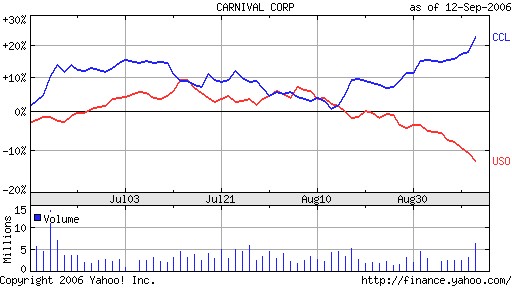
Fast forward six months to today, and you will notice things have changed. I was recently at the gas pump, and noticed that regular gas costs over $3 per gallon for the first time in a while. (Note that I live in Silicon Valley, California.) Below is what that same graph of CCL vs. USO looks like today.
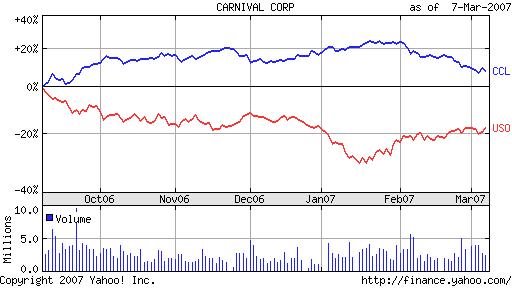
Do you see the inverse relationship? It might be a little hard to see in the chart, but USO reached a low of 42.56 on 1/18/07. Only one day later, on 1/19/07, the price of Carnival Corporation (CCL ) reached a peak of 52.73. Since January, these two charts have reversed course. Oil and gas are increasing in price, while the cruise lines have dropped in price. The North American cruise line industry includes Carnival Corporation, Royal Caribbean (NYSE:RCL), and Norwegian Cruise Lines.
To a lesser extent, the increase in oil prices affects the stock market as a whole as well. So, knowing this relationship is something that you can use to help guide your investments. At this time, I would predict that the cruise lines will drop in value until oil reverses course, or at least until oil prices start to stabilize.
Note: My posts about the cruise line industry are among the most popular posts here at PFStock. Many visitors were searching for information about how to get the shareholder onboard credit benefit offered to cruise line (Carnival Corporation and Royal Caribbean) stock holders. If this is what you are searching for, please read the details in my post about cruise line shareholder benefits for RCCL and Carnival stock holders.
PF Stock
Thursday, March 8, 2007
Daylight Saving Time Reminder
As a reminder, Daylight Saving Time starts this coming Sunday, March 11. I would be interested to know if anyone's VCR automatically adjusts since DST starts early this year.
PF Stock
PF Stock
Wednesday, March 7, 2007
Still Waiting for Windows Vista
A while ago, I had mentioned that I bought a new computer in order to secure a copy of Microsoft Windows Vista. The computer, which I bought back in November 2006, is a Compaq Presario SR2050NX and included the Windows XP MCE 2005 operating system. As part of the deal, I am supposed to receive Microsoft Windows Vista Home Premium from Hewlett-Packard (the parent company of Compaq) after Vista's release. Well, Windows Vista was released back in January. So, where is my free upgrade?
The last time that I checked the status of my Windows Vista order, it said that Vista would be shipped in March 2007. It seems like a while to wait, since I can already go out and buy a new computer with Vista running on it now. On the other hand, compared to the old Dell computer running Windows 98, this new desktop computer is a big improvement. My old computer used to crash on a daily basis.
Is anybody else (who bought a new computer in the last 3-4 months) still waiting for their free Vista upgrade?
PF Stock
The last time that I checked the status of my Windows Vista order, it said that Vista would be shipped in March 2007. It seems like a while to wait, since I can already go out and buy a new computer with Vista running on it now. On the other hand, compared to the old Dell computer running Windows 98, this new desktop computer is a big improvement. My old computer used to crash on a daily basis.
Is anybody else (who bought a new computer in the last 3-4 months) still waiting for their free Vista upgrade?
PF Stock
Tuesday, March 6, 2007
Telephone Tax Refund
Something new that I noticed on 2006 tax forms is a credit for the federal telephone excise tax. You can get back $30 to $60 as a credit depending on your number of exemptions. This is only available in 2006 to taxpayers who paid for long-distance telephone service between March 2003 and July 2006.
Although it seems like you are getting free money, the refund is due to a court decision which found that the excise tax (which has been on the books since 1898 to fund the Spanish-American War) no longer applies to telephone service today.
If you choose to you can actually add up all the federal excise taxes that you paid based on your old phone records. But, most people will take a standard refund amount, based on the number of personal exemptions that you claim. On Form 1040, this credit is claimed on line 71.
PF Stock
Although it seems like you are getting free money, the refund is due to a court decision which found that the excise tax (which has been on the books since 1898 to fund the Spanish-American War) no longer applies to telephone service today.
If you choose to you can actually add up all the federal excise taxes that you paid based on your old phone records. But, most people will take a standard refund amount, based on the number of personal exemptions that you claim. On Form 1040, this credit is claimed on line 71.
PF Stock
Friday, March 2, 2007
Volatility
Volatility is a integral part of the stock market. It is on days like these that we are all reminded of this fact. In actuality, the stock market has done well in the past year. The Dow Jones Industrial Average reached an all-time high of 12,845 only last week. The other major indices (S&P 500 and Nasdaq) have also posted respectable gains over the past year. For the Dow, this new high was followed by a drop of 416 points in one day.
What is a warning sign that the stock market is overvalued? In a word: exuberance. In the past few months, we have seen a constant growth of optimism among financial professionals and analysts. This optimism extends into the realm of personal finance blogs as well. Recently, there seems to be a constant new crop of enthusiastic new PF bloggers out there. Over the past few months, some bloggers have been writing that their portfolios have increased by 4-7% per month. These are quite impressive numbers indeed!
I can't help but get the feeling of deja vu when I compare what is happening now to the hi-tech (dot com) boom of the late 1990s. One blogger, who admits to not having a stock picking philosophy, tell us that he will turn $100k into a cool million over the next ten years. Another blogger scaled back the initial estimate of his net worth growth rate to only 30% per year. Even so, he'll be a millionaire in a little over 4 short years.
Early on in this blog, I wrote a post about me. In that post, I said that I feel the economy is much better now than it was in 2002. But I've learned not to get too overconfident, and to plan for the worst while hoping for the best.
In fact, during the last few months of 2006, I had sold off much of my stock holdings. And I found it very difficult to find new investments to buy. These are the ones that I think have a much greater chance of going up rather than of going down. While there are some exceptions, I think that most stocks are overvalued at this time.
Note that these are my views on the stock market. But regardless if the market goes up or down, it does not make me feel nervous or worried. Indeed, it used to. I imagine that most people who are invested in the stock market would feel a little queasy these days. But I now feel that either direction presents a new, different set of opportunities.
PF Stock
What is a warning sign that the stock market is overvalued? In a word: exuberance. In the past few months, we have seen a constant growth of optimism among financial professionals and analysts. This optimism extends into the realm of personal finance blogs as well. Recently, there seems to be a constant new crop of enthusiastic new PF bloggers out there. Over the past few months, some bloggers have been writing that their portfolios have increased by 4-7% per month. These are quite impressive numbers indeed!
I can't help but get the feeling of deja vu when I compare what is happening now to the hi-tech (dot com) boom of the late 1990s. One blogger, who admits to not having a stock picking philosophy, tell us that he will turn $100k into a cool million over the next ten years. Another blogger scaled back the initial estimate of his net worth growth rate to only 30% per year. Even so, he'll be a millionaire in a little over 4 short years.
Early on in this blog, I wrote a post about me. In that post, I said that I feel the economy is much better now than it was in 2002. But I've learned not to get too overconfident, and to plan for the worst while hoping for the best.
In fact, during the last few months of 2006, I had sold off much of my stock holdings. And I found it very difficult to find new investments to buy. These are the ones that I think have a much greater chance of going up rather than of going down. While there are some exceptions, I think that most stocks are overvalued at this time.
Note that these are my views on the stock market. But regardless if the market goes up or down, it does not make me feel nervous or worried. Indeed, it used to. I imagine that most people who are invested in the stock market would feel a little queasy these days. But I now feel that either direction presents a new, different set of opportunities.
PF Stock
Subscribe to:
Posts (Atom)






 Posts
Posts


