Previously, I wrote about collecting freebies at The Money Show and at the Hard Assets Conference (also known as the Gold and Precious Metals Investment Conference) in San Francisco. At the Hard Assets Conference held over this past weekend (Thanksgiving Weekend), I have discovered a new trend in freebies: USB (Universal Serial Bus) flash drives. For those who are not familiar with the technology, a USB flash drive is a portable computer memory that plugs into a computer USB port and can be used like a small hard disk. USB Flash drives are also known as thumb drives.
In the past, exhibitors have used a variety of media to get their messages across. Typically, they have used glossy brochures, and CD-ROMs containing information about their companies. Now, some companies have put their annual reports, company press releases, PowerPoint slides, and other data onto USB flash drives that they give away as freebies. I was able to snag a couple of these 512MB drives from a booth at the conference. My DW also got a free MP3 player for herself. In this case, the 256MB MP3 player also contained soft copies of company literature from the sponsoring firm. Of course, the casing of each USB flash memory is printed with the company logo, so it is unmistakably a freebie. After viewing the information on the USB flash drive, the memory can be re-used for whatever purpose the user wants.
I think this is a shrewd move on the part of the exhibitors. When their company literature was contained on a CD-ROM, I might choose not to view it. However, when the information is on a USB drive, I pretty much have to at least glance at it once (even if it is only to delete the data so that I can re-use the flash memory). With a bunch of new freebies in hand, I've chalked up another successful investment conference!
On a related topic, I also purchased the latest versions of H&R Block's TaxCut and Microsoft Money, this past weekend. I am getting started on taxes early this year. TaxCut also offers a version of their software on a reusable USB flash drive. But I got the regular version of TaxCut on CD-ROM since it is $10 cheaper. Also, I think that the flash drive has a pretty small capacity.
pfstock


Wednesday, November 29, 2006

Monday, November 27, 2006
Ameritrade's Unimpressive Site Upgrade
I have written before that I have both an original Ameritrade account and an original Waterhouse account. Ameritrade recently upgraded their web site. This "upgrade" was delayed for about a week with no reason given. Thus far, I'm thoroughly unimpressed with the new site.
So, where's the upgrade? I was expecting things like better online statements, easier to use account history, PDF views for my trade confirmations, and so on. Instead, the changes to the Ameritrade website are mostly cosmetic in nature -- mostly rearranging the menus, and changing the site color to green. I can't see any real improvement in functionality. Some features are either not improved, or even worse than before.
Take for example, the new stock screener. Here is a stock screen that I might put together: find all large cap stocks that are within 10% of their 52-week low. I couldn't figure out how to run this simple screen in the Ameritrade stock screener. Another thing is that the screener is no better than the free stock screens available at Yahoo Finance or MSN Money.
I use Standard and Poors (S&P) stock reports extensively for my personal research. However, the usual S&P reports available at the new Ameritrade site have somehow shrunk from 8 pages to 5 pages. I think that they cut out the three pages that include S&P's Sub-Industry Outlook, Company News, and Analysts' Recommendations from the abbreviated reports. Again, there's no explanation for the change.
As a former Waterhouse customer, I would qualify for Ameritrade APEX twice over based on my Waterhouse account balance. But after talking with Ameritrade customer service representatives about this, they were unwilling to upgrade me to APEX unless I transfer my funds from my original Waterhouse account to a new Ameritrade account. Logically, this is like saying that TD Ameritrade is one company, but you have to transfer your funds from one TD Ameritrade to another TD Ameritrade in order to get APEX access. Huh, what gives?
As a Waterhouse customer, I'm concerned now that Ameritrade will downgrade my account to a lower standard when they finally finish straightening out the mess they made. As I mentioned in my previous post, there are features that I particularly like in my Waterhouse account. Mainly, these features are access to IPOs and the cost basis calculator available through Waterhouse. Ameritrade doesn't keep track of cost basis for you, and instead the refers you to Gainskeeper which costs extra.
Ameritrade SPAM: I know that I am not the first person to write about getting SPAM at my Ameritrade Email address, as it has been reported by other PF bloggers. Like many others, I use a unique Email address for my Ameritrade account. This is accomplished through Yahoo's "AddressGuard" feature. In other words, the only entity that knows my Ameritrade Email address is Ameritrade itself. However, I have been getting spam at this address. Whenever this happens, I change my Email address to a new one, and delete the old Email address. This has happened three times already, as it seems that my Ameritrade Email address has been repeatedly compromised. I think that it is a security issue at the Ameritrade end, and I now have to delete yet another Email address. By contrast, the Email addresses that I use for Waterhouse and E*TRADE have never been compromised.
Ameritrade has been touting such features as Trade Triggers, but I'll tell you that the E*TRADE site has them beat there. However, I think E*TRADE's customer service is worse than Ameritrade's. Nevertheless, I now have a wait-and-see attitude on Ameritrade. But based on what I am seeing, I predict that E*TRADE might end up with a lot more business out of me in the future.
pfstock
So, where's the upgrade? I was expecting things like better online statements, easier to use account history, PDF views for my trade confirmations, and so on. Instead, the changes to the Ameritrade website are mostly cosmetic in nature -- mostly rearranging the menus, and changing the site color to green. I can't see any real improvement in functionality. Some features are either not improved, or even worse than before.
Take for example, the new stock screener. Here is a stock screen that I might put together: find all large cap stocks that are within 10% of their 52-week low. I couldn't figure out how to run this simple screen in the Ameritrade stock screener. Another thing is that the screener is no better than the free stock screens available at Yahoo Finance or MSN Money.
I use Standard and Poors (S&P) stock reports extensively for my personal research. However, the usual S&P reports available at the new Ameritrade site have somehow shrunk from 8 pages to 5 pages. I think that they cut out the three pages that include S&P's Sub-Industry Outlook, Company News, and Analysts' Recommendations from the abbreviated reports. Again, there's no explanation for the change.
As a former Waterhouse customer, I would qualify for Ameritrade APEX twice over based on my Waterhouse account balance. But after talking with Ameritrade customer service representatives about this, they were unwilling to upgrade me to APEX unless I transfer my funds from my original Waterhouse account to a new Ameritrade account. Logically, this is like saying that TD Ameritrade is one company, but you have to transfer your funds from one TD Ameritrade to another TD Ameritrade in order to get APEX access. Huh, what gives?
As a Waterhouse customer, I'm concerned now that Ameritrade will downgrade my account to a lower standard when they finally finish straightening out the mess they made. As I mentioned in my previous post, there are features that I particularly like in my Waterhouse account. Mainly, these features are access to IPOs and the cost basis calculator available through Waterhouse. Ameritrade doesn't keep track of cost basis for you, and instead the refers you to Gainskeeper which costs extra.
Ameritrade SPAM: I know that I am not the first person to write about getting SPAM at my Ameritrade Email address, as it has been reported by other PF bloggers. Like many others, I use a unique Email address for my Ameritrade account. This is accomplished through Yahoo's "AddressGuard" feature. In other words, the only entity that knows my Ameritrade Email address is Ameritrade itself. However, I have been getting spam at this address. Whenever this happens, I change my Email address to a new one, and delete the old Email address. This has happened three times already, as it seems that my Ameritrade Email address has been repeatedly compromised. I think that it is a security issue at the Ameritrade end, and I now have to delete yet another Email address. By contrast, the Email addresses that I use for Waterhouse and E*TRADE have never been compromised.
Ameritrade has been touting such features as Trade Triggers, but I'll tell you that the E*TRADE site has them beat there. However, I think E*TRADE's customer service is worse than Ameritrade's. Nevertheless, I now have a wait-and-see attitude on Ameritrade. But based on what I am seeing, I predict that E*TRADE might end up with a lot more business out of me in the future.
pfstock
Wednesday, November 22, 2006
Hard Assets 06: San Francisco
I had previously written about the San Francisco Money Show, which is held each fall at the downtown San Francisco Marriott Hotel. There is a second investment conference that is held each year at the same hotel. This year the theme is "Hard Assets". While the carnival atmosphere of the Money Show is retained at this show, the subject matter usually focuses on precious metals, mining, oil, and gas.
Many of the exhibitors in the investment conference are foreign mining companies. These are largely listed on the Canadian stock exchanges, most notably the Toronto Stock Exchange (the TSX). Unfortunately, a large share of these stocks are penny stocks of questionable quality. For a few years, there were a lot of dotcom exhibitors, and even mining companies that actually became dotcoms to feed off of the associated hype. This came at a time when the prices for gold, oil, and other commodities were depressed.
Among the speakers at the conference, one stands out among the crowd: James Dines. This flamboyant individual has been touting something every year since about the late 1960s, whether it is gold, dotcom stocks, or his current favorite, uranium. Mr. Dines is the publisher of The Dines Letter, and the author of the book Mass Psychology. I haven't had the opportunity to read the latter, though. His booth is typically rimmed by half a dozen blond, blue-eyed assistants that could politely be referred to as bimbos. And you wouldn't expect anything less from a man whose motto is "Always travel first class, because if you don't, your heirs will!" At any rate, his seminar is usually well attended and very entertaining, to say the least.
Just like at the Money Show, this investment conference also offers an array of freebies. Over the years I've been able to snag several tote bags, caps, and keychains. I have one titanium keychain that was offered by a titanium mining company, and I have another one that includes a flashlight and looks like a miniature miner's hat. Hard Assets '06 is held November 26-27 this year.
pfstock
Many of the exhibitors in the investment conference are foreign mining companies. These are largely listed on the Canadian stock exchanges, most notably the Toronto Stock Exchange (the TSX). Unfortunately, a large share of these stocks are penny stocks of questionable quality. For a few years, there were a lot of dotcom exhibitors, and even mining companies that actually became dotcoms to feed off of the associated hype. This came at a time when the prices for gold, oil, and other commodities were depressed.
Among the speakers at the conference, one stands out among the crowd: James Dines. This flamboyant individual has been touting something every year since about the late 1960s, whether it is gold, dotcom stocks, or his current favorite, uranium. Mr. Dines is the publisher of The Dines Letter, and the author of the book Mass Psychology. I haven't had the opportunity to read the latter, though. His booth is typically rimmed by half a dozen blond, blue-eyed assistants that could politely be referred to as bimbos. And you wouldn't expect anything less from a man whose motto is "Always travel first class, because if you don't, your heirs will!" At any rate, his seminar is usually well attended and very entertaining, to say the least.
Just like at the Money Show, this investment conference also offers an array of freebies. Over the years I've been able to snag several tote bags, caps, and keychains. I have one titanium keychain that was offered by a titanium mining company, and I have another one that includes a flashlight and looks like a miniature miner's hat. Hard Assets '06 is held November 26-27 this year.
pfstock
Saturday, November 18, 2006
David Bach: 90% Good, 10% Evil
A lot of good things have been said about David Bach, author of The Automatic Millionaire. I do think that his work is largely good, and a lot of good things have been said about him. His book is especially helpful for those who are just starting to pull themselves out of debt, and starting to build on their savings. I won't repeat the positive things that have already been said. Instead, I'm going to focus on what I don't like about his books.
First of all, Bach has a way of oversimplifying things. Throughout the book, he uses examples of how you will end up with an astronomical amount of money, if you stop buying coffee drinks, and invest the money at a 10% annual return. Of course, he doesn't really tell you where you can get the 10% annual return. He dances around the issue in his book, and mentions a bunch of brokerages and mutual funds, but I don't see any one of them guaranteeing a 10% annual return.
Like many popular financial writers today, Bach's book reads like an advertisement. Indeed The Automatic Millionaire contains 5 full pages of advertisements for his website, his other books, and his 10 CD set for the complete Automatic Millionaire Audio System. And, did you realize that Bach trademarked the term "The Latte Factor (TM)"? Boy, I hope I don't owe Bach royalties for writing this post.
Aside from this, nothing irks me more than Bach's three paragraphs covering the term "leverage". In this one section, Bach describes buying a $250,000 home with $50,000 down. He states that if the home's value goes up to $300,000, then the investor has doubled his money. Fair enough. But, he goes on to finish the section with the following paragraph.
Talk about glittering generalities! In any responsible coverage of the topic of leverage, the author would explain that leverage is a double-edged sword. While one can make outsized profits in an up market, one's loss could also be multiplied in a down market. In the stock market, the parallel example is buying stocks on margin. In this case, you are using leverage in the hopes of making multiplied gains when the stock market goes up. On the other hand, if the stock goes down, you could lose your entire investment and more.
Bach doesn't even mention the potential downside of leverage anywhere in his 240 page book; he only discusses the upside. I think that David Bach's omission here is at best irresponsible, and at worst criminal. While the term criminal may be a harsh assessment of The Automatic Millionaire, it is nonetheless accurate. You may have noticed that mutual fund prospectuses have a statement that goes something like this:
Do you know why mutual funds are required by government regulators to print this in their prospectuses? That's because it's true! You can't make the assumption that if an investment is increasing in value at a certain rate, that it will continue to do that in the future. Similarly, you can't just assume that if the stock market has returned an average of 10% for several years, that it will only continue to do that in the future. Clearly, Bach is strongly implying that buying a home in this already overheated market is a great investment. And at that, he is peddling his advice to those who are least likely to know any better.
Anyway, so much for David Bach. As I have said, his material is pretty good for people who are just starting to pull themselves out of debt. I will say that his books do contain about 90% good advice. It is the other 10% that I have issues with.
Clearly, though, there are better personal finance books available. I would recommend a couple time-tested classics. My first recommendation is The Richest Man in Babylon, by George Clason. The second book is The Wealthy Barber by David Chilton. These books have a far better track record that Bach, and I think that they will better withstand the test of time.
pfstock
First of all, Bach has a way of oversimplifying things. Throughout the book, he uses examples of how you will end up with an astronomical amount of money, if you stop buying coffee drinks, and invest the money at a 10% annual return. Of course, he doesn't really tell you where you can get the 10% annual return. He dances around the issue in his book, and mentions a bunch of brokerages and mutual funds, but I don't see any one of them guaranteeing a 10% annual return.
Like many popular financial writers today, Bach's book reads like an advertisement. Indeed The Automatic Millionaire contains 5 full pages of advertisements for his website, his other books, and his 10 CD set for the complete Automatic Millionaire Audio System. And, did you realize that Bach trademarked the term "The Latte Factor (TM)"? Boy, I hope I don't owe Bach royalties for writing this post.
Aside from this, nothing irks me more than Bach's three paragraphs covering the term "leverage". In this one section, Bach describes buying a $250,000 home with $50,000 down. He states that if the home's value goes up to $300,000, then the investor has doubled his money. Fair enough. But, he goes on to finish the section with the following paragraph.
Over the last five years, many homes have doubled in price. Think of
what this means in terms of leverage. If you invested $50,000 in a
$250,000 home five years ago and it's now worth $500,000, you've made $250,000 on a $50,000 investment. In investment circles, that's called a five-bagger -- an amazing 500 percent return on your money.
Talk about glittering generalities! In any responsible coverage of the topic of leverage, the author would explain that leverage is a double-edged sword. While one can make outsized profits in an up market, one's loss could also be multiplied in a down market. In the stock market, the parallel example is buying stocks on margin. In this case, you are using leverage in the hopes of making multiplied gains when the stock market goes up. On the other hand, if the stock goes down, you could lose your entire investment and more.
Bach doesn't even mention the potential downside of leverage anywhere in his 240 page book; he only discusses the upside. I think that David Bach's omission here is at best irresponsible, and at worst criminal. While the term criminal may be a harsh assessment of The Automatic Millionaire, it is nonetheless accurate. You may have noticed that mutual fund prospectuses have a statement that goes something like this:
Past performance is not an indication of future performance.
Do you know why mutual funds are required by government regulators to print this in their prospectuses? That's because it's true! You can't make the assumption that if an investment is increasing in value at a certain rate, that it will continue to do that in the future. Similarly, you can't just assume that if the stock market has returned an average of 10% for several years, that it will only continue to do that in the future. Clearly, Bach is strongly implying that buying a home in this already overheated market is a great investment. And at that, he is peddling his advice to those who are least likely to know any better.
Anyway, so much for David Bach. As I have said, his material is pretty good for people who are just starting to pull themselves out of debt. I will say that his books do contain about 90% good advice. It is the other 10% that I have issues with.
Clearly, though, there are better personal finance books available. I would recommend a couple time-tested classics. My first recommendation is The Richest Man in Babylon, by George Clason. The second book is The Wealthy Barber by David Chilton. These books have a far better track record that Bach, and I think that they will better withstand the test of time.
pfstock
Tuesday, November 14, 2006
Ameritrade's "Hidden" Cash Sweep Account
Ameritrade has a cash sweep option called the Total Asset Plan (TAP) which offers a significantly higher interest rate on cash than the default Ameritrade cash sweep option. When you first setup an Ameritrade account, you are put into a cash sweep option that pays less than 1% interest. By contrast, as a participant in the TAP, the cash sweep is offered through money market funds at "The Reserve" (website: ther.com). There are a variety of taxable and tax-free money funds available. For example, the taxable Primary Money Market fund pays about 4.4%. Personally, I chose the California Tax-Exempt fund which pays about 2.4%.
But, don't go looking for the Total Asset Plan on the Ameritrade website; it's not there. In order to setup this account, I needed to talk to a customer service representative. In fact, I would not have even known that the TAP option existed without speaking to a real person at Ameritrade. I don't know why they keep the TAP a secret from most investors.
Lastly, having gone through the application process once, I now know where to find the TAP application on the Internet. However, since this is a "hidden" option (that Ameritrade doesn't want the average person to know about), I would suggest calling Ameritrade to inquire about it.
pfstock
But, don't go looking for the Total Asset Plan on the Ameritrade website; it's not there. In order to setup this account, I needed to talk to a customer service representative. In fact, I would not have even known that the TAP option existed without speaking to a real person at Ameritrade. I don't know why they keep the TAP a secret from most investors.
Lastly, having gone through the application process once, I now know where to find the TAP application on the Internet. However, since this is a "hidden" option (that Ameritrade doesn't want the average person to know about), I would suggest calling Ameritrade to inquire about it.
pfstock
Friday, November 10, 2006
Buying an IPO: Free Money
I had previously mentioned the Bare Escentuals IPO (Nasdaq: BARE) that I received from my stock broker, Waterhouse. Since most people are probably not familiar with the process of getting Initial Public Offering (IPO) shares, I thought that I would write an overview of the process. My caution here is that I am not an expert. IPOs represent an added layer of risk that many investors are not willing to take. Nevertheless, if one is willing to "invest" the time to understand the IPO process, and more importantly the companies in which you are investing, buying IPOs can be a relatively low-risk venture that is like getting free money.
First of all, there are two online brokers that I use which offer IPO shares. These are Waterhouse, and E*TRADE. Of course, there are other brokers that offer IPOs, but I'm not yet involved with them. I recently found that Fidelity offers IPOs. However, their minimum requirement of $500,000 in a Fidelity account makes that venture prohibitive for most people.
The first step in getting an IPO is passing an eligibility questionnaire. You will be asked questions about your income, your liquid net worth (excluding the value of your primary residence), your investment experience, and your investment objective. My only advice here is to be honest when answering the questions.
Once you pass the IPO eligibility questionnaire, the next stage is to wait until the broker announces that they are taking conditional offers on a new IPO. At that time, you should go to the broker website, read (or at least skim) through the prospectus, and place a conditional offer. In general, a conditional offer is placed in multiples of 100 shares, and you will indicate the maximum number of shares you are willing to buy at the offer price. Up to this point, you are not under any obligation to buy the IPO shares, and may cancel your offer up until the allocation phase. However, it is your responsibility to read and understand the "risk factors" that are listed in the prospectus.
Next comes the pricing (if the IPO is not withdrawn). Note that pricing occurs after hours on the day before the IPO begins trading. You will be asked to confirm your conditional offer (usually by midnight of the same day). This step is very important! You have to make the decision at this point if the IPO is one that you really want to participate in. If you decide that you don't want the IPO, you can still cancel at this time. Warning: not all IPOs go up, so choose carefully! I cannot overemphasize this point: buying an IPO can involve significant risk.
The last stage is the allocation phase, which occurs in the early morning hours on the day that the IPO begins trading. Here you will be randomly allocated shares based on the level of interest in the IPO. However, I estimate that 80-90% of the time, I was not allocated any shares after completing this whole procedure. In practice, I have usually placed conditional orders for 200-300 shares of a new IPO, and have been allocated either 100 shares or nothing.
In the case of Bare Escentuals, the IPO priced on Thursday, September 28 at $22 per share. I placed an order for 300 shares, and was allocated 100 shares. It began trading on Friday, September 29 when it closed at 27.15. I later sold the stock at $30, and made a profit of $800.
As with any investment, I advise you to do some outside research of the companies that you are potentially investing it. Two resources I use to gather information about new IPOs are IPOhome and MarketWatch. Please use these resources before you invest. One last note, sometimes you will see what is called a secondary offering for stocks that are already being traded on a stock exchange. I generally avoid these because the potential for quick gains is not as good.
In summary, buying an IPO can be a big hassle, and you most likely won't even get any IPO shares in the end. But if you play the IPO game right (and avoid poor quality IPOs), you can end up with an almost certain profit. It is like getting free money.
pfstock
First of all, there are two online brokers that I use which offer IPO shares. These are Waterhouse, and E*TRADE. Of course, there are other brokers that offer IPOs, but I'm not yet involved with them. I recently found that Fidelity offers IPOs. However, their minimum requirement of $500,000 in a Fidelity account makes that venture prohibitive for most people.
The first step in getting an IPO is passing an eligibility questionnaire. You will be asked questions about your income, your liquid net worth (excluding the value of your primary residence), your investment experience, and your investment objective. My only advice here is to be honest when answering the questions.
Once you pass the IPO eligibility questionnaire, the next stage is to wait until the broker announces that they are taking conditional offers on a new IPO. At that time, you should go to the broker website, read (or at least skim) through the prospectus, and place a conditional offer. In general, a conditional offer is placed in multiples of 100 shares, and you will indicate the maximum number of shares you are willing to buy at the offer price. Up to this point, you are not under any obligation to buy the IPO shares, and may cancel your offer up until the allocation phase. However, it is your responsibility to read and understand the "risk factors" that are listed in the prospectus.
Next comes the pricing (if the IPO is not withdrawn). Note that pricing occurs after hours on the day before the IPO begins trading. You will be asked to confirm your conditional offer (usually by midnight of the same day). This step is very important! You have to make the decision at this point if the IPO is one that you really want to participate in. If you decide that you don't want the IPO, you can still cancel at this time. Warning: not all IPOs go up, so choose carefully! I cannot overemphasize this point: buying an IPO can involve significant risk.
The last stage is the allocation phase, which occurs in the early morning hours on the day that the IPO begins trading. Here you will be randomly allocated shares based on the level of interest in the IPO. However, I estimate that 80-90% of the time, I was not allocated any shares after completing this whole procedure. In practice, I have usually placed conditional orders for 200-300 shares of a new IPO, and have been allocated either 100 shares or nothing.
In the case of Bare Escentuals, the IPO priced on Thursday, September 28 at $22 per share. I placed an order for 300 shares, and was allocated 100 shares. It began trading on Friday, September 29 when it closed at 27.15. I later sold the stock at $30, and made a profit of $800.
As with any investment, I advise you to do some outside research of the companies that you are potentially investing it. Two resources I use to gather information about new IPOs are IPOhome and MarketWatch. Please use these resources before you invest. One last note, sometimes you will see what is called a secondary offering for stocks that are already being traded on a stock exchange. I generally avoid these because the potential for quick gains is not as good.
In summary, buying an IPO can be a big hassle, and you most likely won't even get any IPO shares in the end. But if you play the IPO game right (and avoid poor quality IPOs), you can end up with an almost certain profit. It is like getting free money.
pfstock
Thursday, November 9, 2006
NetBank Increases MMA Rates
After nearly a year, NetBank (Nasdaq: NTBK) has finally raised its interest rates on money market accounts for existing customers from 2.90% to 2.99% APY. Although this rate is much below what its competitors are offering, it shows NetBank's willingness to move in the right direction. Honestly, I thought that this day would never come! This is an impressive 0.09% increase! Imagine that if you have $10,000 deposited with NetBank, that would work out to an incredible $0.75 per month or $9 more per year. I'm absolutely flabbergasted by the immense generosity of the folks at NetBank. For once, I'm speechless...
pfstock
Prior posts about NetBank (Nasdaq: NTBK):
Sayonara NetBank
More on NetBank
Unprofitable and Unstable NetBank
pfstock
Prior posts about NetBank (Nasdaq: NTBK):
Sayonara NetBank
More on NetBank
Unprofitable and Unstable NetBank
Tuesday, November 7, 2006
Internet Explorer 7
This past weekend I upgraded my browser to Internet Explorer 7 (IE7) by Microsoft. This upgrade is only available for legitimate owners of Microsoft Windows XP and Windows Server 2003. Some of the new features that I like in the new IE7 are tabbed browsing, a customizable search box on the right side of the address bar, and a shrink-to-fit feature for printing wide webpages. In Internet Explorer 6 (IE6), many webpages had to be rotated (or the right side was cut off), and thus wasted lots of paper.
But, what I like the best about the new IE7 browser is the ability to read RSS feeds (i.e. XML) directly. For example. The URL of the RSS feed for this blog is
pfstock.blogspot.com/rss.xml. This usually appears as gibberish in older browsers, but is formatted quite nicely in IE7. It includes all of the links, and if the blog is broken out into categories, you can filter posts by category. I think that this will be most useful when reading blogs that choose to load down their site with advertising. I am not opposed to ads, since I have a few on my own site. However, when a site has ads on the top, left column, right column, in-between posts, and so on, it gets a little out of hand...
I have noted a couple of issues with IE7 that will affect PF bloggers. In Blogger, there is a preview function on the "edit posts" page that lets you view a post without going into the editor. This doesn't work in IE7. And at pfblogs.org, clicking on "all" underneath "Today's active weblogs" will open a search panel on the left side that contains a list of all available blogs. This doesn't work in IE7, as it will open the list in a new window. There are various other websites that I've seen where parts of the text or images are cropped off, or don't display the same as they did in IE6. In the some cases, there are parts of the webpage that you can't read.
In a twist of irony, there isn't a way to run IE7 and IE6 on same computer. This will force me to install a competing browser, Firefox, on my machine in order to view the websites that are "broken" in IE7. This is probably not Microsoft's original intent.
On a related topic, I recently installed a Site Meter on this blog. This is basically a web counter that keeps track of a few different statistics including browser share. For this blog, a slim majority of the readers use Internet Explorer, with IE7 representing about 5%. (I expect that percentage to grow in the future.) About a third of the readers use the Firefox browser. (But I think that most of this fraction is actually one reader who visits frequently.) The rest use miscellaneous other browsers like Safari, Opera, Netscape, and Mozilla.
If you are curious, I have kept the statistics on my Site Meter public. Just scroll down to the very bottom of this page and click on the Site Meter icon.
pfstock
But, what I like the best about the new IE7 browser is the ability to read RSS feeds (i.e. XML) directly. For example. The URL of the RSS feed for this blog is
pfstock.blogspot.com/rss.xml. This usually appears as gibberish in older browsers, but is formatted quite nicely in IE7. It includes all of the links, and if the blog is broken out into categories, you can filter posts by category. I think that this will be most useful when reading blogs that choose to load down their site with advertising. I am not opposed to ads, since I have a few on my own site. However, when a site has ads on the top, left column, right column, in-between posts, and so on, it gets a little out of hand...
I have noted a couple of issues with IE7 that will affect PF bloggers. In Blogger, there is a preview function on the "edit posts" page that lets you view a post without going into the editor. This doesn't work in IE7. And at pfblogs.org, clicking on "all" underneath "Today's active weblogs" will open a search panel on the left side that contains a list of all available blogs. This doesn't work in IE7, as it will open the list in a new window. There are various other websites that I've seen where parts of the text or images are cropped off, or don't display the same as they did in IE6. In the some cases, there are parts of the webpage that you can't read.
In a twist of irony, there isn't a way to run IE7 and IE6 on same computer. This will force me to install a competing browser, Firefox, on my machine in order to view the websites that are "broken" in IE7. This is probably not Microsoft's original intent.
On a related topic, I recently installed a Site Meter on this blog. This is basically a web counter that keeps track of a few different statistics including browser share. For this blog, a slim majority of the readers use Internet Explorer, with IE7 representing about 5%. (I expect that percentage to grow in the future.) About a third of the readers use the Firefox browser. (But I think that most of this fraction is actually one reader who visits frequently.) The rest use miscellaneous other browsers like Safari, Opera, Netscape, and Mozilla.
If you are curious, I have kept the statistics on my Site Meter public. Just scroll down to the very bottom of this page and click on the Site Meter icon.
pfstock
Saturday, November 4, 2006
Nasdaq-100 May Be Reaching a Top
I wanted to take the opportunity to mention the Nasdaq-100 and Exchange Traded Funds (ETFs). ETFs are like Index Mutual Funds; however, they are traded like stocks. Until this past week, I had been holding shares of an ETF called Nasdaq-100 Tracking Stock (Nasdaq: QQQQ) which I purchased back in July (before I started PFStock). As an ETF, QQQQ is broadly positioned with 100 of the largest Nasdaq companies as its components.
Some of my investment decisions are based on technical analysis (i.e. looking at the chart) of an investment. The recent run-up of QQQQ is a nearly picture perfect example of how to buy into an uptrend. Here is a 6-month price chart of QQQQ (click to enlarge):
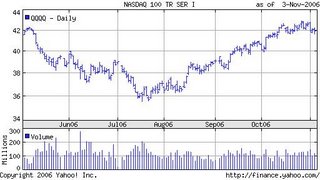
As I had mentioned, I first purchased QQQQ in July. From the chart, you can see that QQQQ hit a low in July. Low price alone is generally not enough of a reason to justify buying a stock. I waited until almost the end of July, when QQQQ was starting into an uptrend before buying. From there, I've held on until this past week. You can see that stock price has seen some dips along the way, which might stop out some traders.
Currently, the Nasdaq-100 Index is starting to encounter some resistance after this prolonged uptrend. If you look at the very end of the QQQQ chart for the past several days, you can see some recent weakness.
Although QQQQ may continue to climb, and I have closed out my position in QQQQ. This doesn't necessarily mean that I think that QQQQ is going to drop. However, I'm pretty confident that we won't be seeing the same kind of increase in QQQQ that we have in the past three months. QQQQ is near a 52-week high again, and has entered a volatile phase where it might be risky to take either a long or short position.
My opinion is that the safe thing to do now is to take profits. These are a certainty, and it is perhaps time to look for other investment opportunities. I will caution you, though, that I have a tendency to sell a little bit early.
pfstock
Some of my investment decisions are based on technical analysis (i.e. looking at the chart) of an investment. The recent run-up of QQQQ is a nearly picture perfect example of how to buy into an uptrend. Here is a 6-month price chart of QQQQ (click to enlarge):
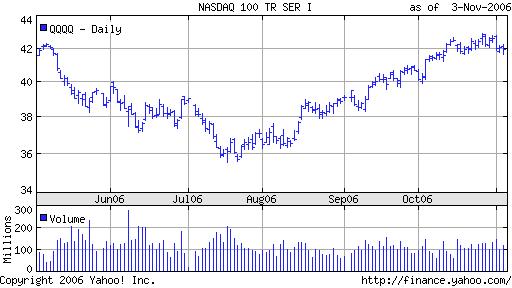
As I had mentioned, I first purchased QQQQ in July. From the chart, you can see that QQQQ hit a low in July. Low price alone is generally not enough of a reason to justify buying a stock. I waited until almost the end of July, when QQQQ was starting into an uptrend before buying. From there, I've held on until this past week. You can see that stock price has seen some dips along the way, which might stop out some traders.
Currently, the Nasdaq-100 Index is starting to encounter some resistance after this prolonged uptrend. If you look at the very end of the QQQQ chart for the past several days, you can see some recent weakness.
Although QQQQ may continue to climb, and I have closed out my position in QQQQ. This doesn't necessarily mean that I think that QQQQ is going to drop. However, I'm pretty confident that we won't be seeing the same kind of increase in QQQQ that we have in the past three months. QQQQ is near a 52-week high again, and has entered a volatile phase where it might be risky to take either a long or short position.
My opinion is that the safe thing to do now is to take profits. These are a certainty, and it is perhaps time to look for other investment opportunities. I will caution you, though, that I have a tendency to sell a little bit early.
pfstock
Thursday, November 2, 2006
Annoyed
I had written before that I found a web site that used snippets of text that were literally stolen from this blog for what is called a "Made for Adsense" advertising site. I've now identified other similar sites and one particular site that has copied my entire entry on Resources for Early Retirement, verbatim. Again, there was no attribution to my blog or any link back to this blog from that site. Others whose stolen material appears on this site include 2million, John Greaney, Suze Orman, and other bloggers. It appears that the sole purpose of that web site is to earn revenue from junk ads that appear there.
Annoyed is perhaps an understatement of my feelings. Someone else is making money off of the material that I wrote here, and I feel that this is a violation of trust to say the least. I created PFStock with the genuine intention of giving others my insights in the areas of personal finance and stock investing. I had never expected my writing to be plagiarized in this way. I sought assistance from Google, the owner of Adsense, but they have been useless in helping combat this problem. And why should they be? After all, Google makes money from these sites that steal copyrighted material from others. Considering these events, I am now seriously considering ending the publication of this blog.
Update: On the advice of JLP from AllFinancialMatters, I Emailed a cease-and-desist letter to the owner of the offending website. In the end, the offending website was removed. But, I am still annoyed by the whole situation.
pfstock
Annoyed is perhaps an understatement of my feelings. Someone else is making money off of the material that I wrote here, and I feel that this is a violation of trust to say the least. I created PFStock with the genuine intention of giving others my insights in the areas of personal finance and stock investing. I had never expected my writing to be plagiarized in this way. I sought assistance from Google, the owner of Adsense, but they have been useless in helping combat this problem. And why should they be? After all, Google makes money from these sites that steal copyrighted material from others. Considering these events, I am now seriously considering ending the publication of this blog.
Update: On the advice of JLP from AllFinancialMatters, I Emailed a cease-and-desist letter to the owner of the offending website. In the end, the offending website was removed. But, I am still annoyed by the whole situation.
pfstock
Saturday, October 28, 2006
More Links for Early Retirement
Akaisha and Billy Kaderli are the couple that I mentioned in my previous post about early retirement. Akaisha has asked me to post a link to their favorite websites. Among the links that they have listed, the ones near the top of the page are the most useful for those considering early retirement. Toward the bottom page are links that are related to their travels, mostly in Southeast Asia.
Akaisha and Billy have recently been profiled in the October 2006 issue of Kiplinger's Personal Finance magazine. According to this article, the couple has been able to keep their expenses very low -- about $24,000 per year. They maintain a diversified portfolio of mostly stock index funds. And they withdraw only about 3% a year from this stash.
For people considering early retirement, a question that would be interesting to ask is do you think that you could live off $24,000 a year? Here in Silicon Valley, I would say that it would be very difficult to retire on that amount, without moving to a less expensive area. Interestingly, the couple used to live in California, but have now setup residence in Arizona.
I also wanted to acknowledge that fin_indie has mentioned pfstock on his Retiring Early blog. His post expands on the mine by describing the main boards on the Early Retirement Forum, which I mentioned before. He has promised to provide some more of his insights of what he has learned from "actively lurking" on the retirement forums.
Updates:
Early Retirement Housing
pfstock
Akaisha and Billy have recently been profiled in the October 2006 issue of Kiplinger's Personal Finance magazine. According to this article, the couple has been able to keep their expenses very low -- about $24,000 per year. They maintain a diversified portfolio of mostly stock index funds. And they withdraw only about 3% a year from this stash.
For people considering early retirement, a question that would be interesting to ask is do you think that you could live off $24,000 a year? Here in Silicon Valley, I would say that it would be very difficult to retire on that amount, without moving to a less expensive area. Interestingly, the couple used to live in California, but have now setup residence in Arizona.
I also wanted to acknowledge that fin_indie has mentioned pfstock on his Retiring Early blog. His post expands on the mine by describing the main boards on the Early Retirement Forum, which I mentioned before. He has promised to provide some more of his insights of what he has learned from "actively lurking" on the retirement forums.
Updates:
Early Retirement Housing
pfstock
Tuesday, October 24, 2006
Comparing Online Brokers
The main online brokerages that I use are TD Ameritrade and E*TRADE. I actually had both an original Waterhouse account and an original Ameritrade account before their merger. For all intents and purposes, however, TD Ameritrade is still really two separate brokerages. I will give my opinion of each broker.
Each account that I have has its pluses and minuses. I still prefer to use my original Waterhouse account for most trades. There are some features that Waterhouse still offers that Ameritrade does not. These are access to IPOs, and a better selection of cash sweep accounts. In fact, I got my recent shares in the Bare Escentuals IPO (Nasdaq: BARE) from Waterhouse. However, as far as I know, you can no longer apply for a new Waterhouse brokerage account.
I think that E*TRADE has a better website overall than either Ameritrade or Waterhouse. However, their customer service is not as good. The E*TRADE site doesn't have a tear away "snap ticker" like either Ameritrade or Waterhouse. This makes it harder to look at real time quotes from the main website. The E*TRADE website also provides access to IPOs, and has a decent streamer (for streaming real-time quotes).
Comparing Ameritrade to E*TRADE, I think that Ameritrade has a better streamer. One annoyance that I have found is that Ameritrade doesn't keep track of your capital gains and losses. They say that "the calculation of gains and losses the responsibility of the taxpayer, so TD AMERITRADE does not provide this information." The truth is that I don't rely on this information to calculate taxes, but it is nice to be able to see it to quickly gauge my gains for the year.
As far as commissions are concerned, Ameritrade and Waterhouse are generally a little bit cheaper than E*TRADE. However, I stopped paying attention to commissions when they dropped below $20 per trade. The difference of few dollars is not a big deal.
All three brokerages have access to research such as Standard & Poors (S&P) and Morningstar stock reports. I do use S&P stock reports extensively to do some of my initial research when selecting new stocks to buy.
pfstock
Each account that I have has its pluses and minuses. I still prefer to use my original Waterhouse account for most trades. There are some features that Waterhouse still offers that Ameritrade does not. These are access to IPOs, and a better selection of cash sweep accounts. In fact, I got my recent shares in the Bare Escentuals IPO (Nasdaq: BARE) from Waterhouse. However, as far as I know, you can no longer apply for a new Waterhouse brokerage account.
I think that E*TRADE has a better website overall than either Ameritrade or Waterhouse. However, their customer service is not as good. The E*TRADE site doesn't have a tear away "snap ticker" like either Ameritrade or Waterhouse. This makes it harder to look at real time quotes from the main website. The E*TRADE website also provides access to IPOs, and has a decent streamer (for streaming real-time quotes).
Comparing Ameritrade to E*TRADE, I think that Ameritrade has a better streamer. One annoyance that I have found is that Ameritrade doesn't keep track of your capital gains and losses. They say that "the calculation of gains and losses the responsibility of the taxpayer, so TD AMERITRADE does not provide this information." The truth is that I don't rely on this information to calculate taxes, but it is nice to be able to see it to quickly gauge my gains for the year.
As far as commissions are concerned, Ameritrade and Waterhouse are generally a little bit cheaper than E*TRADE. However, I stopped paying attention to commissions when they dropped below $20 per trade. The difference of few dollars is not a big deal.
All three brokerages have access to research such as Standard & Poors (S&P) and Morningstar stock reports. I do use S&P stock reports extensively to do some of my initial research when selecting new stocks to buy.
pfstock
Wednesday, October 18, 2006
Resources for Early Retirement
I think that many people can admit to fantasies of an early retirement. I know that I have had more than a few daydreams about the subject.
Over the years I have found a few really good resources (and many more really bad ones) to seek advice on early retirement. I think that the best resources are actual people who have retired early and are willing to share their thoughts.
I have found a few common themes among those who have retired early:
1) Living below your means (LBYM).
2) Maintaining a diversified investment portfolio on which to draw from.
3) Using a conservative 4% rule of thumb as a baseline for withdrawing from your retirement savings.
Since I am not retired (yet), I'll refer you to my sources for more information.
Books:
How to Retire Early and Live Well by Gillette Edmunds focuses on building a diversified portfolio on which to draw living expenses from.
Retire Early and Live the Life You Want Now by John F. Wasik is a very good all around reference on early retirement.
Cashing in on the American Dream by Paul Terhorst focuses on reducing expenses, and advocates selling your house, and moving to a less expensive residence, to finance an early retirement. Unfortunately this book is out of print, but might be available at some libraries.
Websites:
The Retire Early Homepage is maintained by John P. Greaney, an engineer who retired at age 38. This site gives a lot of general information about early retirement. He strongly cautions against retiring too early when your savings aren't really enough to sustain you for the rest of your life. I think that some of his older material is of more practical use than the more recent entries.
Early Retirement Forum is a message board for those who have retired early, and those who intend to. There are various forum topics broken out by the stages of planning for an early retirement.
Retire Early Lifestyle is an inspirational website by a couple who retired in their 30s. They spend a lot of time traveling the world, and are able to keep their expenses amazingly low. They also have an e-book available on CD-ROM which I recently purchased.
One last note, on the Internet, you may come across the acronym FIRE which stands for Financial Independence Retire Early.
Updates:
More Links for Early Retirement
Early Retirement Housing
pfstock
Over the years I have found a few really good resources (and many more really bad ones) to seek advice on early retirement. I think that the best resources are actual people who have retired early and are willing to share their thoughts.
I have found a few common themes among those who have retired early:
1) Living below your means (LBYM).
2) Maintaining a diversified investment portfolio on which to draw from.
3) Using a conservative 4% rule of thumb as a baseline for withdrawing from your retirement savings.
Since I am not retired (yet), I'll refer you to my sources for more information.
Books:
How to Retire Early and Live Well by Gillette Edmunds focuses on building a diversified portfolio on which to draw living expenses from.
Retire Early and Live the Life You Want Now by John F. Wasik is a very good all around reference on early retirement.
Cashing in on the American Dream by Paul Terhorst focuses on reducing expenses, and advocates selling your house, and moving to a less expensive residence, to finance an early retirement. Unfortunately this book is out of print, but might be available at some libraries.
Websites:
The Retire Early Homepage is maintained by John P. Greaney, an engineer who retired at age 38. This site gives a lot of general information about early retirement. He strongly cautions against retiring too early when your savings aren't really enough to sustain you for the rest of your life. I think that some of his older material is of more practical use than the more recent entries.
Early Retirement Forum is a message board for those who have retired early, and those who intend to. There are various forum topics broken out by the stages of planning for an early retirement.
Retire Early Lifestyle is an inspirational website by a couple who retired in their 30s. They spend a lot of time traveling the world, and are able to keep their expenses amazingly low. They also have an e-book available on CD-ROM which I recently purchased.
One last note, on the Internet, you may come across the acronym FIRE which stands for Financial Independence Retire Early.
Updates:
More Links for Early Retirement
Early Retirement Housing
pfstock
Saturday, October 14, 2006
HELP! What is This?
I was recently searching for this blog through the usual search engines when I came upon this site and others like it. It appears to contain random snipets of text that I wrote for this blog, similar to what you would see in search engine results. However, no references are made to my blog and there are no links to my blog on that site. In fact, the entire site is completely unintelligible to me.
There are quite a few ads on that site and I've seen other ones like it when I was searching the Internet for other topics. I imagine that the Internet is littered with thousands of websites like these.
To be honest, I am a bit annoyed that someone else is making money on ads by reposting text that I wrote to their junk website. I'd like to ask if my fellow PF bloggers have encountered something similar. Is there anything that can be done to stop these sites from taking material that I wrote for their ads?
pfstock
There are quite a few ads on that site and I've seen other ones like it when I was searching the Internet for other topics. I imagine that the Internet is littered with thousands of websites like these.
To be honest, I am a bit annoyed that someone else is making money on ads by reposting text that I wrote to their junk website. I'd like to ask if my fellow PF bloggers have encountered something similar. Is there anything that can be done to stop these sites from taking material that I wrote for their ads?
pfstock
Wednesday, October 11, 2006
The San Francisco Money Show
Each fall, The Money Show is held at the San Francisco Marriott Hotel in the city's downtown. This a literal carnival of investing. Every year The Money Show brings in a large collection of speakers, most of whom have some sort of investing product or service to sell, who pitch their advice in 30-45 minute speaker sessions. Over the years, though, I have seen some notable speakers. The ones that I remember most vividly are Bambi Francisco of Marketwatch.com, James Jubak who is a commentator for MSN Money, and William J. O'Neil who is the founder of Investor's Business Daily.
The seminar sessions are broken out into many of the hotel's subterranean meeting rooms. The SF Marriott is a huge hotel with dozens of meeting rooms that can be re-sized for practically any group of speakers. It is well suited for conventions such as The Money Show. At any given time, several speakers will be talking about different topics. Many of the speakers do have something to say about important topics. I think that the speakers representing larger firms are often trying to share their knowledge with people. But having said that, there are a lot of speakers who are just giving a sales pitch and fishing for new business.
The exhibitors at The Money Show range from large mutual fund companies and brokerage houses to individual newsletter writers and penny stock promoters. All and all, one has to pick and choose which booths are worth stopping by for more than quick glance. If you linger too long at any one booth, you might find yourself in the middle of an unwanted sales pitch. There is no shortage of reading materials for the numerous offerings that the exhibitors have. This brings me to another reason I like going to The Money Show: freebies.
I can usually cart off a couple of bags worth of sample newsletters, magazines, pens, notepads, keychains, refrigerator magnets, mouse pads, and candies. Sometimes, I've been able to land a canvas tote bag, baseball cap, or a free T-shirt. My DW says that I'm a magnet for a free T-shirt offer. One time, I was lucky enough to get a copy of William J. O'Neil's book, 24 Essential Lessons for Investment Success. And occasionally, exhibitors will invite you for lunch or cocktails, but that usually involves listening to a sales presentation for the duration.
Oh, and did I mention that admission to The Money Show is free as well? My DW and I generally make a trek into the city for The Money Show event. Unfortunately, this year we are not going because they have decided to hold it on the weekdays only from October 16-18, 2006. I still have a regular job to hold down, so I will have to miss it. Maybe next year.
pfstock
The seminar sessions are broken out into many of the hotel's subterranean meeting rooms. The SF Marriott is a huge hotel with dozens of meeting rooms that can be re-sized for practically any group of speakers. It is well suited for conventions such as The Money Show. At any given time, several speakers will be talking about different topics. Many of the speakers do have something to say about important topics. I think that the speakers representing larger firms are often trying to share their knowledge with people. But having said that, there are a lot of speakers who are just giving a sales pitch and fishing for new business.
The exhibitors at The Money Show range from large mutual fund companies and brokerage houses to individual newsletter writers and penny stock promoters. All and all, one has to pick and choose which booths are worth stopping by for more than quick glance. If you linger too long at any one booth, you might find yourself in the middle of an unwanted sales pitch. There is no shortage of reading materials for the numerous offerings that the exhibitors have. This brings me to another reason I like going to The Money Show: freebies.
I can usually cart off a couple of bags worth of sample newsletters, magazines, pens, notepads, keychains, refrigerator magnets, mouse pads, and candies. Sometimes, I've been able to land a canvas tote bag, baseball cap, or a free T-shirt. My DW says that I'm a magnet for a free T-shirt offer. One time, I was lucky enough to get a copy of William J. O'Neil's book, 24 Essential Lessons for Investment Success. And occasionally, exhibitors will invite you for lunch or cocktails, but that usually involves listening to a sales presentation for the duration.
Oh, and did I mention that admission to The Money Show is free as well? My DW and I generally make a trek into the city for The Money Show event. Unfortunately, this year we are not going because they have decided to hold it on the weekdays only from October 16-18, 2006. I still have a regular job to hold down, so I will have to miss it. Maybe next year.
pfstock
Friday, October 6, 2006
As a Rule of Thumb...
In an earlier post, I cautioned against putting too much weight into the usefulness of a rule of thumb. (See Wealth According to The Millionaire Next Door.) Let's build on my example, and take a single-income family (two people, no kids). Assume that one makes $80k/year, and they are both about 35 years-old. So according to the formula in The Millionaire Next Door, if they have over $560,000, they are PAWs (prodigious accumulators of wealth). For argument sake, suppose that they do have $560,000 in net worth, which would put them squarely in the PAW category.
Now, suppose the other partner decides to start a business, and their combined income increases by $60k to $140k. By the formula, they ought to now have $980,000 in net worth in order to stay in the PAW club. Well, they now fall $420k short of the mark. This sounds crazy, but the math proves it. Using this backwards logic, one could conclude that any activity that increases the income of the couple is a bad decision because it would change them from being PAWs (rich) to just plain average. Does this nonsense make sense to anybody?
Let's look at another example using two "rules of thumb." The first rule of thumb is that in order to have enough accumulated wealth to retire, one needs to be able to replace 80% of their current income in retirement through savings, IRAs, 401(k)s, and the like. The second rule of thumb is that one can expect to earn 4% on their accumulated savings in retirement (This is a conservative estimate that assures you won't run out of money after you quit working). Now suppose that an individual in his early 50s makes $100k per year. By the first formula, that person needs to be able to replace $80k per year in retirement. Using the second formula, the person has saved nearly $2,000,000. In the example, we assume a 4% interest rate: $2,000,000 X 4% = $80,000. So, he's all set!
Suppose, just months before early retirement, the boss comes by to acknowledge the great job he's been doing and offers a $10,000/year raise for his efforts. Let's run the numbers once again. A salary of $110,000/year X 80% = $88,000 that needs to be replaced in retirement. In order to guarantee this level of income, our friend needs to have saved $88,000 / 4% = $2,200,000. This is a full $200,000 MORE than he budgeted for.
That number, by the way, happens to be 20 times the amount of the raise. I can assure you that mathematically, a raise of any amount will require a 20X increase in savings based on these two "rules of thumb". So, the next time you are offered a raise, are you going to tell the boss, "No thanks, that will just push out my retirement date"? Of course not! Common sense alone tells you that you would be better off getting the raise, but a bunch of rules of thumb tell you that the raise will hurt you financially.
So, in summary, take a rule of thumb with a grain of salt.
Update: See also The Millionaire's Rule of Thumb.
pfstock
Now, suppose the other partner decides to start a business, and their combined income increases by $60k to $140k. By the formula, they ought to now have $980,000 in net worth in order to stay in the PAW club. Well, they now fall $420k short of the mark. This sounds crazy, but the math proves it. Using this backwards logic, one could conclude that any activity that increases the income of the couple is a bad decision because it would change them from being PAWs (rich) to just plain average. Does this nonsense make sense to anybody?
Let's look at another example using two "rules of thumb." The first rule of thumb is that in order to have enough accumulated wealth to retire, one needs to be able to replace 80% of their current income in retirement through savings, IRAs, 401(k)s, and the like. The second rule of thumb is that one can expect to earn 4% on their accumulated savings in retirement (This is a conservative estimate that assures you won't run out of money after you quit working). Now suppose that an individual in his early 50s makes $100k per year. By the first formula, that person needs to be able to replace $80k per year in retirement. Using the second formula, the person has saved nearly $2,000,000. In the example, we assume a 4% interest rate: $2,000,000 X 4% = $80,000. So, he's all set!
Suppose, just months before early retirement, the boss comes by to acknowledge the great job he's been doing and offers a $10,000/year raise for his efforts. Let's run the numbers once again. A salary of $110,000/year X 80% = $88,000 that needs to be replaced in retirement. In order to guarantee this level of income, our friend needs to have saved $88,000 / 4% = $2,200,000. This is a full $200,000 MORE than he budgeted for.
That number, by the way, happens to be 20 times the amount of the raise. I can assure you that mathematically, a raise of any amount will require a 20X increase in savings based on these two "rules of thumb". So, the next time you are offered a raise, are you going to tell the boss, "No thanks, that will just push out my retirement date"? Of course not! Common sense alone tells you that you would be better off getting the raise, but a bunch of rules of thumb tell you that the raise will hurt you financially.
So, in summary, take a rule of thumb with a grain of salt.
Update: See also The Millionaire's Rule of Thumb.
pfstock
Tuesday, October 3, 2006
Unprofitable and Unstable, NetBank Ousts its CEO
Only one day after I posted my findings about NetBank's financial condition, NetBank (Nasdaq: NTBK) has announced that it will be replacing its CEO. So long. Hasta la vista, baby! This post was a follow up to my original posting where I speculated that something fishy was going on at NetBank, and that a worst-case scenario would be that NetBank customers would need to recover their funds from the FDIC if NetBank becomes insolvent. However, I noted that while this is certainly possible, it is not the most likely case.
To my blog readers at NetBank: I am glad that you have finally decided to pay some attention to me; it is a pity that you didn't afford me such attention when I was just a NetBank customer.
All joking aside, I think that replacing NetBank's CEO is a bold first move toward righting the problems at NetBank. Clearly, NetBank has finally admitted that there are serious problems going on. This is a statement by the new CEO taken from today's press release:
Overall, I think this is good sign. I'll be watching to see how NetBank follows through.
pfstock
To my blog readers at NetBank: I am glad that you have finally decided to pay some attention to me; it is a pity that you didn't afford me such attention when I was just a NetBank customer.
All joking aside, I think that replacing NetBank's CEO is a bold first move toward righting the problems at NetBank. Clearly, NetBank has finally admitted that there are serious problems going on. This is a statement by the new CEO taken from today's press release:
[NetBank's] main objective over the next three to six months will be to stabilize the company's operating profile and return to profitability as quickly as possible.
Overall, I think this is good sign. I'll be watching to see how NetBank follows through.
pfstock
Monday, October 2, 2006
More on NetBank
A previous post about my reasons for withdrawing my money from NetBank created a bit of a buzz among personal finance bloggers. Mostly, people wanted to know where I get my information about NetBank's financial condition from. I get it from NetBank (Nasdaq: NTBK) press releases and Securities and Exchange Commission (SEC) filings.
From NetBank's previous releases and other information available at their website, I can discern the following facts:
1) NetBank lost $11 million in the first quarter of 2006.
2) NetBank lost $31.4 million in the second quarter of 2006.
3) NetBank has stopped paying its shareholder dividend saying that they need "to protect the company's capital base and tangible book value from further erosion."
4) Most people know that money market interest rates at most banks have increased significantly in the past year. However, NetBank has not increased their MM rates since January 2006.
On September 25, NetBank filed a Form 8-K with the SEC. This covers their monthly financial data for the past year. This report shows that NetBank's deposits (assets) have been steadily declining over the last year. This means that people (like me) have been taking their money out of NetBank.
Regarding NetBank's dismal interest rates, I have copied this quote from the 8-K:
It stops a little bit short of saying that NetBank won't ever increase their interest rates. But it does look like NetBank is not even trying to compete with other online banks anymore. NetBank is currently paying a 2.9% APY on their money markets for existing customers. And they are pretty much admitting here that some of their competition is paying a lot more in interest.
The NetBank 8-K filing has already forecast that they will continue to lose money in the third quarter of 2006. They talk about selling off parts of the company that they are losing money on. Unfortunately, what is really lacking from the NetBank 8-K report is any type of good news.
pfstock
From NetBank's previous releases and other information available at their website, I can discern the following facts:
1) NetBank lost $11 million in the first quarter of 2006.
2) NetBank lost $31.4 million in the second quarter of 2006.
3) NetBank has stopped paying its shareholder dividend saying that they need "to protect the company's capital base and tangible book value from further erosion."
4) Most people know that money market interest rates at most banks have increased significantly in the past year. However, NetBank has not increased their MM rates since January 2006.
On September 25, NetBank filed a Form 8-K with the SEC. This covers their monthly financial data for the past year. This report shows that NetBank's deposits (assets) have been steadily declining over the last year. This means that people (like me) have been taking their money out of NetBank.
Regarding NetBank's dismal interest rates, I have copied this quote from the 8-K:
The online marketplace for deposits remains hypercompetitive. A number of providers continue to advertise money market rates in excess of the short-term FedFunds rate at 5.25%. Given the current overall rate environment, these rates are difficult to rationalize and likely not sustainable over the long-term. Since [NetBank] cannot invest deposits at such rates profitably, we have not matched them.
It stops a little bit short of saying that NetBank won't ever increase their interest rates. But it does look like NetBank is not even trying to compete with other online banks anymore. NetBank is currently paying a 2.9% APY on their money markets for existing customers. And they are pretty much admitting here that some of their competition is paying a lot more in interest.
The NetBank 8-K filing has already forecast that they will continue to lose money in the third quarter of 2006. They talk about selling off parts of the company that they are losing money on. Unfortunately, what is really lacking from the NetBank 8-K report is any type of good news.
pfstock
Friday, September 29, 2006
Bare Escentuals IPO
Great news! I was allocated shares of the Bare Escentuals IPO. Bare Escentuals (Nasdaq: BARE) priced on Thursday afternoon at $22 per share. Bare Escentuals, which is based in San Francisco, develops and markets mineral-based cosmetics. They were originally expected to sell 16 million IPO shares at between $15-17 per share.
The final share pricing of $22 per share indicates a high degree of demand for the underlying stock. I expect BARE to rise well above the $22 IPO price in early trading on Friday morning. Buying shares in an IPO such as this one is an almost certain guarantee of make money. Buying IPO stock is one of my investment strategies. I'll write more about the intricacies of subscribing to and getting an IPO share allocation in a later post.
pfstock
The final share pricing of $22 per share indicates a high degree of demand for the underlying stock. I expect BARE to rise well above the $22 IPO price in early trading on Friday morning. Buying shares in an IPO such as this one is an almost certain guarantee of make money. Buying IPO stock is one of my investment strategies. I'll write more about the intricacies of subscribing to and getting an IPO share allocation in a later post.
pfstock
Wednesday, September 27, 2006
About Dividend Yields
One of my investment strategies is to buy dividend-paying stocks. When making investment decisions on dividend-paying stocks, it is important to know what the dividend yield of the stock is. Basically, a dividend yield is the sum of the regular dividends that a company pays over the course of a year, divided by the current stock price. In the United States, most dividend-paying stocks pay out every three months (quarterly). In a previous post, I stated that Pfizer (NYSE: PFE) had a dividend yield of 3.43%. Currently, Pfizer pays 24 cents per share in quarterly dividends, for a total of 96 cents in dividends per year. At the time of my post, Pfizer was trading at 27.96. If you take the annual dividend divided by the price, you get 0.96/27.96 = 0.0343 or 3.43%.
[Note that PFE has risen in price to 28.41 and the yield is now 0.96/28.41 = 3.38%. It is important to know that when the stock price goes up, the yield goes down. On the other hand, if the stock price went down, the yield would go up.]
When researching a stock at a financial website such as Yahoo Finance, the dividend and yield is listed with the company quote. I estimate that 95% of the time this number is correct. However, sometimes this number is inaccurate or outdated. This can be the case if a dividend has been reduced or eliminated. For example in another post I mentioned that NetBank has sustained a series of quarterly losses, and its management has decided to suspend their dividend. So the yield for NetBank (Nasdaq: NTBK) is actually 0%, but the Yahoo stock information still indicates that it pays a dividend.
Another case is when a one-time special dividend is paid by a company. This will make you believe that the dividend (and thus the yield) is greater than it really is. Unfortunately, it is not always obvious whether a dividend payment is a regular dividend or a special dividend. So be careful when looking only at the dividend yield statistic on financial sites.
While dividend yield is an important criteria used for selecting stocks worth buying, it is not the only criteria. Dividend yield is not the most important criteria either. In future posts, I will cover some of the other criteria that I use for selecting stocks to buy.
pfstock
[Note that PFE has risen in price to 28.41 and the yield is now 0.96/28.41 = 3.38%. It is important to know that when the stock price goes up, the yield goes down. On the other hand, if the stock price went down, the yield would go up.]
When researching a stock at a financial website such as Yahoo Finance, the dividend and yield is listed with the company quote. I estimate that 95% of the time this number is correct. However, sometimes this number is inaccurate or outdated. This can be the case if a dividend has been reduced or eliminated. For example in another post I mentioned that NetBank has sustained a series of quarterly losses, and its management has decided to suspend their dividend. So the yield for NetBank (Nasdaq: NTBK) is actually 0%, but the Yahoo stock information still indicates that it pays a dividend.
Another case is when a one-time special dividend is paid by a company. This will make you believe that the dividend (and thus the yield) is greater than it really is. Unfortunately, it is not always obvious whether a dividend payment is a regular dividend or a special dividend. So be careful when looking only at the dividend yield statistic on financial sites.
While dividend yield is an important criteria used for selecting stocks worth buying, it is not the only criteria. Dividend yield is not the most important criteria either. In future posts, I will cover some of the other criteria that I use for selecting stocks to buy.
pfstock
Subscribe to:
Posts (Atom)





 Posts
Posts


