Saturday, October 28, 2006
More Links for Early Retirement
Akaisha and Billy Kaderli are the couple that I mentioned in my previous post about early retirement. Akaisha has asked me to post a link to their favorite websites. Among the links that they have listed, the ones near the top of the page are the most useful for those considering early retirement. Toward the bottom page are links that are related to their travels, mostly in Southeast Asia.
Akaisha and Billy have recently been profiled in the October 2006 issue of Kiplinger's Personal Finance magazine. According to this article, the couple has been able to keep their expenses very low -- about $24,000 per year. They maintain a diversified portfolio of mostly stock index funds. And they withdraw only about 3% a year from this stash.
For people considering early retirement, a question that would be interesting to ask is do you think that you could live off $24,000 a year? Here in Silicon Valley, I would say that it would be very difficult to retire on that amount, without moving to a less expensive area. Interestingly, the couple used to live in California, but have now setup residence in Arizona.
I also wanted to acknowledge that fin_indie has mentioned pfstock on his Retiring Early blog. His post expands on the mine by describing the main boards on the Early Retirement Forum, which I mentioned before. He has promised to provide some more of his insights of what he has learned from "actively lurking" on the retirement forums.
Updates:
Early Retirement Housing
pfstock
Akaisha and Billy have recently been profiled in the October 2006 issue of Kiplinger's Personal Finance magazine. According to this article, the couple has been able to keep their expenses very low -- about $24,000 per year. They maintain a diversified portfolio of mostly stock index funds. And they withdraw only about 3% a year from this stash.
For people considering early retirement, a question that would be interesting to ask is do you think that you could live off $24,000 a year? Here in Silicon Valley, I would say that it would be very difficult to retire on that amount, without moving to a less expensive area. Interestingly, the couple used to live in California, but have now setup residence in Arizona.
I also wanted to acknowledge that fin_indie has mentioned pfstock on his Retiring Early blog. His post expands on the mine by describing the main boards on the Early Retirement Forum, which I mentioned before. He has promised to provide some more of his insights of what he has learned from "actively lurking" on the retirement forums.
Updates:
Early Retirement Housing
pfstock
Tuesday, October 24, 2006
Comparing Online Brokers
The main online brokerages that I use are TD Ameritrade and E*TRADE. I actually had both an original Waterhouse account and an original Ameritrade account before their merger. For all intents and purposes, however, TD Ameritrade is still really two separate brokerages. I will give my opinion of each broker.
Each account that I have has its pluses and minuses. I still prefer to use my original Waterhouse account for most trades. There are some features that Waterhouse still offers that Ameritrade does not. These are access to IPOs, and a better selection of cash sweep accounts. In fact, I got my recent shares in the Bare Escentuals IPO (Nasdaq: BARE) from Waterhouse. However, as far as I know, you can no longer apply for a new Waterhouse brokerage account.
I think that E*TRADE has a better website overall than either Ameritrade or Waterhouse. However, their customer service is not as good. The E*TRADE site doesn't have a tear away "snap ticker" like either Ameritrade or Waterhouse. This makes it harder to look at real time quotes from the main website. The E*TRADE website also provides access to IPOs, and has a decent streamer (for streaming real-time quotes).
Comparing Ameritrade to E*TRADE, I think that Ameritrade has a better streamer. One annoyance that I have found is that Ameritrade doesn't keep track of your capital gains and losses. They say that "the calculation of gains and losses the responsibility of the taxpayer, so TD AMERITRADE does not provide this information." The truth is that I don't rely on this information to calculate taxes, but it is nice to be able to see it to quickly gauge my gains for the year.
As far as commissions are concerned, Ameritrade and Waterhouse are generally a little bit cheaper than E*TRADE. However, I stopped paying attention to commissions when they dropped below $20 per trade. The difference of few dollars is not a big deal.
All three brokerages have access to research such as Standard & Poors (S&P) and Morningstar stock reports. I do use S&P stock reports extensively to do some of my initial research when selecting new stocks to buy.
pfstock
Each account that I have has its pluses and minuses. I still prefer to use my original Waterhouse account for most trades. There are some features that Waterhouse still offers that Ameritrade does not. These are access to IPOs, and a better selection of cash sweep accounts. In fact, I got my recent shares in the Bare Escentuals IPO (Nasdaq: BARE) from Waterhouse. However, as far as I know, you can no longer apply for a new Waterhouse brokerage account.
I think that E*TRADE has a better website overall than either Ameritrade or Waterhouse. However, their customer service is not as good. The E*TRADE site doesn't have a tear away "snap ticker" like either Ameritrade or Waterhouse. This makes it harder to look at real time quotes from the main website. The E*TRADE website also provides access to IPOs, and has a decent streamer (for streaming real-time quotes).
Comparing Ameritrade to E*TRADE, I think that Ameritrade has a better streamer. One annoyance that I have found is that Ameritrade doesn't keep track of your capital gains and losses. They say that "the calculation of gains and losses the responsibility of the taxpayer, so TD AMERITRADE does not provide this information." The truth is that I don't rely on this information to calculate taxes, but it is nice to be able to see it to quickly gauge my gains for the year.
As far as commissions are concerned, Ameritrade and Waterhouse are generally a little bit cheaper than E*TRADE. However, I stopped paying attention to commissions when they dropped below $20 per trade. The difference of few dollars is not a big deal.
All three brokerages have access to research such as Standard & Poors (S&P) and Morningstar stock reports. I do use S&P stock reports extensively to do some of my initial research when selecting new stocks to buy.
pfstock
Wednesday, October 18, 2006
Resources for Early Retirement
I think that many people can admit to fantasies of an early retirement. I know that I have had more than a few daydreams about the subject.
Over the years I have found a few really good resources (and many more really bad ones) to seek advice on early retirement. I think that the best resources are actual people who have retired early and are willing to share their thoughts.
I have found a few common themes among those who have retired early:
1) Living below your means (LBYM).
2) Maintaining a diversified investment portfolio on which to draw from.
3) Using a conservative 4% rule of thumb as a baseline for withdrawing from your retirement savings.
Since I am not retired (yet), I'll refer you to my sources for more information.
Books:
How to Retire Early and Live Well by Gillette Edmunds focuses on building a diversified portfolio on which to draw living expenses from.
Retire Early and Live the Life You Want Now by John F. Wasik is a very good all around reference on early retirement.
Cashing in on the American Dream by Paul Terhorst focuses on reducing expenses, and advocates selling your house, and moving to a less expensive residence, to finance an early retirement. Unfortunately this book is out of print, but might be available at some libraries.
Websites:
The Retire Early Homepage is maintained by John P. Greaney, an engineer who retired at age 38. This site gives a lot of general information about early retirement. He strongly cautions against retiring too early when your savings aren't really enough to sustain you for the rest of your life. I think that some of his older material is of more practical use than the more recent entries.
Early Retirement Forum is a message board for those who have retired early, and those who intend to. There are various forum topics broken out by the stages of planning for an early retirement.
Retire Early Lifestyle is an inspirational website by a couple who retired in their 30s. They spend a lot of time traveling the world, and are able to keep their expenses amazingly low. They also have an e-book available on CD-ROM which I recently purchased.
One last note, on the Internet, you may come across the acronym FIRE which stands for Financial Independence Retire Early.
Updates:
More Links for Early Retirement
Early Retirement Housing
pfstock
Over the years I have found a few really good resources (and many more really bad ones) to seek advice on early retirement. I think that the best resources are actual people who have retired early and are willing to share their thoughts.
I have found a few common themes among those who have retired early:
1) Living below your means (LBYM).
2) Maintaining a diversified investment portfolio on which to draw from.
3) Using a conservative 4% rule of thumb as a baseline for withdrawing from your retirement savings.
Since I am not retired (yet), I'll refer you to my sources for more information.
Books:
How to Retire Early and Live Well by Gillette Edmunds focuses on building a diversified portfolio on which to draw living expenses from.
Retire Early and Live the Life You Want Now by John F. Wasik is a very good all around reference on early retirement.
Cashing in on the American Dream by Paul Terhorst focuses on reducing expenses, and advocates selling your house, and moving to a less expensive residence, to finance an early retirement. Unfortunately this book is out of print, but might be available at some libraries.
Websites:
The Retire Early Homepage is maintained by John P. Greaney, an engineer who retired at age 38. This site gives a lot of general information about early retirement. He strongly cautions against retiring too early when your savings aren't really enough to sustain you for the rest of your life. I think that some of his older material is of more practical use than the more recent entries.
Early Retirement Forum is a message board for those who have retired early, and those who intend to. There are various forum topics broken out by the stages of planning for an early retirement.
Retire Early Lifestyle is an inspirational website by a couple who retired in their 30s. They spend a lot of time traveling the world, and are able to keep their expenses amazingly low. They also have an e-book available on CD-ROM which I recently purchased.
One last note, on the Internet, you may come across the acronym FIRE which stands for Financial Independence Retire Early.
Updates:
More Links for Early Retirement
Early Retirement Housing
pfstock
Saturday, October 14, 2006
HELP! What is This?
I was recently searching for this blog through the usual search engines when I came upon this site and others like it. It appears to contain random snipets of text that I wrote for this blog, similar to what you would see in search engine results. However, no references are made to my blog and there are no links to my blog on that site. In fact, the entire site is completely unintelligible to me.
There are quite a few ads on that site and I've seen other ones like it when I was searching the Internet for other topics. I imagine that the Internet is littered with thousands of websites like these.
To be honest, I am a bit annoyed that someone else is making money on ads by reposting text that I wrote to their junk website. I'd like to ask if my fellow PF bloggers have encountered something similar. Is there anything that can be done to stop these sites from taking material that I wrote for their ads?
pfstock
There are quite a few ads on that site and I've seen other ones like it when I was searching the Internet for other topics. I imagine that the Internet is littered with thousands of websites like these.
To be honest, I am a bit annoyed that someone else is making money on ads by reposting text that I wrote to their junk website. I'd like to ask if my fellow PF bloggers have encountered something similar. Is there anything that can be done to stop these sites from taking material that I wrote for their ads?
pfstock
Wednesday, October 11, 2006
The San Francisco Money Show
Each fall, The Money Show is held at the San Francisco Marriott Hotel in the city's downtown. This a literal carnival of investing. Every year The Money Show brings in a large collection of speakers, most of whom have some sort of investing product or service to sell, who pitch their advice in 30-45 minute speaker sessions. Over the years, though, I have seen some notable speakers. The ones that I remember most vividly are Bambi Francisco of Marketwatch.com, James Jubak who is a commentator for MSN Money, and William J. O'Neil who is the founder of Investor's Business Daily.
The seminar sessions are broken out into many of the hotel's subterranean meeting rooms. The SF Marriott is a huge hotel with dozens of meeting rooms that can be re-sized for practically any group of speakers. It is well suited for conventions such as The Money Show. At any given time, several speakers will be talking about different topics. Many of the speakers do have something to say about important topics. I think that the speakers representing larger firms are often trying to share their knowledge with people. But having said that, there are a lot of speakers who are just giving a sales pitch and fishing for new business.
The exhibitors at The Money Show range from large mutual fund companies and brokerage houses to individual newsletter writers and penny stock promoters. All and all, one has to pick and choose which booths are worth stopping by for more than quick glance. If you linger too long at any one booth, you might find yourself in the middle of an unwanted sales pitch. There is no shortage of reading materials for the numerous offerings that the exhibitors have. This brings me to another reason I like going to The Money Show: freebies.
I can usually cart off a couple of bags worth of sample newsletters, magazines, pens, notepads, keychains, refrigerator magnets, mouse pads, and candies. Sometimes, I've been able to land a canvas tote bag, baseball cap, or a free T-shirt. My DW says that I'm a magnet for a free T-shirt offer. One time, I was lucky enough to get a copy of William J. O'Neil's book, 24 Essential Lessons for Investment Success. And occasionally, exhibitors will invite you for lunch or cocktails, but that usually involves listening to a sales presentation for the duration.
Oh, and did I mention that admission to The Money Show is free as well? My DW and I generally make a trek into the city for The Money Show event. Unfortunately, this year we are not going because they have decided to hold it on the weekdays only from October 16-18, 2006. I still have a regular job to hold down, so I will have to miss it. Maybe next year.
pfstock
The seminar sessions are broken out into many of the hotel's subterranean meeting rooms. The SF Marriott is a huge hotel with dozens of meeting rooms that can be re-sized for practically any group of speakers. It is well suited for conventions such as The Money Show. At any given time, several speakers will be talking about different topics. Many of the speakers do have something to say about important topics. I think that the speakers representing larger firms are often trying to share their knowledge with people. But having said that, there are a lot of speakers who are just giving a sales pitch and fishing for new business.
The exhibitors at The Money Show range from large mutual fund companies and brokerage houses to individual newsletter writers and penny stock promoters. All and all, one has to pick and choose which booths are worth stopping by for more than quick glance. If you linger too long at any one booth, you might find yourself in the middle of an unwanted sales pitch. There is no shortage of reading materials for the numerous offerings that the exhibitors have. This brings me to another reason I like going to The Money Show: freebies.
I can usually cart off a couple of bags worth of sample newsletters, magazines, pens, notepads, keychains, refrigerator magnets, mouse pads, and candies. Sometimes, I've been able to land a canvas tote bag, baseball cap, or a free T-shirt. My DW says that I'm a magnet for a free T-shirt offer. One time, I was lucky enough to get a copy of William J. O'Neil's book, 24 Essential Lessons for Investment Success. And occasionally, exhibitors will invite you for lunch or cocktails, but that usually involves listening to a sales presentation for the duration.
Oh, and did I mention that admission to The Money Show is free as well? My DW and I generally make a trek into the city for The Money Show event. Unfortunately, this year we are not going because they have decided to hold it on the weekdays only from October 16-18, 2006. I still have a regular job to hold down, so I will have to miss it. Maybe next year.
pfstock
Friday, October 6, 2006
As a Rule of Thumb...
In an earlier post, I cautioned against putting too much weight into the usefulness of a rule of thumb. (See Wealth According to The Millionaire Next Door.) Let's build on my example, and take a single-income family (two people, no kids). Assume that one makes $80k/year, and they are both about 35 years-old. So according to the formula in The Millionaire Next Door, if they have over $560,000, they are PAWs (prodigious accumulators of wealth). For argument sake, suppose that they do have $560,000 in net worth, which would put them squarely in the PAW category.
Now, suppose the other partner decides to start a business, and their combined income increases by $60k to $140k. By the formula, they ought to now have $980,000 in net worth in order to stay in the PAW club. Well, they now fall $420k short of the mark. This sounds crazy, but the math proves it. Using this backwards logic, one could conclude that any activity that increases the income of the couple is a bad decision because it would change them from being PAWs (rich) to just plain average. Does this nonsense make sense to anybody?
Let's look at another example using two "rules of thumb." The first rule of thumb is that in order to have enough accumulated wealth to retire, one needs to be able to replace 80% of their current income in retirement through savings, IRAs, 401(k)s, and the like. The second rule of thumb is that one can expect to earn 4% on their accumulated savings in retirement (This is a conservative estimate that assures you won't run out of money after you quit working). Now suppose that an individual in his early 50s makes $100k per year. By the first formula, that person needs to be able to replace $80k per year in retirement. Using the second formula, the person has saved nearly $2,000,000. In the example, we assume a 4% interest rate: $2,000,000 X 4% = $80,000. So, he's all set!
Suppose, just months before early retirement, the boss comes by to acknowledge the great job he's been doing and offers a $10,000/year raise for his efforts. Let's run the numbers once again. A salary of $110,000/year X 80% = $88,000 that needs to be replaced in retirement. In order to guarantee this level of income, our friend needs to have saved $88,000 / 4% = $2,200,000. This is a full $200,000 MORE than he budgeted for.
That number, by the way, happens to be 20 times the amount of the raise. I can assure you that mathematically, a raise of any amount will require a 20X increase in savings based on these two "rules of thumb". So, the next time you are offered a raise, are you going to tell the boss, "No thanks, that will just push out my retirement date"? Of course not! Common sense alone tells you that you would be better off getting the raise, but a bunch of rules of thumb tell you that the raise will hurt you financially.
So, in summary, take a rule of thumb with a grain of salt.
Update: See also The Millionaire's Rule of Thumb.
pfstock
Now, suppose the other partner decides to start a business, and their combined income increases by $60k to $140k. By the formula, they ought to now have $980,000 in net worth in order to stay in the PAW club. Well, they now fall $420k short of the mark. This sounds crazy, but the math proves it. Using this backwards logic, one could conclude that any activity that increases the income of the couple is a bad decision because it would change them from being PAWs (rich) to just plain average. Does this nonsense make sense to anybody?
Let's look at another example using two "rules of thumb." The first rule of thumb is that in order to have enough accumulated wealth to retire, one needs to be able to replace 80% of their current income in retirement through savings, IRAs, 401(k)s, and the like. The second rule of thumb is that one can expect to earn 4% on their accumulated savings in retirement (This is a conservative estimate that assures you won't run out of money after you quit working). Now suppose that an individual in his early 50s makes $100k per year. By the first formula, that person needs to be able to replace $80k per year in retirement. Using the second formula, the person has saved nearly $2,000,000. In the example, we assume a 4% interest rate: $2,000,000 X 4% = $80,000. So, he's all set!
Suppose, just months before early retirement, the boss comes by to acknowledge the great job he's been doing and offers a $10,000/year raise for his efforts. Let's run the numbers once again. A salary of $110,000/year X 80% = $88,000 that needs to be replaced in retirement. In order to guarantee this level of income, our friend needs to have saved $88,000 / 4% = $2,200,000. This is a full $200,000 MORE than he budgeted for.
That number, by the way, happens to be 20 times the amount of the raise. I can assure you that mathematically, a raise of any amount will require a 20X increase in savings based on these two "rules of thumb". So, the next time you are offered a raise, are you going to tell the boss, "No thanks, that will just push out my retirement date"? Of course not! Common sense alone tells you that you would be better off getting the raise, but a bunch of rules of thumb tell you that the raise will hurt you financially.
So, in summary, take a rule of thumb with a grain of salt.
Update: See also The Millionaire's Rule of Thumb.
pfstock
Tuesday, October 3, 2006
Unprofitable and Unstable, NetBank Ousts its CEO
Only one day after I posted my findings about NetBank's financial condition, NetBank (Nasdaq: NTBK) has announced that it will be replacing its CEO. So long. Hasta la vista, baby! This post was a follow up to my original posting where I speculated that something fishy was going on at NetBank, and that a worst-case scenario would be that NetBank customers would need to recover their funds from the FDIC if NetBank becomes insolvent. However, I noted that while this is certainly possible, it is not the most likely case.
To my blog readers at NetBank: I am glad that you have finally decided to pay some attention to me; it is a pity that you didn't afford me such attention when I was just a NetBank customer.
All joking aside, I think that replacing NetBank's CEO is a bold first move toward righting the problems at NetBank. Clearly, NetBank has finally admitted that there are serious problems going on. This is a statement by the new CEO taken from today's press release:
Overall, I think this is good sign. I'll be watching to see how NetBank follows through.
pfstock
To my blog readers at NetBank: I am glad that you have finally decided to pay some attention to me; it is a pity that you didn't afford me such attention when I was just a NetBank customer.
All joking aside, I think that replacing NetBank's CEO is a bold first move toward righting the problems at NetBank. Clearly, NetBank has finally admitted that there are serious problems going on. This is a statement by the new CEO taken from today's press release:
[NetBank's] main objective over the next three to six months will be to stabilize the company's operating profile and return to profitability as quickly as possible.
Overall, I think this is good sign. I'll be watching to see how NetBank follows through.
pfstock
Monday, October 2, 2006
More on NetBank
A previous post about my reasons for withdrawing my money from NetBank created a bit of a buzz among personal finance bloggers. Mostly, people wanted to know where I get my information about NetBank's financial condition from. I get it from NetBank (Nasdaq: NTBK) press releases and Securities and Exchange Commission (SEC) filings.
From NetBank's previous releases and other information available at their website, I can discern the following facts:
1) NetBank lost $11 million in the first quarter of 2006.
2) NetBank lost $31.4 million in the second quarter of 2006.
3) NetBank has stopped paying its shareholder dividend saying that they need "to protect the company's capital base and tangible book value from further erosion."
4) Most people know that money market interest rates at most banks have increased significantly in the past year. However, NetBank has not increased their MM rates since January 2006.
On September 25, NetBank filed a Form 8-K with the SEC. This covers their monthly financial data for the past year. This report shows that NetBank's deposits (assets) have been steadily declining over the last year. This means that people (like me) have been taking their money out of NetBank.
Regarding NetBank's dismal interest rates, I have copied this quote from the 8-K:
It stops a little bit short of saying that NetBank won't ever increase their interest rates. But it does look like NetBank is not even trying to compete with other online banks anymore. NetBank is currently paying a 2.9% APY on their money markets for existing customers. And they are pretty much admitting here that some of their competition is paying a lot more in interest.
The NetBank 8-K filing has already forecast that they will continue to lose money in the third quarter of 2006. They talk about selling off parts of the company that they are losing money on. Unfortunately, what is really lacking from the NetBank 8-K report is any type of good news.
pfstock
From NetBank's previous releases and other information available at their website, I can discern the following facts:
1) NetBank lost $11 million in the first quarter of 2006.
2) NetBank lost $31.4 million in the second quarter of 2006.
3) NetBank has stopped paying its shareholder dividend saying that they need "to protect the company's capital base and tangible book value from further erosion."
4) Most people know that money market interest rates at most banks have increased significantly in the past year. However, NetBank has not increased their MM rates since January 2006.
On September 25, NetBank filed a Form 8-K with the SEC. This covers their monthly financial data for the past year. This report shows that NetBank's deposits (assets) have been steadily declining over the last year. This means that people (like me) have been taking their money out of NetBank.
Regarding NetBank's dismal interest rates, I have copied this quote from the 8-K:
The online marketplace for deposits remains hypercompetitive. A number of providers continue to advertise money market rates in excess of the short-term FedFunds rate at 5.25%. Given the current overall rate environment, these rates are difficult to rationalize and likely not sustainable over the long-term. Since [NetBank] cannot invest deposits at such rates profitably, we have not matched them.
It stops a little bit short of saying that NetBank won't ever increase their interest rates. But it does look like NetBank is not even trying to compete with other online banks anymore. NetBank is currently paying a 2.9% APY on their money markets for existing customers. And they are pretty much admitting here that some of their competition is paying a lot more in interest.
The NetBank 8-K filing has already forecast that they will continue to lose money in the third quarter of 2006. They talk about selling off parts of the company that they are losing money on. Unfortunately, what is really lacking from the NetBank 8-K report is any type of good news.
pfstock
Friday, September 29, 2006
Bare Escentuals IPO
Great news! I was allocated shares of the Bare Escentuals IPO. Bare Escentuals (Nasdaq: BARE) priced on Thursday afternoon at $22 per share. Bare Escentuals, which is based in San Francisco, develops and markets mineral-based cosmetics. They were originally expected to sell 16 million IPO shares at between $15-17 per share.
The final share pricing of $22 per share indicates a high degree of demand for the underlying stock. I expect BARE to rise well above the $22 IPO price in early trading on Friday morning. Buying shares in an IPO such as this one is an almost certain guarantee of make money. Buying IPO stock is one of my investment strategies. I'll write more about the intricacies of subscribing to and getting an IPO share allocation in a later post.
pfstock
The final share pricing of $22 per share indicates a high degree of demand for the underlying stock. I expect BARE to rise well above the $22 IPO price in early trading on Friday morning. Buying shares in an IPO such as this one is an almost certain guarantee of make money. Buying IPO stock is one of my investment strategies. I'll write more about the intricacies of subscribing to and getting an IPO share allocation in a later post.
pfstock
Wednesday, September 27, 2006
About Dividend Yields
One of my investment strategies is to buy dividend-paying stocks. When making investment decisions on dividend-paying stocks, it is important to know what the dividend yield of the stock is. Basically, a dividend yield is the sum of the regular dividends that a company pays over the course of a year, divided by the current stock price. In the United States, most dividend-paying stocks pay out every three months (quarterly). In a previous post, I stated that Pfizer (NYSE: PFE) had a dividend yield of 3.43%. Currently, Pfizer pays 24 cents per share in quarterly dividends, for a total of 96 cents in dividends per year. At the time of my post, Pfizer was trading at 27.96. If you take the annual dividend divided by the price, you get 0.96/27.96 = 0.0343 or 3.43%.
[Note that PFE has risen in price to 28.41 and the yield is now 0.96/28.41 = 3.38%. It is important to know that when the stock price goes up, the yield goes down. On the other hand, if the stock price went down, the yield would go up.]
When researching a stock at a financial website such as Yahoo Finance, the dividend and yield is listed with the company quote. I estimate that 95% of the time this number is correct. However, sometimes this number is inaccurate or outdated. This can be the case if a dividend has been reduced or eliminated. For example in another post I mentioned that NetBank has sustained a series of quarterly losses, and its management has decided to suspend their dividend. So the yield for NetBank (Nasdaq: NTBK) is actually 0%, but the Yahoo stock information still indicates that it pays a dividend.
Another case is when a one-time special dividend is paid by a company. This will make you believe that the dividend (and thus the yield) is greater than it really is. Unfortunately, it is not always obvious whether a dividend payment is a regular dividend or a special dividend. So be careful when looking only at the dividend yield statistic on financial sites.
While dividend yield is an important criteria used for selecting stocks worth buying, it is not the only criteria. Dividend yield is not the most important criteria either. In future posts, I will cover some of the other criteria that I use for selecting stocks to buy.
pfstock
[Note that PFE has risen in price to 28.41 and the yield is now 0.96/28.41 = 3.38%. It is important to know that when the stock price goes up, the yield goes down. On the other hand, if the stock price went down, the yield would go up.]
When researching a stock at a financial website such as Yahoo Finance, the dividend and yield is listed with the company quote. I estimate that 95% of the time this number is correct. However, sometimes this number is inaccurate or outdated. This can be the case if a dividend has been reduced or eliminated. For example in another post I mentioned that NetBank has sustained a series of quarterly losses, and its management has decided to suspend their dividend. So the yield for NetBank (Nasdaq: NTBK) is actually 0%, but the Yahoo stock information still indicates that it pays a dividend.
Another case is when a one-time special dividend is paid by a company. This will make you believe that the dividend (and thus the yield) is greater than it really is. Unfortunately, it is not always obvious whether a dividend payment is a regular dividend or a special dividend. So be careful when looking only at the dividend yield statistic on financial sites.
While dividend yield is an important criteria used for selecting stocks worth buying, it is not the only criteria. Dividend yield is not the most important criteria either. In future posts, I will cover some of the other criteria that I use for selecting stocks to buy.
pfstock
Saturday, September 23, 2006
The Backwards Investor
Would you rather make 21% in a year on your investment or lose 18% in a year on your investments? Believe it or not there is a subset of investors who would rather lose 18% than gain 21% on their investments. Let me clarify. The Standard and Poors (S&P) 500 index went down 23.37% (excluding dividends) in 2002. In 2003, the S&P 500 gained 26.38%. There is a subset of investors who strive to "beat the S&P 500." This perverse group of people would be thrilled to have lost 18% of their money in 2002 because they would have beaten the S&P 500 by over 5%. (If you didn't invest in the stock market at all and ended up with a 0% return, you would have beaten the S&P 500 by 23% in 2002.) In either case, I didn't exactly see many people celebrating their investment portfolios at the time.
By contrast, These same folks would be bummed out to make only 21% on their investments in 2003 because they would have underperformed the S&P 500 by more than 5%. I don't know about you, but I would happy to make 21% in a year on my investments, and would feel ashamed to have lost 18% in my investments. The truth be told, I used to compare my stock performance against the S&P. I don't do that anymore, after I saw how ridiculous that comparison can be. This reminds me of the "keeping up with the Joneses" comparison in personal finance. My advice is not to constantly compare your portfolio performance with the S&P, Nasdaq, or your neighbors. Instead, strive to improve your own position year over year.
pfstock
By contrast, These same folks would be bummed out to make only 21% on their investments in 2003 because they would have underperformed the S&P 500 by more than 5%. I don't know about you, but I would happy to make 21% in a year on my investments, and would feel ashamed to have lost 18% in my investments. The truth be told, I used to compare my stock performance against the S&P. I don't do that anymore, after I saw how ridiculous that comparison can be. This reminds me of the "keeping up with the Joneses" comparison in personal finance. My advice is not to constantly compare your portfolio performance with the S&P, Nasdaq, or your neighbors. Instead, strive to improve your own position year over year.
pfstock
Wednesday, September 20, 2006
Sayonara NetBank
I have started the process of evacuating my money from NetBank. To make a long story short, I haven't paid a lot of attention to NetBank for a couple of years. I recently started to compare my various bank accounts, and I was shocked at how poorly the money market account I opened at NetBank was doing. Let me go back to the beginning.
I first opened my Net.B@nk (that is what they used to call NetBank) account six years ago. At the time, they offered interest rates of about 6% which was quite good at the time. I really wasn't so bothered by the fact that it was an Internet-only bank. True, deposits at NetBank took longer (usually over a week), and my checks were considered out-of-state. But that was only a slight inconvenience when you consider that the interest rate was about 2% more than what local banks were paying. To add to that they gave me a nice little bonus for opening my account.
Over the years, things have gone downhill at NetBank. They stopped sending me paper statements in 2001, and started to charge more fees. But, the interest rates still remained better because of their Internet-only model.
Fast-forward to today. NetBank is only paying 2.90% APY on my money market. Currently, I can get a 5.oo% APY return on money market accounts at either Citibank and WaMu (Washington Mutual). And these banks have real branches and ATMs. I was wondering why there was such a big discrepancy when NetBank does not even have to maintain the bricks and mortar branches and ATMs that these competitors do. As you will see later, the real answer is NetBank can no longer afford to pay good interest rates.
I could bore you with a laundry list of other reasons why I've decided to get out of NetBank, but it really comes down to poor interest rates and the inconvenience of having to deal with an internet only bank. I also think that there may be larger problems at NetBank.
The stock analyst side of my personality took a look at the overall company, NetBank (Nasdaq: NTBK), and I have some real concerns. NetBank stock has been steadily declining for over three years now. The company has posted significant losses for the first two quarters of this year. And NTBK has stopped paying its dividend. This is not good news for either NTBK investors or NetBank customers. NetBank's management has not adequately explained the reasons for these significant losses. In this era where the news is reporting one business scandal after another, I smell something fishy.
The worst case scenario for NetBank customers will be waiting for months to get their money back from the FDIC if NetBank defaults. More realistically, it is likely that NTBK will be acquired or merged into another bank. In any case, don't want to stick around long enough to see the fallout. I just hope that closing my account with them is not as difficult as putting money in with its long delays.
pfstock
I first opened my Net.B@nk (that is what they used to call NetBank) account six years ago. At the time, they offered interest rates of about 6% which was quite good at the time. I really wasn't so bothered by the fact that it was an Internet-only bank. True, deposits at NetBank took longer (usually over a week), and my checks were considered out-of-state. But that was only a slight inconvenience when you consider that the interest rate was about 2% more than what local banks were paying. To add to that they gave me a nice little bonus for opening my account.
Over the years, things have gone downhill at NetBank. They stopped sending me paper statements in 2001, and started to charge more fees. But, the interest rates still remained better because of their Internet-only model.
Fast-forward to today. NetBank is only paying 2.90% APY on my money market. Currently, I can get a 5.oo% APY return on money market accounts at either Citibank and WaMu (Washington Mutual). And these banks have real branches and ATMs. I was wondering why there was such a big discrepancy when NetBank does not even have to maintain the bricks and mortar branches and ATMs that these competitors do. As you will see later, the real answer is NetBank can no longer afford to pay good interest rates.
I could bore you with a laundry list of other reasons why I've decided to get out of NetBank, but it really comes down to poor interest rates and the inconvenience of having to deal with an internet only bank. I also think that there may be larger problems at NetBank.
The stock analyst side of my personality took a look at the overall company, NetBank (Nasdaq: NTBK), and I have some real concerns. NetBank stock has been steadily declining for over three years now. The company has posted significant losses for the first two quarters of this year. And NTBK has stopped paying its dividend. This is not good news for either NTBK investors or NetBank customers. NetBank's management has not adequately explained the reasons for these significant losses. In this era where the news is reporting one business scandal after another, I smell something fishy.
The worst case scenario for NetBank customers will be waiting for months to get their money back from the FDIC if NetBank defaults. More realistically, it is likely that NTBK will be acquired or merged into another bank. In any case, don't want to stick around long enough to see the fallout. I just hope that closing my account with them is not as difficult as putting money in with its long delays.
pfstock
Monday, September 18, 2006
How to Calculate APY
Have you ever wondered how banks calculate the annual percentage yield (APY) of a bank account? Suppose that an account pays 5.84% (nominal rate) compounded daily and yields 6.01% APY. The APY is the annual percentage yield, and is the best number to use when comparing rates from different banks. To calculate the APY from the nominal rate, you will need a scientific or financial calculator. A computer spreadsheet could be used instead of a calculator.
Warning: math is involved in the next section. In this example,
1) Enter the interest rate in decimal form: 0.0584
2) Divide the rate by 365 (number of days in a year)
3) Add 1 to the result
4) Then use the y^x key, and type 365 for the number of days.
You should end up with something that says 1.060134.... The digits after the decimal point represent the APY. In this case, it is 6.01% APY.
Shortcut: In most cases, you can take the nominal interest rate: 0.0584, and hit the e^x key on your calculator to get 1.060138.... This quickly approximates the APY, assuming that interest is compounded daily.
If you have an account that is compounded monthly, then replace the 365's above with 12 (number of months in a year). In this case, if interest were compounded monthly, then the APY would round off to 6.00% APY.
pfstock
Warning: math is involved in the next section. In this example,
1) Enter the interest rate in decimal form: 0.0584
2) Divide the rate by 365 (number of days in a year)
3) Add 1 to the result
4) Then use the y^x key, and type 365 for the number of days.
You should end up with something that says 1.060134.... The digits after the decimal point represent the APY. In this case, it is 6.01% APY.
Shortcut: In most cases, you can take the nominal interest rate: 0.0584, and hit the e^x key on your calculator to get 1.060138.... This quickly approximates the APY, assuming that interest is compounded daily.
If you have an account that is compounded monthly, then replace the 365's above with 12 (number of months in a year). In this case, if interest were compounded monthly, then the APY would round off to 6.00% APY.
pfstock
Saturday, September 16, 2006
The Squirrels Club
I remember opening my first bank account when I was about 7 years old. It was at a bank called Glendale Federal Savings, at the corner of 25th Avenue and Geary Boulevard in San Francisco. They offered a special account for children called the Squirrels Club account. The club would send a newsletter every few months and gave me a bank for saving coins in. The newsletters featured squirrels as cartoon characters with the head squirrel named Filbert. The materials included games, puzzles, and tips on such things as saving money. The educational part of the newsletter would explain things like interest compounding. I believe that the Squirrels Club was run by an association of different savings and loans.
I was a Squirrels Club member until I was 12 years old. After that, my account was changed to a regular savings account. Looking back, I think that it is a pity that more banks don't offer this type of club for young savers. The educational material that they offered really formed the foundation of how I think about money today as an adult. Actually, the Squirrels Club still exists in a different incarnation. This was the only information that I could find on the Internet.
As far as Glendale Federal is concerned, it went through different incarnations in its history. I think that they changed the name once to West Coast Federal Savings, and then back to Glendale Federal. In the late 1990s, they advertised that as a small bank, they were able to give superior customer service. This was largely a true statement. That was before things started to change.
Glendale Federal was acquired by California Federal Savings which was for the most part acceptable. Then CalFed was finally bought by Citibank. So, what was to me a small bank with good customer service was replaced with one of the biggest, most impersonal banks in the country.
pfstock
I was a Squirrels Club member until I was 12 years old. After that, my account was changed to a regular savings account. Looking back, I think that it is a pity that more banks don't offer this type of club for young savers. The educational material that they offered really formed the foundation of how I think about money today as an adult. Actually, the Squirrels Club still exists in a different incarnation. This was the only information that I could find on the Internet.
As far as Glendale Federal is concerned, it went through different incarnations in its history. I think that they changed the name once to West Coast Federal Savings, and then back to Glendale Federal. In the late 1990s, they advertised that as a small bank, they were able to give superior customer service. This was largely a true statement. That was before things started to change.
Glendale Federal was acquired by California Federal Savings which was for the most part acceptable. Then CalFed was finally bought by Citibank. So, what was to me a small bank with good customer service was replaced with one of the biggest, most impersonal banks in the country.
pfstock
Wednesday, September 13, 2006
Investing in the Cruise Line Industry
Carnival Corporation stock (NYSE: CCL) is the largest cruise line operator in the world. In the United States, it operates several different cruise lines including Carnival, Princess, and Holland America. A few years ago, Carnival merged with Princess, and there are actually two stock symbols for Carnival. CCL is the symbol that represents shares in the original Carnival Corp. The symbol CUK represents American Depositary Shares (ADS) of the original Princess Cruise Lines, and is called Carnival plc. Carnival has what is called a dual listing on the London and New York Stock Exchanges. This arrangement is confusing, even to me. Although the two stock symbols technically represent two separate companies, they have the same management, and for all intents and purposes the stock prices move in lockstep with one another. I have only ever invested in the CCL symbol stock. CCL closed on Wednesday at 43.85.
Carnival's biggest competitor is Royal Caribbean (NYSE: RCL) which includes Celebrity Cruises. I also own shares in RCL which closed on Wednesday at 38.00. The third major player in the US cruise market is Norwegian Cruise Lines. However, NCL is owned by the Genting Group of Malaysia (which also owns the Asian cruise line Star Cruises). It would be difficult for US residents to directly buy shares in Genting. Though, it is possible to buy and an Exchange Traded Fund (ETF) which holds shares in Genting. This fund is the iShares MSCI Malaysia Index (AMEX: EWM).
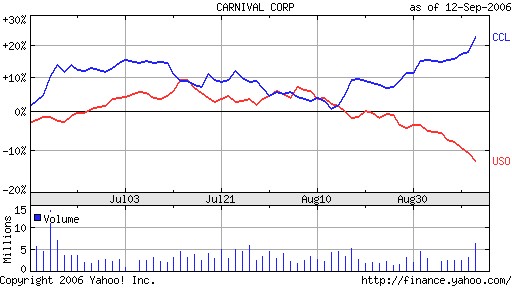
Admittedly the timing of this post might be a little late as the cruise industry has already started to rally. The price of fuel factors in as a key component of the latest price movements. In the graph below, Carnival (CCL) is represented by the blue line. The red line is the U.S. Oil Fund ETF (AMEX: USO). This is another ETF that tracks the price of crude oil. Over the past few weeks, you might have noticed that oil has dropped in price. This is evident if you noticed that you're paying a little bit less at the pump for gas. As you can see in the graph, the price of oil has dropped while the price of CCL has increased.
Carnival's biggest competitor is Royal Caribbean (NYSE: RCL) which includes Celebrity Cruises. I also own shares in RCL which closed on Wednesday at 38.00. The third major player in the US cruise market is Norwegian Cruise Lines. However, NCL is owned by the Genting Group of Malaysia (which also owns the Asian cruise line Star Cruises). It would be difficult for US residents to directly buy shares in Genting. Though, it is possible to buy and an Exchange Traded Fund (ETF) which holds shares in Genting. This fund is the iShares MSCI Malaysia Index (AMEX: EWM).
Admittedly the timing of this post might be a little late as the cruise industry has already started to rally. The price of fuel factors in as a key component of the latest price movements. In the graph below, Carnival (CCL) is represented by the blue line. The red line is the U.S. Oil Fund ETF (AMEX: USO). This is another ETF that tracks the price of crude oil. Over the past few weeks, you might have noticed that oil has dropped in price. This is evident if you noticed that you're paying a little bit less at the pump for gas. As you can see in the graph, the price of oil has dropped while the price of CCL has increased.

In addition to the recent upward movement of cruise line stocks, I will add some of my usual criteria for purchase of CCL & RCL. Both are profitable companies that pay a dividend.
There is one more bonus, if you are considering going on a cruise in the near future. Both CCL & RCL offer a Shareholder Benefit in the form of an onboard credit for booking a cruise. For example, each offers a $100 onboard credit for shareholders that book a 7 day cruise and a minimum of 100 shares.
Update: If you were searching for information about how to get the Shareholder Benefit offered to cruise line stock holders, please find the details in my post about cruise line shareholder benefits for RCCL and Carnival stock holders.
pfstock
Tuesday, September 12, 2006
Calculating Net Worth
I thought that calculating one's net worth would be pretty simple. Add up the value of your assets and subtract your liabilities (debts) to arrive at your net worth. Having looked through a few blogs, however, I see that the definition is neither simple nor consistent. I've seen one guy who has listed over $50k in automobiles and the value of jewelry as "assets". On the other hand, I was recently reading a book (Getting Loaded by Peter Bielagus) where in calculating net worth, the author deliberately excludes things such as cars and other depreciable assets from the calculation.
I agree with the latter formula. I don't include what I would call non-financial assets as part of my net worth. I wouldn't consider stamp and coin collections, or jewelry to be financial assets. The reality is that while these items do have value, it is not as if I would be willing to sell any of them, or that I would rely on them for income. Similarly, I don't consider my primary residence an asset for the purpose of calculating net worth. In fact, I've seen a few questionnaires (that brokerage houses use to determine the suitability of certain investments) that specifically ask for net worth excluding one's primary residence.
Getting back to the question of net worth, I suppose that if one would exclude the value of their home from the calculation, then one could also exclude their primary mortgage (but not their second mortgage since that is not usually used to finance the house, but other consumer items instead) from their liabilities. Why do people try to inflate their net worth by including miscellaneous non-financial assets? My guess is that is like the game people play with inflating their resumes when applying for a job. You may be able to fool other people into thinking that your net worth is more than it is, but just be certain you aren't just fooling yourself.
pfstock
I agree with the latter formula. I don't include what I would call non-financial assets as part of my net worth. I wouldn't consider stamp and coin collections, or jewelry to be financial assets. The reality is that while these items do have value, it is not as if I would be willing to sell any of them, or that I would rely on them for income. Similarly, I don't consider my primary residence an asset for the purpose of calculating net worth. In fact, I've seen a few questionnaires (that brokerage houses use to determine the suitability of certain investments) that specifically ask for net worth excluding one's primary residence.
Getting back to the question of net worth, I suppose that if one would exclude the value of their home from the calculation, then one could also exclude their primary mortgage (but not their second mortgage since that is not usually used to finance the house, but other consumer items instead) from their liabilities. Why do people try to inflate their net worth by including miscellaneous non-financial assets? My guess is that is like the game people play with inflating their resumes when applying for a job. You may be able to fool other people into thinking that your net worth is more than it is, but just be certain you aren't just fooling yourself.
pfstock
Friday, September 8, 2006
Wealth According to The Millionaire Next Door
To answer the question of whether one is wealthy, I will take a quote from The Millionaire Next Door, by Thomas Stanley & William Danko, which I read a few years ago. I consider this book to be a classic. Here, the authors discuss what one's expected net worth should be at any given point in life.
To give an example, suppose one is 35 years old and makes $100,000 per year. Then, by the above formula, one's expected net worth is $350,000. The authors then go on to describe the wealthy (prodigious accumulators of wealth, PAWs) as those who have at least double this expected net worth based on age and income. Conversely, one who has accumulated less than half of their expected net worth is known as an under accumulator of wealth, or UAW. (I have always found it peculiar that this acronym is the same as the one used by the United Auto Workers union, but that is another story.)
In any case, the suggestion by the two authors is a broad rule of thumb. I would caution one against putting too much weight into the usefulness of a rule of thumb. Nevertheless, armed with this knowledge, you can at least have a rough idea of where you stand with regard to what your savings should be at any point in time.
Update: See also As a Rule of Thumb...
and The Millionaire's Rule of Thumb.
pfstock
Multiply your age times your realized pretax annual household income from all sources except inheritances. Divide by ten. This, less any inherited wealth, is what your net worth should be.
To give an example, suppose one is 35 years old and makes $100,000 per year. Then, by the above formula, one's expected net worth is $350,000. The authors then go on to describe the wealthy (prodigious accumulators of wealth, PAWs) as those who have at least double this expected net worth based on age and income. Conversely, one who has accumulated less than half of their expected net worth is known as an under accumulator of wealth, or UAW. (I have always found it peculiar that this acronym is the same as the one used by the United Auto Workers union, but that is another story.)
In any case, the suggestion by the two authors is a broad rule of thumb. I would caution one against putting too much weight into the usefulness of a rule of thumb. Nevertheless, armed with this knowledge, you can at least have a rough idea of where you stand with regard to what your savings should be at any point in time.
Update: See also As a Rule of Thumb...
and The Millionaire's Rule of Thumb.
pfstock
Monday, September 4, 2006
Stock Pick: Pfizer (PFE)
I'm ready to make the first stock pick on my blog. I am now recommending Pfizer Inc. (NYSE: PFE) for purchase. This pharmaceutical giant is a member of both the Standard and Poors 500 index, and the Dow Jones Industrial Average (DJIA). Pfizer is one of the largest makers of prescription drugs.
This stock closed on Friday at 27.96. Pfizer's stock price has stagnated for over a year, trading in a narrow range in the mid-20s. However, PFE has recently begun upward price movement, with Friday's close being a new 52-week high. My opinion is that Pfizer (and several other large pharmaceutical makers) are coming off of a period of depressed stock valuation.
I have picked Pfizer because it satisfies the following criteria:
Looking for My Coke Rewards Codes? Keep searching!
pfstock
This stock closed on Friday at 27.96. Pfizer's stock price has stagnated for over a year, trading in a narrow range in the mid-20s. However, PFE has recently begun upward price movement, with Friday's close being a new 52-week high. My opinion is that Pfizer (and several other large pharmaceutical makers) are coming off of a period of depressed stock valuation.
I have picked Pfizer because it satisfies the following criteria:
- Profitable for the last 3 years, and consistently profitable for several years (Source: S&P Stock Reports): In general, I will not recommend an unprofitable company for purchase.
- Current dividend yield of 3.43%: I like to know that if the stock price stagnates, that I will still receive some income for having my money tied up.
- Large capitalization stock: PFE has a market capitalization of $200 billion. As a general rule, large companies are less volatile than smaller ones.
Looking for My Coke Rewards Codes? Keep searching!
pfstock
Saturday, September 2, 2006
Disclaimer
Before I get too far along here, I thought that I would write a disclaimer.
First of all, this is a personal blog, and I am not a financial advisor. The material provided by PFStock is for general information only. This information is not intended as an offer or solicitation of an offer to sell or buy, or as an endorsement, recommendation or sponsorship of any company, security or fund. Readers should not assume that any recommendations made by PFStock will be profitable.
In other words, if you invest in something that I've mentioned here and lose money, then I'm sorry that this has happened, but I can't accept responsibility for your loss. On the other hand, if you do the opposite of what I've suggested and lose money, then I would say that I told you so.
Lastly, readers accept responsibility for their own investment research, due diligence and decision making. All investments involve risks and are not guaranteed. You may wish to seek the advice of a professional before investing.
Copyright © 2006 pfstock
First of all, this is a personal blog, and I am not a financial advisor. The material provided by PFStock is for general information only. This information is not intended as an offer or solicitation of an offer to sell or buy, or as an endorsement, recommendation or sponsorship of any company, security or fund. Readers should not assume that any recommendations made by PFStock will be profitable.
In other words, if you invest in something that I've mentioned here and lose money, then I'm sorry that this has happened, but I can't accept responsibility for your loss. On the other hand, if you do the opposite of what I've suggested and lose money, then I would say that I told you so.
Lastly, readers accept responsibility for their own investment research, due diligence and decision making. All investments involve risks and are not guaranteed. You may wish to seek the advice of a professional before investing.
Copyright © 2006 pfstock
Friday, September 1, 2006
Citibank Dividend MasterCard
I was going to write an entry about how much I like the 5% cash back feature for purchases at supermarkets, drug stores, and gas stations that I get with my Citi Dividend MasterCard. However, Citibank changed the rules. They recently sent me a letter stating that as of October 13, 2006, I will only be getting 2% cash back on my "everyday" purchases. I also noted that they added convenience stores and utilities to the purchases eligible for 2% cash back.
The way that this credit card works, one accumulates Dividend Dollars for the above mentioned "everyday" purchases. For all other purchases, a 1% cash reward is earned. Whenever $50 or more is accumulated, I can request a check from Citibank. They will pay out the entire balance, not just the minimum amount of $50. Believe me, this is a lot less hassle than a lot of the other rewards cards. In many other cases, I've found myself browsing through reward catalogs to find something that I had enough points for, and that I really wanted to get. Also, the Citi Dividend credit card is not a tiered award where you have to spend a certain amount (usually a few thousand dollars) before you qualify to get the maximum rate.
With the reward changing from 5% to 2%, this of course dampens my enthusiasm for using the card. On the other hand, I don't really have any better alternative card to use at the time. The 2% rebate is a lot better than most of my other credit cards which pay nothing. I would be interested, though, to see if another better offer will come along.
pfstock
The way that this credit card works, one accumulates Dividend Dollars for the above mentioned "everyday" purchases. For all other purchases, a 1% cash reward is earned. Whenever $50 or more is accumulated, I can request a check from Citibank. They will pay out the entire balance, not just the minimum amount of $50. Believe me, this is a lot less hassle than a lot of the other rewards cards. In many other cases, I've found myself browsing through reward catalogs to find something that I had enough points for, and that I really wanted to get. Also, the Citi Dividend credit card is not a tiered award where you have to spend a certain amount (usually a few thousand dollars) before you qualify to get the maximum rate.
With the reward changing from 5% to 2%, this of course dampens my enthusiasm for using the card. On the other hand, I don't really have any better alternative card to use at the time. The 2% rebate is a lot better than most of my other credit cards which pay nothing. I would be interested, though, to see if another better offer will come along.
pfstock
Subscribe to:
Posts (Atom)