A while ago, I heard about a website called Prosper.com. This is a marketplace for individual consumer loans. The concept is like eBay where you have borrowers asking for and lenders bidding on small personal loans. It works like this, a borrower requests a loan. Lenders then compete on some or all of the requested loan amount. The attractive part of this exchange is that potentially higher interest rates can be found than in a regular savings or CD account. For borrowers, it provides an opportunity to apply for loans that they would not usually qualify for using traditional avenues. In exchange for the higher interest rates, the lenders bear the risk that a borrower may default.
I have not signed up for a Prosper account, and probably won't do so in the near future. Since I'm not in the market to request a personal loan, I would be looking at this venture from the lender's prospective. I don't have a problem with the Prosper.com concept. However, it does take time to review and vet each of the loan requests. This is akin to the type of stock research that I do before I before I invest. With a typical loan bid running about $50-$250, this can quickly become a lot of research to do for even a small investment. Of course, one is welcome to offer larger loan amounts, but this also increases the risk in the event that one larger loan defaults.
I'm not saying that Prosper is a bad thing. Quite the contrary; I think that it may work out for a lot of lenders and borrowers. However, in order to invest the same amount that I would in a typical stock transaction, investing in Prosper loans would end up using a disproportionate amount of time for me. It is fair to say that Prosper is not necessarily right for everyone. My philosophy, when considering an investment, is to either invest a lot at once or not at all. Thus, small little loans are not consistent with my investment strategy.
All said, I invite others to share their experiences with Prosper.com. I guess that I'm interested in know if you've had any bad experiences, and whether or not you feel that the extra boost in interest rates is worth the extra effort (and risk).
PF Stock

Saturday, January 27, 2007

Friday, January 19, 2007
Questions
I remember reading somewhere that one way to increase blog traffic and comments is to ask a lot of questions. So, here goes nothing:
1) Does anybody know of any youth savings accounts that are similar to Glendale Federal Savings's Squirrels Club?
2) Did anybody use my method to calculate the APY on their bank accounts? Curiously, this is one of my most popular posts, and I haven't figured out why. So far, there are no comments on this post.
3) Did anybody else say "Sayonara" to NetBank (Nasdaq: NTBK), after they ousted their CEO, and in light of their continuing decline? To be fair, NetBank did increase their interest rates slightly.
4) Can somebody answer my question about why online banks feel it is necessary to outwardly lie in order to attract new customers?
5) Has anyone gone through the IPO qualification process?
6) Did anyone else invest in Bare Escentuals (Nasdaq: BARE) stock?
7) Did anyone else attend The Money Show or Hard Assets Conferences?
8) Has anyone called up Ameritrade demanding to be switched to a higher rate money market fund as their Money Market Sweep vehicle? This is another very popular post.
9) Has anybody else read The Automatic Millionaire?
10) Anybody else want to exchange links for the blogroll? I have links to four very good blogs already:
Retiring Early
Growing Money
The Money Tortoise
Blunt Money
and I'm still looking for more...
PF Stock
1) Does anybody know of any youth savings accounts that are similar to Glendale Federal Savings's Squirrels Club?
2) Did anybody use my method to calculate the APY on their bank accounts? Curiously, this is one of my most popular posts, and I haven't figured out why. So far, there are no comments on this post.
3) Did anybody else say "Sayonara" to NetBank (Nasdaq: NTBK), after they ousted their CEO, and in light of their continuing decline? To be fair, NetBank did increase their interest rates slightly.
4) Can somebody answer my question about why online banks feel it is necessary to outwardly lie in order to attract new customers?
5) Has anyone gone through the IPO qualification process?
6) Did anyone else invest in Bare Escentuals (Nasdaq: BARE) stock?
7) Did anyone else attend The Money Show or Hard Assets Conferences?
8) Has anyone called up Ameritrade demanding to be switched to a higher rate money market fund as their Money Market Sweep vehicle? This is another very popular post.
9) Has anybody else read The Automatic Millionaire?
10) Anybody else want to exchange links for the blogroll? I have links to four very good blogs already:
Retiring Early
Growing Money
The Money Tortoise
Blunt Money
and I'm still looking for more...
PF Stock
Wednesday, January 10, 2007
TD Ameritrade Sent Me a Flashlight Toolkit
What is a flashlight tool kit? Well, TD Ameritrade sent me one the other day. It was a gift for me, as one of TD Ameritrade's most valued clients. A note inside said, "Here, all in one place, are the tools you need to achieve success, and the guidance to help light your way."
The flashlight tool kit itself is somewhat hard to describe. It is silver in color emblazoned with their green on white "TD" trademark, and resembles a small clothes iron. A flashlight is mounted in the front, and the tool kit opens up to reveal a set of tools. Inside, the tool set includes small screwdrivers, and a set of interchangeable screwdriver bits with ratchet sockets.
As one of TD Ameritrade's most valued clients, I wished that they would offer me access to APEX which I've been asking for. That would be more helpful than a flashlight tool kit.
PF Stock
The flashlight tool kit itself is somewhat hard to describe. It is silver in color emblazoned with their green on white "TD" trademark, and resembles a small clothes iron. A flashlight is mounted in the front, and the tool kit opens up to reveal a set of tools. Inside, the tool set includes small screwdrivers, and a set of interchangeable screwdriver bits with ratchet sockets.
As one of TD Ameritrade's most valued clients, I wished that they would offer me access to APEX which I've been asking for. That would be more helpful than a flashlight tool kit.
PF Stock
Tuesday, January 9, 2007
Changes in Daylight Saving Time
Happy New Year! I was just recently looking at the list of optional updates at Microsoft Windows Update, and noticed a couple patches for Daylight Saving Time (DST). Curious, I clicked on one to find out more. It was then that I realized that the period when DST is in effect will be different starting in 2007. The new rules are:
That means that in 2007, these dates are March 11, 2007 and November 4, 2007. Note that DST (known as "summer time" in some places) actually begins in the last couple weeks of winter! So much for the expression "spring forward."
But, what is really starting to concern me now is the clocks in my VCRs? They are supposed to automatically adjust the time on the first Sunday of April and again on the last Sunday in October. By contrast computers, telephones, and radio-controlled clocks (also erroneously called atomic clocks) all have software that should automatically adjust to the new DST rules. However, as far as I can tell, VCRs (made prior to 2005) are hardwired to adjust their clocks according the old rules, and VCRs don't have upgradeable firmware to update this change.
I even have a bunch of physical (paper) calendars that say DST will begin on April 1, 2007, and end on October 28, 2007. (These are the incorrect dates, by the way.) I refer to these as defective calendars, as they will tell you the wrong dates for DST. Do I foresee hoards of lawyers salivating over the prospect of a massive class action lawsuit against electronics manufacturers and calendar makers over "defective DST" products? This is like the Y2K problem all over again...
PF Stock
DST will begin at 2 a.m. on the second Sunday in March and Standard Time will resume at 2 a.m. on the first Sunday in November.
That means that in 2007, these dates are March 11, 2007 and November 4, 2007. Note that DST (known as "summer time" in some places) actually begins in the last couple weeks of winter! So much for the expression "spring forward."
But, what is really starting to concern me now is the clocks in my VCRs? They are supposed to automatically adjust the time on the first Sunday of April and again on the last Sunday in October. By contrast computers, telephones, and radio-controlled clocks (also erroneously called atomic clocks) all have software that should automatically adjust to the new DST rules. However, as far as I can tell, VCRs (made prior to 2005) are hardwired to adjust their clocks according the old rules, and VCRs don't have upgradeable firmware to update this change.
I even have a bunch of physical (paper) calendars that say DST will begin on April 1, 2007, and end on October 28, 2007. (These are the incorrect dates, by the way.) I refer to these as defective calendars, as they will tell you the wrong dates for DST. Do I foresee hoards of lawyers salivating over the prospect of a massive class action lawsuit against electronics manufacturers and calendar makers over "defective DST" products? This is like the Y2K problem all over again...
PF Stock
Friday, January 5, 2007
Who is Running Windows Vista?
I was going to write a post about the lack of blog visitors running Microsoft Windows Vista. But, now I have had my first visitor who is running Windows Vista. One of the statistics that the Site Meter for this blog keeps track of is operating system. Until this week, I hadn't noticed any blog visitors running Microsoft Windows Vista. I know that Windows Vista hasn't been widely released, since most versions of Vista won't be available until the end of this month. But I do know that many beta versions of Vista exist, and the business version of Windows Vista has already been released.
On a related note, I recently purchased a new desktop computer. I held off on my buying decision until the computer manufacturer (Hewlett-Packard) agreed to provide an upgrade to Microsoft Windows Vista. Currently, the computer runs Windows XP Media Center Edition 2005, and I'm supposed to receive Windows Vista Home Premium after the general release later this year. I only have to pay for the shipping charges.
PF Stock
On a related note, I recently purchased a new desktop computer. I held off on my buying decision until the computer manufacturer (Hewlett-Packard) agreed to provide an upgrade to Microsoft Windows Vista. Currently, the computer runs Windows XP Media Center Edition 2005, and I'm supposed to receive Windows Vista Home Premium after the general release later this year. I only have to pay for the shipping charges.
PF Stock
Wednesday, January 3, 2007
The Millionaire's Rule of Thumb
In the landmark book, The Millionaire Next Door by Thomas J. Stanley and William D. Danko, the authors present a now well-known formula for one's expected net worth. Unfortunately, it seems that the result of the formula has been repeatedly misinterpreted as a hard limit, where if you are below this number, you are considered "poor", and if you are above it, you're "rich". But, there is not a single break point that divides Prodigious Accumulators of Wealth (PAWs, the "rich") and Under Accumulators of Wealth (UAWs, the "poor"). Instead there is a broad middle range that the authors call Average Accumulators of Wealth (AAW).
Admittedly, the way in which Stanley and Danko presented the formula for expected net worth in their book is perhaps the source of much of this confusion. (See Wealth According to The Millionaire Next Door.) To be a PAW one needs to have at least twice their expected net worth. Instead of repeating the often misinterpreted formula here, I will present a simplified version of what the authors tried to convey in their book.
Suppose that one is 40 years old and has an annual income of $75,000. In this case, 40/5=8. So, to be "rich" at 40, one needs to have 8X their annual income or $600,000 in this example.
But, you are not necessarily a UAW if you have less than $600,000. The converse formula is:
Using the same example, 40/20 = 2. So, one is poor at age 40, if their net worth is less than 2X their annual income, or $150,000 in this case.
I think that blog posts that discuss The Millionaire Next Door often illicit responses like: "The formula is flawed," or "This is nonsense." Indeed, broad rules of thumb like this one can have their limitations. I think that the authors only intended this formula to be a rough measure of one's wealth. On the other hand, if you find yourself making excuses as to why you can't achieve at least the lower limit of AAW status, then you are exactly what the authors have profiled as a UAW. My definition of a UAW is one that fits the formula and has a dozen "reasons" why he or she is stuck there.
Another typical reaction to the Millionaire's formula is people who say the formula is nonsensical, and that they will then develop a new and improved formula. Presumably, this new formula will show that they aren't doing so badly after all. In any case, I won't hold my breath for a new and improved breakthrough formula to come out.
Regardless of whether or not you agree with the Millionaire's Rule of Thumb, I think that everyone can strive to do better. Let me offer these words of encouragement: If you are a UAW, you can strive to become an AAW; if you are an AAW, you can strive to become a PAW. I wish you good luck in this endeavor.
Further Reading:
Wealth According to The Millionaire Next Door.
As a Rule of Thumb.
PF Stock
Admittedly, the way in which Stanley and Danko presented the formula for expected net worth in their book is perhaps the source of much of this confusion. (See Wealth According to The Millionaire Next Door.) To be a PAW one needs to have at least twice their expected net worth. Instead of repeating the often misinterpreted formula here, I will present a simplified version of what the authors tried to convey in their book.
Take your age, and divide by 5. Multiply the result by your annual income. If your net worth is at least that amount, then you are a PAW (i.e. wealthy).
Suppose that one is 40 years old and has an annual income of $75,000. In this case, 40/5=8. So, to be "rich" at 40, one needs to have 8X their annual income or $600,000 in this example.
But, you are not necessarily a UAW if you have less than $600,000. The converse formula is:
Take your age, and divide by 20. Multiply the result by your annual income. If your net worth is less than that amount, then you are a UAW (i.e. "poor").
Using the same example, 40/20 = 2. So, one is poor at age 40, if their net worth is less than 2X their annual income, or $150,000 in this case.
I think that blog posts that discuss The Millionaire Next Door often illicit responses like: "The formula is flawed," or "This is nonsense." Indeed, broad rules of thumb like this one can have their limitations. I think that the authors only intended this formula to be a rough measure of one's wealth. On the other hand, if you find yourself making excuses as to why you can't achieve at least the lower limit of AAW status, then you are exactly what the authors have profiled as a UAW. My definition of a UAW is one that fits the formula and has a dozen "reasons" why he or she is stuck there.
Another typical reaction to the Millionaire's formula is people who say the formula is nonsensical, and that they will then develop a new and improved formula. Presumably, this new formula will show that they aren't doing so badly after all. In any case, I won't hold my breath for a new and improved breakthrough formula to come out.
Regardless of whether or not you agree with the Millionaire's Rule of Thumb, I think that everyone can strive to do better. Let me offer these words of encouragement: If you are a UAW, you can strive to become an AAW; if you are an AAW, you can strive to become a PAW. I wish you good luck in this endeavor.
Further Reading:
Wealth According to The Millionaire Next Door.
As a Rule of Thumb.
PF Stock
Saturday, December 30, 2006
Are Macs Irrelevant?
In my post about recently installing Internet Explorer 7 on my computer, I had mentioned that I have added a Site Meter to my blog. This lets me keep track of some statistics, like browser share. Currently (as of 12/30/06), Internet Explorer represents 61% of the browsers used to view my blog. Firefox is represented by 38%, and the other 1% is an Opera browser.
One of the other statistics that is tracked is operating system (OS). Currently, 100% of the blog readers are using some version of Windows. This means that 0% of you are using an Apple Macintosh. While this is very surprising, Macs almost always represent less than 5% of my audience. I will occasionally see some Linux or UNIX systems show up in the stats. And so far, nobody running Windows Vista (beta) has visited my blog. I have recently purchased a new Compaq computer (made by Hewlett-Packard), and I'm entitled to a copy of Windows Vista when it is officially released.
I suppose that these statistics represent who is visiting this blog, and not the general population as a whole. Since I write this blog for the personal finance community, I would assume that the Windows-based PC is the machine of choice in the area of personal finance.
pfstock
One of the other statistics that is tracked is operating system (OS). Currently, 100% of the blog readers are using some version of Windows. This means that 0% of you are using an Apple Macintosh. While this is very surprising, Macs almost always represent less than 5% of my audience. I will occasionally see some Linux or UNIX systems show up in the stats. And so far, nobody running Windows Vista (beta) has visited my blog. I have recently purchased a new Compaq computer (made by Hewlett-Packard), and I'm entitled to a copy of Windows Vista when it is officially released.
I suppose that these statistics represent who is visiting this blog, and not the general population as a whole. Since I write this blog for the personal finance community, I would assume that the Windows-based PC is the machine of choice in the area of personal finance.
pfstock
Thursday, December 28, 2006
The Blogroll
I have been writing for PFStock for about five months now. I am surprised that (so far) nobody has asked me to put their blog onto my Blogroll. By contrast, I've recently been fighting blog spam. I found a bunch of irrelevant comments or links to advertising sites on my blog, which I have deleted.
Anyway, the invitation remains out to legitimate PF bloggers. If you have a personal finance or investing blog, please send me an Email, and I will consider including a link to it. (Note that my Email address is listed in the right side column of my blog.) However, I won't generally link to another blog that doesn't contain original material, or that has more ads than useful text. Even I have standards...
pfstock
Anyway, the invitation remains out to legitimate PF bloggers. If you have a personal finance or investing blog, please send me an Email, and I will consider including a link to it. (Note that my Email address is listed in the right side column of my blog.) However, I won't generally link to another blog that doesn't contain original material, or that has more ads than useful text. Even I have standards...
pfstock
Thursday, December 21, 2006
Cruise Line Shareholder Benefits
I recently noticed that one of my most popular postings on PFStock was my post about Investing in the Cruise Line Industry. Most people reading this post were searching for information about how to get the Shareholder Benefit offered to stock holders of Carnival Corporation (NYSE: CCL), Carnival plc (NYSE: CUK), or Royal Caribbean (NYSE: RCL). I mentioned that each cruise company offers a $100 onboard credit for shareholders that book a 7 day cruise and a minimum of 100 shares. However, I didn't post all of the details at that time.
As a service to my blog readers, I have decided to publish more details of the Carnival and Royal Caribbean Cruise Lines (RCCL) shareholder benefit programs. If you are considering going on a cruise in the near future, both RCL and CCL require that shareholders own a minimum of 100 shares of their stock. The associated stock symbols are RCL, CCL, and CUK depending on which cruise you are going on.
For Carnival Corporation (including Carnival Cruise Lines, Princess Cruises, Holland America Line, Windstar, Seabourn, and Cunard Line in North America) the following benefit is offered:
Onboard credit per stateroom on sailings of 14 days or longer: US $250
Onboard credit per stateroom on sailings of 7 to 13 days: US $100
Onboard credit per stateroom on sailings of 6 days or less: US $ 50
Outside of North America, Carnival Corporation also operates P&O Cruises, Ocean Village, Swan Hellenic, Costa Cruises, Aida Cruises, and P&O Cruises Australia. Note that on these ships, the shareholder benefit will be offered in British pounds, Euros, or Australian dollars depending on the currency used onboard the particular cruise ship.
This is the direct link to the Carnival Corporation Shareholder Benefit. It gives the address and telephone numbers for each of the cruise lines that offer this benefit.
For Royal Caribbean (RCCL) and Celebrity Cruises the following benefit is offered:
$250 Onboard Credit per Stateroom on Sailings of 14 or more nights.
$200 Onboard Credit per Stateroom on Sailings of 9 to 13 nights.
$100 Onboard Credit per Stateroom on Sailings of 6 to 8 nights.
$50 Onboard Credit per Stateroom on Sailings of 5 nights or less.
The Shareholder Benefit excludes sailings on Celebrity Xpeditions.
Here is the direct link to RCCL Shareholder Benefit. This is an FAQ for their program. And this is a PDF file of the information for Royal Carribean. (I just noticed that the P.O. Box numbers differ between these two documents, so it is probably best to contact RCCL by email or phone before submitting your information to them.)
In general, you will need to mail or fax either a shareholder proxy card or a copy or your brokerage statement to the company (either RCCL or CCL). This is to prove that you own at least 100 shares of stock.
Personally, I have taken advantage of the CCL shareholder benefit twice. However, I have not (yet) used the RCL benefit. If you have general questions about the shareholder benefit, or just want to talk about cruising, I invite you to send me an Email. (Note my Email address is listed in the right side column of my blog). Also, the above links may change or go out of date. If you find that the information or links are out of date, please Email me so that I will know to update it.
The other major player in the North American cruise market is Norwegian Cruise Lines (NCL). NCL and NCL America are owned by the Genting Group of Malaysia (which also owns the Asian cruise line Star Cruises). I mentioned that you cannot buy their stock directly in the United States. Unfortunately, a shareholder shipboard credit is not offered for NCL or NCL America cruises.
I have a one final thought. If you don't already own Carnival or RCCL stock, then I do not recommend buying the stock just to get the shareholder benefit. Make your investment decisions to buy CCL or RCL based on your investment needs, and not on your vacation needs.
A Note from the Author:
Thousands of people have read this post, but neither Carnival nor Royal Caribbean compensate me for directing readers to their websites. A few readers have sent me a message of thanks for pointing out a benefit that they didn't know about, but the vast majority of people pass through without saying anything. I don't want to get into the details, but unfortunately, PF Stock has fallen upon some financial difficulties. Things are simply not nearly as stable as they've been in the past.
If you have read my posts and have benefited from the information, I want to ask you to consider making a donation to help out PF Stock. I have added a PayPal link below, if you choose to make a donation. Any amount is appreciated, but of course this is strictly voluntary. Thank you for your support and happy travels.
PLEASE NOTE: There is a newer version of this post. Please see Updated Cruise Line Shareholder Benefits for the latest information.
pfstock
As a service to my blog readers, I have decided to publish more details of the Carnival and Royal Caribbean Cruise Lines (RCCL) shareholder benefit programs. If you are considering going on a cruise in the near future, both RCL and CCL require that shareholders own a minimum of 100 shares of their stock. The associated stock symbols are RCL, CCL, and CUK depending on which cruise you are going on.
For Carnival Corporation (including Carnival Cruise Lines, Princess Cruises, Holland America Line, Windstar, Seabourn, and Cunard Line in North America) the following benefit is offered:
Onboard credit per stateroom on sailings of 14 days or longer: US $250
Onboard credit per stateroom on sailings of 7 to 13 days: US $100
Onboard credit per stateroom on sailings of 6 days or less: US $ 50
Outside of North America, Carnival Corporation also operates P&O Cruises, Ocean Village, Swan Hellenic, Costa Cruises, Aida Cruises, and P&O Cruises Australia. Note that on these ships, the shareholder benefit will be offered in British pounds, Euros, or Australian dollars depending on the currency used onboard the particular cruise ship.
This is the direct link to the Carnival Corporation Shareholder Benefit. It gives the address and telephone numbers for each of the cruise lines that offer this benefit.
For Royal Caribbean (RCCL) and Celebrity Cruises the following benefit is offered:
$250 Onboard Credit per Stateroom on Sailings of 14 or more nights.
$200 Onboard Credit per Stateroom on Sailings of 9 to 13 nights.
$100 Onboard Credit per Stateroom on Sailings of 6 to 8 nights.
$50 Onboard Credit per Stateroom on Sailings of 5 nights or less.
The Shareholder Benefit excludes sailings on Celebrity Xpeditions.
Here is the direct link to RCCL Shareholder Benefit. This is an FAQ for their program. And this is a PDF file of the information for Royal Carribean. (I just noticed that the P.O. Box numbers differ between these two documents, so it is probably best to contact RCCL by email or phone before submitting your information to them.)
In general, you will need to mail or fax either a shareholder proxy card or a copy or your brokerage statement to the company (either RCCL or CCL). This is to prove that you own at least 100 shares of stock.
Personally, I have taken advantage of the CCL shareholder benefit twice. However, I have not (yet) used the RCL benefit. If you have general questions about the shareholder benefit, or just want to talk about cruising, I invite you to send me an Email. (Note my Email address is listed in the right side column of my blog). Also, the above links may change or go out of date. If you find that the information or links are out of date, please Email me so that I will know to update it.
The other major player in the North American cruise market is Norwegian Cruise Lines (NCL). NCL and NCL America are owned by the Genting Group of Malaysia (which also owns the Asian cruise line Star Cruises). I mentioned that you cannot buy their stock directly in the United States. Unfortunately, a shareholder shipboard credit is not offered for NCL or NCL America cruises.
I have a one final thought. If you don't already own Carnival or RCCL stock, then I do not recommend buying the stock just to get the shareholder benefit. Make your investment decisions to buy CCL or RCL based on your investment needs, and not on your vacation needs.
A Note from the Author:
Thousands of people have read this post, but neither Carnival nor Royal Caribbean compensate me for directing readers to their websites. A few readers have sent me a message of thanks for pointing out a benefit that they didn't know about, but the vast majority of people pass through without saying anything. I don't want to get into the details, but unfortunately, PF Stock has fallen upon some financial difficulties. Things are simply not nearly as stable as they've been in the past.
If you have read my posts and have benefited from the information, I want to ask you to consider making a donation to help out PF Stock. I have added a PayPal link below, if you choose to make a donation. Any amount is appreciated, but of course this is strictly voluntary. Thank you for your support and happy travels.
PLEASE NOTE: There is a newer version of this post. Please see Updated Cruise Line Shareholder Benefits for the latest information.
pfstock
Sunday, December 10, 2006
Vacation
This month, I will only be posting sporadically to my blog. I have some well deserved vacation time coming up, and I don't plan to post while I'm away. Have a safe and happy holiday.
pfstock
pfstock
Friday, December 1, 2006
The Decline and Fall of Internet-only Banks
Many people know that I have been following approaching demise of NetBank (Nasdaq: NTBK) on this blog. The story began when I decided that I was going to close my NetBank money market account because it was underperforming other money market accounts, and I was tired of the long delays it took to make deposits. I hinted that NetBank would no longer be able to pay competitive interest rates due to some significant losses that they suffered earlier this year. There were questions about where I was getting my information from, so I wrote another post explaining that I got most of my data about NetBank's deteriorating financials from NTBK press releases and the NetBank website. Only one day after I posted that article, NetBank publicly admitted that the company was both unprofitable and unstable. As a result, NetBank ousted their CEO that same week.
At this point, I have gotten all of my money back from NetBank, and redeployed it to some safer institutions. I wanted to point out that the NetBank website offers existing customers a 2.99% APY interest rate for their Standard Money Market. However, I can get a 5.oo% APY at both Citibank and Washington Mutual (WaMu), and they have real branches and ATMs. Note: Please do not misconstrue that I am an advocate for either for Citibank or WaMu here. I am only pointing out the facts about their higher interest rates. The truth is that I've had other issues with both Citibank and Washington Mutual in the past. I have a saying that "There are no good banks, only some that are less bad."
Anyway, I've digressed. On the same web page that notes NetBank's 2.99% APY money market, there is a statement that touts "Earn over three times the national average." However, according to Bankrate.com the average MMA is said to pay 3.41% APY.
Am I reading something wrong? It seems like NetBank's rate is actually below the national average. I don't know what y'all folks in Georgia call that, but here in California I call that a bald-faced lie!
At the same Bankrate.com site, this is their assessment of Netbank:
NetBank could say that other online banks are making similarly outrageous claims. And they wouldn't be wrong. The Orange Savings Account offered by ING Direct pays only 4.50% APY (recently raised from 4.40% APY). At the same time, they claim that the average bank's money market rate is only 0.84% APY. I don't know how they can keep a straight face, when the Bankrate.com website shows an average rate much greater than 0.84% APY. Somebody answer one question for me: why do online banks feel it is necessary to outwardly lie in order to attract new customers?
The claim to fame of NetBank, ING, and other internet-only banks is that they save money by doing business online and not incurring the expenses associated with maintaining branch locations. Unfortunately, they are starting to be outmaneuvered by their bricks-and-mortar competitors. The historically high interest rates that online banks used to offer on their deposit accounts was the only compelling reason for their competitive advantage. You can mark my words now: if they fail to compete, this will be the beginning of the end for internet-only banks.
pfstock
At this point, I have gotten all of my money back from NetBank, and redeployed it to some safer institutions. I wanted to point out that the NetBank website offers existing customers a 2.99% APY interest rate for their Standard Money Market. However, I can get a 5.oo% APY at both Citibank and Washington Mutual (WaMu), and they have real branches and ATMs. Note: Please do not misconstrue that I am an advocate for either for Citibank or WaMu here. I am only pointing out the facts about their higher interest rates. The truth is that I've had other issues with both Citibank and Washington Mutual in the past. I have a saying that "There are no good banks, only some that are less bad."
Anyway, I've digressed. On the same web page that notes NetBank's 2.99% APY money market, there is a statement that touts "Earn over three times the national average." However, according to Bankrate.com the average MMA is said to pay 3.41% APY.
Am I reading something wrong? It seems like NetBank's rate is actually below the national average. I don't know what y'all folks in Georgia call that, but here in California I call that a bald-faced lie!
At the same Bankrate.com site, this is their assessment of Netbank:
We have come to believe that, as of June 30, 2006, [NetBank] exhibited a significantly below average condition, characterized by lower then [sic] normal overall, sustainable profitability, questionable asset quality, below standard capitalization, and lower than normal liquidity.
NetBank could say that other online banks are making similarly outrageous claims. And they wouldn't be wrong. The Orange Savings Account offered by ING Direct pays only 4.50% APY (recently raised from 4.40% APY). At the same time, they claim that the average bank's money market rate is only 0.84% APY. I don't know how they can keep a straight face, when the Bankrate.com website shows an average rate much greater than 0.84% APY. Somebody answer one question for me: why do online banks feel it is necessary to outwardly lie in order to attract new customers?
The claim to fame of NetBank, ING, and other internet-only banks is that they save money by doing business online and not incurring the expenses associated with maintaining branch locations. Unfortunately, they are starting to be outmaneuvered by their bricks-and-mortar competitors. The historically high interest rates that online banks used to offer on their deposit accounts was the only compelling reason for their competitive advantage. You can mark my words now: if they fail to compete, this will be the beginning of the end for internet-only banks.
pfstock
Wednesday, November 29, 2006
Free USB Flash Drives
Previously, I wrote about collecting freebies at The Money Show and at the Hard Assets Conference (also known as the Gold and Precious Metals Investment Conference) in San Francisco. At the Hard Assets Conference held over this past weekend (Thanksgiving Weekend), I have discovered a new trend in freebies: USB (Universal Serial Bus) flash drives. For those who are not familiar with the technology, a USB flash drive is a portable computer memory that plugs into a computer USB port and can be used like a small hard disk. USB Flash drives are also known as thumb drives.
In the past, exhibitors have used a variety of media to get their messages across. Typically, they have used glossy brochures, and CD-ROMs containing information about their companies. Now, some companies have put their annual reports, company press releases, PowerPoint slides, and other data onto USB flash drives that they give away as freebies. I was able to snag a couple of these 512MB drives from a booth at the conference. My DW also got a free MP3 player for herself. In this case, the 256MB MP3 player also contained soft copies of company literature from the sponsoring firm. Of course, the casing of each USB flash memory is printed with the company logo, so it is unmistakably a freebie. After viewing the information on the USB flash drive, the memory can be re-used for whatever purpose the user wants.
I think this is a shrewd move on the part of the exhibitors. When their company literature was contained on a CD-ROM, I might choose not to view it. However, when the information is on a USB drive, I pretty much have to at least glance at it once (even if it is only to delete the data so that I can re-use the flash memory). With a bunch of new freebies in hand, I've chalked up another successful investment conference!
On a related topic, I also purchased the latest versions of H&R Block's TaxCut and Microsoft Money, this past weekend. I am getting started on taxes early this year. TaxCut also offers a version of their software on a reusable USB flash drive. But I got the regular version of TaxCut on CD-ROM since it is $10 cheaper. Also, I think that the flash drive has a pretty small capacity.
pfstock
In the past, exhibitors have used a variety of media to get their messages across. Typically, they have used glossy brochures, and CD-ROMs containing information about their companies. Now, some companies have put their annual reports, company press releases, PowerPoint slides, and other data onto USB flash drives that they give away as freebies. I was able to snag a couple of these 512MB drives from a booth at the conference. My DW also got a free MP3 player for herself. In this case, the 256MB MP3 player also contained soft copies of company literature from the sponsoring firm. Of course, the casing of each USB flash memory is printed with the company logo, so it is unmistakably a freebie. After viewing the information on the USB flash drive, the memory can be re-used for whatever purpose the user wants.
I think this is a shrewd move on the part of the exhibitors. When their company literature was contained on a CD-ROM, I might choose not to view it. However, when the information is on a USB drive, I pretty much have to at least glance at it once (even if it is only to delete the data so that I can re-use the flash memory). With a bunch of new freebies in hand, I've chalked up another successful investment conference!
On a related topic, I also purchased the latest versions of H&R Block's TaxCut and Microsoft Money, this past weekend. I am getting started on taxes early this year. TaxCut also offers a version of their software on a reusable USB flash drive. But I got the regular version of TaxCut on CD-ROM since it is $10 cheaper. Also, I think that the flash drive has a pretty small capacity.
pfstock
Monday, November 27, 2006
Ameritrade's Unimpressive Site Upgrade
I have written before that I have both an original Ameritrade account and an original Waterhouse account. Ameritrade recently upgraded their web site. This "upgrade" was delayed for about a week with no reason given. Thus far, I'm thoroughly unimpressed with the new site.
So, where's the upgrade? I was expecting things like better online statements, easier to use account history, PDF views for my trade confirmations, and so on. Instead, the changes to the Ameritrade website are mostly cosmetic in nature -- mostly rearranging the menus, and changing the site color to green. I can't see any real improvement in functionality. Some features are either not improved, or even worse than before.
Take for example, the new stock screener. Here is a stock screen that I might put together: find all large cap stocks that are within 10% of their 52-week low. I couldn't figure out how to run this simple screen in the Ameritrade stock screener. Another thing is that the screener is no better than the free stock screens available at Yahoo Finance or MSN Money.
I use Standard and Poors (S&P) stock reports extensively for my personal research. However, the usual S&P reports available at the new Ameritrade site have somehow shrunk from 8 pages to 5 pages. I think that they cut out the three pages that include S&P's Sub-Industry Outlook, Company News, and Analysts' Recommendations from the abbreviated reports. Again, there's no explanation for the change.
As a former Waterhouse customer, I would qualify for Ameritrade APEX twice over based on my Waterhouse account balance. But after talking with Ameritrade customer service representatives about this, they were unwilling to upgrade me to APEX unless I transfer my funds from my original Waterhouse account to a new Ameritrade account. Logically, this is like saying that TD Ameritrade is one company, but you have to transfer your funds from one TD Ameritrade to another TD Ameritrade in order to get APEX access. Huh, what gives?
As a Waterhouse customer, I'm concerned now that Ameritrade will downgrade my account to a lower standard when they finally finish straightening out the mess they made. As I mentioned in my previous post, there are features that I particularly like in my Waterhouse account. Mainly, these features are access to IPOs and the cost basis calculator available through Waterhouse. Ameritrade doesn't keep track of cost basis for you, and instead the refers you to Gainskeeper which costs extra.
Ameritrade SPAM: I know that I am not the first person to write about getting SPAM at my Ameritrade Email address, as it has been reported by other PF bloggers. Like many others, I use a unique Email address for my Ameritrade account. This is accomplished through Yahoo's "AddressGuard" feature. In other words, the only entity that knows my Ameritrade Email address is Ameritrade itself. However, I have been getting spam at this address. Whenever this happens, I change my Email address to a new one, and delete the old Email address. This has happened three times already, as it seems that my Ameritrade Email address has been repeatedly compromised. I think that it is a security issue at the Ameritrade end, and I now have to delete yet another Email address. By contrast, the Email addresses that I use for Waterhouse and E*TRADE have never been compromised.
Ameritrade has been touting such features as Trade Triggers, but I'll tell you that the E*TRADE site has them beat there. However, I think E*TRADE's customer service is worse than Ameritrade's. Nevertheless, I now have a wait-and-see attitude on Ameritrade. But based on what I am seeing, I predict that E*TRADE might end up with a lot more business out of me in the future.
pfstock
So, where's the upgrade? I was expecting things like better online statements, easier to use account history, PDF views for my trade confirmations, and so on. Instead, the changes to the Ameritrade website are mostly cosmetic in nature -- mostly rearranging the menus, and changing the site color to green. I can't see any real improvement in functionality. Some features are either not improved, or even worse than before.
Take for example, the new stock screener. Here is a stock screen that I might put together: find all large cap stocks that are within 10% of their 52-week low. I couldn't figure out how to run this simple screen in the Ameritrade stock screener. Another thing is that the screener is no better than the free stock screens available at Yahoo Finance or MSN Money.
I use Standard and Poors (S&P) stock reports extensively for my personal research. However, the usual S&P reports available at the new Ameritrade site have somehow shrunk from 8 pages to 5 pages. I think that they cut out the three pages that include S&P's Sub-Industry Outlook, Company News, and Analysts' Recommendations from the abbreviated reports. Again, there's no explanation for the change.
As a former Waterhouse customer, I would qualify for Ameritrade APEX twice over based on my Waterhouse account balance. But after talking with Ameritrade customer service representatives about this, they were unwilling to upgrade me to APEX unless I transfer my funds from my original Waterhouse account to a new Ameritrade account. Logically, this is like saying that TD Ameritrade is one company, but you have to transfer your funds from one TD Ameritrade to another TD Ameritrade in order to get APEX access. Huh, what gives?
As a Waterhouse customer, I'm concerned now that Ameritrade will downgrade my account to a lower standard when they finally finish straightening out the mess they made. As I mentioned in my previous post, there are features that I particularly like in my Waterhouse account. Mainly, these features are access to IPOs and the cost basis calculator available through Waterhouse. Ameritrade doesn't keep track of cost basis for you, and instead the refers you to Gainskeeper which costs extra.
Ameritrade SPAM: I know that I am not the first person to write about getting SPAM at my Ameritrade Email address, as it has been reported by other PF bloggers. Like many others, I use a unique Email address for my Ameritrade account. This is accomplished through Yahoo's "AddressGuard" feature. In other words, the only entity that knows my Ameritrade Email address is Ameritrade itself. However, I have been getting spam at this address. Whenever this happens, I change my Email address to a new one, and delete the old Email address. This has happened three times already, as it seems that my Ameritrade Email address has been repeatedly compromised. I think that it is a security issue at the Ameritrade end, and I now have to delete yet another Email address. By contrast, the Email addresses that I use for Waterhouse and E*TRADE have never been compromised.
Ameritrade has been touting such features as Trade Triggers, but I'll tell you that the E*TRADE site has them beat there. However, I think E*TRADE's customer service is worse than Ameritrade's. Nevertheless, I now have a wait-and-see attitude on Ameritrade. But based on what I am seeing, I predict that E*TRADE might end up with a lot more business out of me in the future.
pfstock
Wednesday, November 22, 2006
Hard Assets 06: San Francisco
I had previously written about the San Francisco Money Show, which is held each fall at the downtown San Francisco Marriott Hotel. There is a second investment conference that is held each year at the same hotel. This year the theme is "Hard Assets". While the carnival atmosphere of the Money Show is retained at this show, the subject matter usually focuses on precious metals, mining, oil, and gas.
Many of the exhibitors in the investment conference are foreign mining companies. These are largely listed on the Canadian stock exchanges, most notably the Toronto Stock Exchange (the TSX). Unfortunately, a large share of these stocks are penny stocks of questionable quality. For a few years, there were a lot of dotcom exhibitors, and even mining companies that actually became dotcoms to feed off of the associated hype. This came at a time when the prices for gold, oil, and other commodities were depressed.
Among the speakers at the conference, one stands out among the crowd: James Dines. This flamboyant individual has been touting something every year since about the late 1960s, whether it is gold, dotcom stocks, or his current favorite, uranium. Mr. Dines is the publisher of The Dines Letter, and the author of the book Mass Psychology. I haven't had the opportunity to read the latter, though. His booth is typically rimmed by half a dozen blond, blue-eyed assistants that could politely be referred to as bimbos. And you wouldn't expect anything less from a man whose motto is "Always travel first class, because if you don't, your heirs will!" At any rate, his seminar is usually well attended and very entertaining, to say the least.
Just like at the Money Show, this investment conference also offers an array of freebies. Over the years I've been able to snag several tote bags, caps, and keychains. I have one titanium keychain that was offered by a titanium mining company, and I have another one that includes a flashlight and looks like a miniature miner's hat. Hard Assets '06 is held November 26-27 this year.
pfstock
Many of the exhibitors in the investment conference are foreign mining companies. These are largely listed on the Canadian stock exchanges, most notably the Toronto Stock Exchange (the TSX). Unfortunately, a large share of these stocks are penny stocks of questionable quality. For a few years, there were a lot of dotcom exhibitors, and even mining companies that actually became dotcoms to feed off of the associated hype. This came at a time when the prices for gold, oil, and other commodities were depressed.
Among the speakers at the conference, one stands out among the crowd: James Dines. This flamboyant individual has been touting something every year since about the late 1960s, whether it is gold, dotcom stocks, or his current favorite, uranium. Mr. Dines is the publisher of The Dines Letter, and the author of the book Mass Psychology. I haven't had the opportunity to read the latter, though. His booth is typically rimmed by half a dozen blond, blue-eyed assistants that could politely be referred to as bimbos. And you wouldn't expect anything less from a man whose motto is "Always travel first class, because if you don't, your heirs will!" At any rate, his seminar is usually well attended and very entertaining, to say the least.
Just like at the Money Show, this investment conference also offers an array of freebies. Over the years I've been able to snag several tote bags, caps, and keychains. I have one titanium keychain that was offered by a titanium mining company, and I have another one that includes a flashlight and looks like a miniature miner's hat. Hard Assets '06 is held November 26-27 this year.
pfstock
Saturday, November 18, 2006
David Bach: 90% Good, 10% Evil
A lot of good things have been said about David Bach, author of The Automatic Millionaire. I do think that his work is largely good, and a lot of good things have been said about him. His book is especially helpful for those who are just starting to pull themselves out of debt, and starting to build on their savings. I won't repeat the positive things that have already been said. Instead, I'm going to focus on what I don't like about his books.
First of all, Bach has a way of oversimplifying things. Throughout the book, he uses examples of how you will end up with an astronomical amount of money, if you stop buying coffee drinks, and invest the money at a 10% annual return. Of course, he doesn't really tell you where you can get the 10% annual return. He dances around the issue in his book, and mentions a bunch of brokerages and mutual funds, but I don't see any one of them guaranteeing a 10% annual return.
Like many popular financial writers today, Bach's book reads like an advertisement. Indeed The Automatic Millionaire contains 5 full pages of advertisements for his website, his other books, and his 10 CD set for the complete Automatic Millionaire Audio System. And, did you realize that Bach trademarked the term "The Latte Factor (TM)"? Boy, I hope I don't owe Bach royalties for writing this post.
Aside from this, nothing irks me more than Bach's three paragraphs covering the term "leverage". In this one section, Bach describes buying a $250,000 home with $50,000 down. He states that if the home's value goes up to $300,000, then the investor has doubled his money. Fair enough. But, he goes on to finish the section with the following paragraph.
Talk about glittering generalities! In any responsible coverage of the topic of leverage, the author would explain that leverage is a double-edged sword. While one can make outsized profits in an up market, one's loss could also be multiplied in a down market. In the stock market, the parallel example is buying stocks on margin. In this case, you are using leverage in the hopes of making multiplied gains when the stock market goes up. On the other hand, if the stock goes down, you could lose your entire investment and more.
Bach doesn't even mention the potential downside of leverage anywhere in his 240 page book; he only discusses the upside. I think that David Bach's omission here is at best irresponsible, and at worst criminal. While the term criminal may be a harsh assessment of The Automatic Millionaire, it is nonetheless accurate. You may have noticed that mutual fund prospectuses have a statement that goes something like this:
Do you know why mutual funds are required by government regulators to print this in their prospectuses? That's because it's true! You can't make the assumption that if an investment is increasing in value at a certain rate, that it will continue to do that in the future. Similarly, you can't just assume that if the stock market has returned an average of 10% for several years, that it will only continue to do that in the future. Clearly, Bach is strongly implying that buying a home in this already overheated market is a great investment. And at that, he is peddling his advice to those who are least likely to know any better.
Anyway, so much for David Bach. As I have said, his material is pretty good for people who are just starting to pull themselves out of debt. I will say that his books do contain about 90% good advice. It is the other 10% that I have issues with.
Clearly, though, there are better personal finance books available. I would recommend a couple time-tested classics. My first recommendation is The Richest Man in Babylon, by George Clason. The second book is The Wealthy Barber by David Chilton. These books have a far better track record that Bach, and I think that they will better withstand the test of time.
pfstock
First of all, Bach has a way of oversimplifying things. Throughout the book, he uses examples of how you will end up with an astronomical amount of money, if you stop buying coffee drinks, and invest the money at a 10% annual return. Of course, he doesn't really tell you where you can get the 10% annual return. He dances around the issue in his book, and mentions a bunch of brokerages and mutual funds, but I don't see any one of them guaranteeing a 10% annual return.
Like many popular financial writers today, Bach's book reads like an advertisement. Indeed The Automatic Millionaire contains 5 full pages of advertisements for his website, his other books, and his 10 CD set for the complete Automatic Millionaire Audio System. And, did you realize that Bach trademarked the term "The Latte Factor (TM)"? Boy, I hope I don't owe Bach royalties for writing this post.
Aside from this, nothing irks me more than Bach's three paragraphs covering the term "leverage". In this one section, Bach describes buying a $250,000 home with $50,000 down. He states that if the home's value goes up to $300,000, then the investor has doubled his money. Fair enough. But, he goes on to finish the section with the following paragraph.
Over the last five years, many homes have doubled in price. Think of
what this means in terms of leverage. If you invested $50,000 in a
$250,000 home five years ago and it's now worth $500,000, you've made $250,000 on a $50,000 investment. In investment circles, that's called a five-bagger -- an amazing 500 percent return on your money.
Talk about glittering generalities! In any responsible coverage of the topic of leverage, the author would explain that leverage is a double-edged sword. While one can make outsized profits in an up market, one's loss could also be multiplied in a down market. In the stock market, the parallel example is buying stocks on margin. In this case, you are using leverage in the hopes of making multiplied gains when the stock market goes up. On the other hand, if the stock goes down, you could lose your entire investment and more.
Bach doesn't even mention the potential downside of leverage anywhere in his 240 page book; he only discusses the upside. I think that David Bach's omission here is at best irresponsible, and at worst criminal. While the term criminal may be a harsh assessment of The Automatic Millionaire, it is nonetheless accurate. You may have noticed that mutual fund prospectuses have a statement that goes something like this:
Past performance is not an indication of future performance.
Do you know why mutual funds are required by government regulators to print this in their prospectuses? That's because it's true! You can't make the assumption that if an investment is increasing in value at a certain rate, that it will continue to do that in the future. Similarly, you can't just assume that if the stock market has returned an average of 10% for several years, that it will only continue to do that in the future. Clearly, Bach is strongly implying that buying a home in this already overheated market is a great investment. And at that, he is peddling his advice to those who are least likely to know any better.
Anyway, so much for David Bach. As I have said, his material is pretty good for people who are just starting to pull themselves out of debt. I will say that his books do contain about 90% good advice. It is the other 10% that I have issues with.
Clearly, though, there are better personal finance books available. I would recommend a couple time-tested classics. My first recommendation is The Richest Man in Babylon, by George Clason. The second book is The Wealthy Barber by David Chilton. These books have a far better track record that Bach, and I think that they will better withstand the test of time.
pfstock
Tuesday, November 14, 2006
Ameritrade's "Hidden" Cash Sweep Account
Ameritrade has a cash sweep option called the Total Asset Plan (TAP) which offers a significantly higher interest rate on cash than the default Ameritrade cash sweep option. When you first setup an Ameritrade account, you are put into a cash sweep option that pays less than 1% interest. By contrast, as a participant in the TAP, the cash sweep is offered through money market funds at "The Reserve" (website: ther.com). There are a variety of taxable and tax-free money funds available. For example, the taxable Primary Money Market fund pays about 4.4%. Personally, I chose the California Tax-Exempt fund which pays about 2.4%.
But, don't go looking for the Total Asset Plan on the Ameritrade website; it's not there. In order to setup this account, I needed to talk to a customer service representative. In fact, I would not have even known that the TAP option existed without speaking to a real person at Ameritrade. I don't know why they keep the TAP a secret from most investors.
Lastly, having gone through the application process once, I now know where to find the TAP application on the Internet. However, since this is a "hidden" option (that Ameritrade doesn't want the average person to know about), I would suggest calling Ameritrade to inquire about it.
pfstock
But, don't go looking for the Total Asset Plan on the Ameritrade website; it's not there. In order to setup this account, I needed to talk to a customer service representative. In fact, I would not have even known that the TAP option existed without speaking to a real person at Ameritrade. I don't know why they keep the TAP a secret from most investors.
Lastly, having gone through the application process once, I now know where to find the TAP application on the Internet. However, since this is a "hidden" option (that Ameritrade doesn't want the average person to know about), I would suggest calling Ameritrade to inquire about it.
pfstock
Friday, November 10, 2006
Buying an IPO: Free Money
I had previously mentioned the Bare Escentuals IPO (Nasdaq: BARE) that I received from my stock broker, Waterhouse. Since most people are probably not familiar with the process of getting Initial Public Offering (IPO) shares, I thought that I would write an overview of the process. My caution here is that I am not an expert. IPOs represent an added layer of risk that many investors are not willing to take. Nevertheless, if one is willing to "invest" the time to understand the IPO process, and more importantly the companies in which you are investing, buying IPOs can be a relatively low-risk venture that is like getting free money.
First of all, there are two online brokers that I use which offer IPO shares. These are Waterhouse, and E*TRADE. Of course, there are other brokers that offer IPOs, but I'm not yet involved with them. I recently found that Fidelity offers IPOs. However, their minimum requirement of $500,000 in a Fidelity account makes that venture prohibitive for most people.
The first step in getting an IPO is passing an eligibility questionnaire. You will be asked questions about your income, your liquid net worth (excluding the value of your primary residence), your investment experience, and your investment objective. My only advice here is to be honest when answering the questions.
Once you pass the IPO eligibility questionnaire, the next stage is to wait until the broker announces that they are taking conditional offers on a new IPO. At that time, you should go to the broker website, read (or at least skim) through the prospectus, and place a conditional offer. In general, a conditional offer is placed in multiples of 100 shares, and you will indicate the maximum number of shares you are willing to buy at the offer price. Up to this point, you are not under any obligation to buy the IPO shares, and may cancel your offer up until the allocation phase. However, it is your responsibility to read and understand the "risk factors" that are listed in the prospectus.
Next comes the pricing (if the IPO is not withdrawn). Note that pricing occurs after hours on the day before the IPO begins trading. You will be asked to confirm your conditional offer (usually by midnight of the same day). This step is very important! You have to make the decision at this point if the IPO is one that you really want to participate in. If you decide that you don't want the IPO, you can still cancel at this time. Warning: not all IPOs go up, so choose carefully! I cannot overemphasize this point: buying an IPO can involve significant risk.
The last stage is the allocation phase, which occurs in the early morning hours on the day that the IPO begins trading. Here you will be randomly allocated shares based on the level of interest in the IPO. However, I estimate that 80-90% of the time, I was not allocated any shares after completing this whole procedure. In practice, I have usually placed conditional orders for 200-300 shares of a new IPO, and have been allocated either 100 shares or nothing.
In the case of Bare Escentuals, the IPO priced on Thursday, September 28 at $22 per share. I placed an order for 300 shares, and was allocated 100 shares. It began trading on Friday, September 29 when it closed at 27.15. I later sold the stock at $30, and made a profit of $800.
As with any investment, I advise you to do some outside research of the companies that you are potentially investing it. Two resources I use to gather information about new IPOs are IPOhome and MarketWatch. Please use these resources before you invest. One last note, sometimes you will see what is called a secondary offering for stocks that are already being traded on a stock exchange. I generally avoid these because the potential for quick gains is not as good.
In summary, buying an IPO can be a big hassle, and you most likely won't even get any IPO shares in the end. But if you play the IPO game right (and avoid poor quality IPOs), you can end up with an almost certain profit. It is like getting free money.
pfstock
First of all, there are two online brokers that I use which offer IPO shares. These are Waterhouse, and E*TRADE. Of course, there are other brokers that offer IPOs, but I'm not yet involved with them. I recently found that Fidelity offers IPOs. However, their minimum requirement of $500,000 in a Fidelity account makes that venture prohibitive for most people.
The first step in getting an IPO is passing an eligibility questionnaire. You will be asked questions about your income, your liquid net worth (excluding the value of your primary residence), your investment experience, and your investment objective. My only advice here is to be honest when answering the questions.
Once you pass the IPO eligibility questionnaire, the next stage is to wait until the broker announces that they are taking conditional offers on a new IPO. At that time, you should go to the broker website, read (or at least skim) through the prospectus, and place a conditional offer. In general, a conditional offer is placed in multiples of 100 shares, and you will indicate the maximum number of shares you are willing to buy at the offer price. Up to this point, you are not under any obligation to buy the IPO shares, and may cancel your offer up until the allocation phase. However, it is your responsibility to read and understand the "risk factors" that are listed in the prospectus.
Next comes the pricing (if the IPO is not withdrawn). Note that pricing occurs after hours on the day before the IPO begins trading. You will be asked to confirm your conditional offer (usually by midnight of the same day). This step is very important! You have to make the decision at this point if the IPO is one that you really want to participate in. If you decide that you don't want the IPO, you can still cancel at this time. Warning: not all IPOs go up, so choose carefully! I cannot overemphasize this point: buying an IPO can involve significant risk.
The last stage is the allocation phase, which occurs in the early morning hours on the day that the IPO begins trading. Here you will be randomly allocated shares based on the level of interest in the IPO. However, I estimate that 80-90% of the time, I was not allocated any shares after completing this whole procedure. In practice, I have usually placed conditional orders for 200-300 shares of a new IPO, and have been allocated either 100 shares or nothing.
In the case of Bare Escentuals, the IPO priced on Thursday, September 28 at $22 per share. I placed an order for 300 shares, and was allocated 100 shares. It began trading on Friday, September 29 when it closed at 27.15. I later sold the stock at $30, and made a profit of $800.
As with any investment, I advise you to do some outside research of the companies that you are potentially investing it. Two resources I use to gather information about new IPOs are IPOhome and MarketWatch. Please use these resources before you invest. One last note, sometimes you will see what is called a secondary offering for stocks that are already being traded on a stock exchange. I generally avoid these because the potential for quick gains is not as good.
In summary, buying an IPO can be a big hassle, and you most likely won't even get any IPO shares in the end. But if you play the IPO game right (and avoid poor quality IPOs), you can end up with an almost certain profit. It is like getting free money.
pfstock
Thursday, November 9, 2006
NetBank Increases MMA Rates
After nearly a year, NetBank (Nasdaq: NTBK) has finally raised its interest rates on money market accounts for existing customers from 2.90% to 2.99% APY. Although this rate is much below what its competitors are offering, it shows NetBank's willingness to move in the right direction. Honestly, I thought that this day would never come! This is an impressive 0.09% increase! Imagine that if you have $10,000 deposited with NetBank, that would work out to an incredible $0.75 per month or $9 more per year. I'm absolutely flabbergasted by the immense generosity of the folks at NetBank. For once, I'm speechless...
pfstock
Prior posts about NetBank (Nasdaq: NTBK):
Sayonara NetBank
More on NetBank
Unprofitable and Unstable NetBank
pfstock
Prior posts about NetBank (Nasdaq: NTBK):
Sayonara NetBank
More on NetBank
Unprofitable and Unstable NetBank
Tuesday, November 7, 2006
Internet Explorer 7
This past weekend I upgraded my browser to Internet Explorer 7 (IE7) by Microsoft. This upgrade is only available for legitimate owners of Microsoft Windows XP and Windows Server 2003. Some of the new features that I like in the new IE7 are tabbed browsing, a customizable search box on the right side of the address bar, and a shrink-to-fit feature for printing wide webpages. In Internet Explorer 6 (IE6), many webpages had to be rotated (or the right side was cut off), and thus wasted lots of paper.
But, what I like the best about the new IE7 browser is the ability to read RSS feeds (i.e. XML) directly. For example. The URL of the RSS feed for this blog is
pfstock.blogspot.com/rss.xml. This usually appears as gibberish in older browsers, but is formatted quite nicely in IE7. It includes all of the links, and if the blog is broken out into categories, you can filter posts by category. I think that this will be most useful when reading blogs that choose to load down their site with advertising. I am not opposed to ads, since I have a few on my own site. However, when a site has ads on the top, left column, right column, in-between posts, and so on, it gets a little out of hand...
I have noted a couple of issues with IE7 that will affect PF bloggers. In Blogger, there is a preview function on the "edit posts" page that lets you view a post without going into the editor. This doesn't work in IE7. And at pfblogs.org, clicking on "all" underneath "Today's active weblogs" will open a search panel on the left side that contains a list of all available blogs. This doesn't work in IE7, as it will open the list in a new window. There are various other websites that I've seen where parts of the text or images are cropped off, or don't display the same as they did in IE6. In the some cases, there are parts of the webpage that you can't read.
In a twist of irony, there isn't a way to run IE7 and IE6 on same computer. This will force me to install a competing browser, Firefox, on my machine in order to view the websites that are "broken" in IE7. This is probably not Microsoft's original intent.
On a related topic, I recently installed a Site Meter on this blog. This is basically a web counter that keeps track of a few different statistics including browser share. For this blog, a slim majority of the readers use Internet Explorer, with IE7 representing about 5%. (I expect that percentage to grow in the future.) About a third of the readers use the Firefox browser. (But I think that most of this fraction is actually one reader who visits frequently.) The rest use miscellaneous other browsers like Safari, Opera, Netscape, and Mozilla.
If you are curious, I have kept the statistics on my Site Meter public. Just scroll down to the very bottom of this page and click on the Site Meter icon.
pfstock
But, what I like the best about the new IE7 browser is the ability to read RSS feeds (i.e. XML) directly. For example. The URL of the RSS feed for this blog is
pfstock.blogspot.com/rss.xml. This usually appears as gibberish in older browsers, but is formatted quite nicely in IE7. It includes all of the links, and if the blog is broken out into categories, you can filter posts by category. I think that this will be most useful when reading blogs that choose to load down their site with advertising. I am not opposed to ads, since I have a few on my own site. However, when a site has ads on the top, left column, right column, in-between posts, and so on, it gets a little out of hand...
I have noted a couple of issues with IE7 that will affect PF bloggers. In Blogger, there is a preview function on the "edit posts" page that lets you view a post without going into the editor. This doesn't work in IE7. And at pfblogs.org, clicking on "all" underneath "Today's active weblogs" will open a search panel on the left side that contains a list of all available blogs. This doesn't work in IE7, as it will open the list in a new window. There are various other websites that I've seen where parts of the text or images are cropped off, or don't display the same as they did in IE6. In the some cases, there are parts of the webpage that you can't read.
In a twist of irony, there isn't a way to run IE7 and IE6 on same computer. This will force me to install a competing browser, Firefox, on my machine in order to view the websites that are "broken" in IE7. This is probably not Microsoft's original intent.
On a related topic, I recently installed a Site Meter on this blog. This is basically a web counter that keeps track of a few different statistics including browser share. For this blog, a slim majority of the readers use Internet Explorer, with IE7 representing about 5%. (I expect that percentage to grow in the future.) About a third of the readers use the Firefox browser. (But I think that most of this fraction is actually one reader who visits frequently.) The rest use miscellaneous other browsers like Safari, Opera, Netscape, and Mozilla.
If you are curious, I have kept the statistics on my Site Meter public. Just scroll down to the very bottom of this page and click on the Site Meter icon.
pfstock
Saturday, November 4, 2006
Nasdaq-100 May Be Reaching a Top
I wanted to take the opportunity to mention the Nasdaq-100 and Exchange Traded Funds (ETFs). ETFs are like Index Mutual Funds; however, they are traded like stocks. Until this past week, I had been holding shares of an ETF called Nasdaq-100 Tracking Stock (Nasdaq: QQQQ) which I purchased back in July (before I started PFStock). As an ETF, QQQQ is broadly positioned with 100 of the largest Nasdaq companies as its components.
Some of my investment decisions are based on technical analysis (i.e. looking at the chart) of an investment. The recent run-up of QQQQ is a nearly picture perfect example of how to buy into an uptrend. Here is a 6-month price chart of QQQQ (click to enlarge):
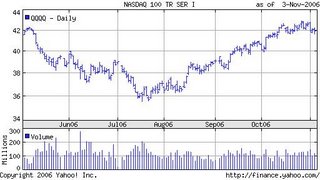
As I had mentioned, I first purchased QQQQ in July. From the chart, you can see that QQQQ hit a low in July. Low price alone is generally not enough of a reason to justify buying a stock. I waited until almost the end of July, when QQQQ was starting into an uptrend before buying. From there, I've held on until this past week. You can see that stock price has seen some dips along the way, which might stop out some traders.
Currently, the Nasdaq-100 Index is starting to encounter some resistance after this prolonged uptrend. If you look at the very end of the QQQQ chart for the past several days, you can see some recent weakness.
Although QQQQ may continue to climb, and I have closed out my position in QQQQ. This doesn't necessarily mean that I think that QQQQ is going to drop. However, I'm pretty confident that we won't be seeing the same kind of increase in QQQQ that we have in the past three months. QQQQ is near a 52-week high again, and has entered a volatile phase where it might be risky to take either a long or short position.
My opinion is that the safe thing to do now is to take profits. These are a certainty, and it is perhaps time to look for other investment opportunities. I will caution you, though, that I have a tendency to sell a little bit early.
pfstock
Some of my investment decisions are based on technical analysis (i.e. looking at the chart) of an investment. The recent run-up of QQQQ is a nearly picture perfect example of how to buy into an uptrend. Here is a 6-month price chart of QQQQ (click to enlarge):
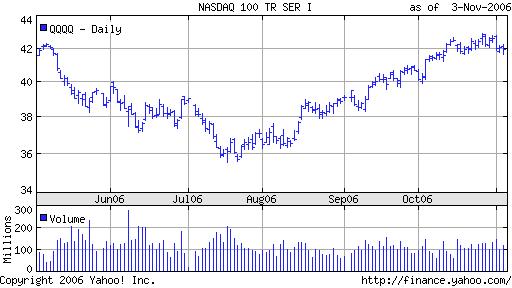
As I had mentioned, I first purchased QQQQ in July. From the chart, you can see that QQQQ hit a low in July. Low price alone is generally not enough of a reason to justify buying a stock. I waited until almost the end of July, when QQQQ was starting into an uptrend before buying. From there, I've held on until this past week. You can see that stock price has seen some dips along the way, which might stop out some traders.
Currently, the Nasdaq-100 Index is starting to encounter some resistance after this prolonged uptrend. If you look at the very end of the QQQQ chart for the past several days, you can see some recent weakness.
Although QQQQ may continue to climb, and I have closed out my position in QQQQ. This doesn't necessarily mean that I think that QQQQ is going to drop. However, I'm pretty confident that we won't be seeing the same kind of increase in QQQQ that we have in the past three months. QQQQ is near a 52-week high again, and has entered a volatile phase where it might be risky to take either a long or short position.
My opinion is that the safe thing to do now is to take profits. These are a certainty, and it is perhaps time to look for other investment opportunities. I will caution you, though, that I have a tendency to sell a little bit early.
pfstock
Subscribe to:
Posts (Atom)






 Posts
Posts


